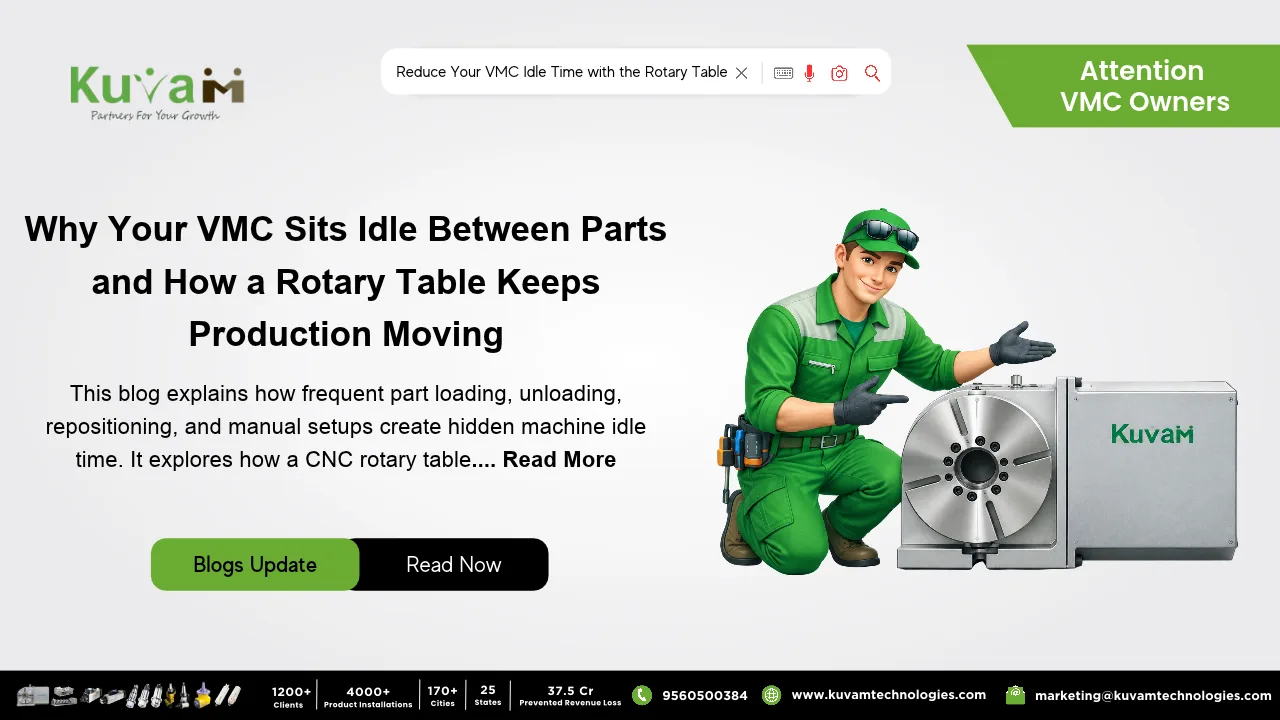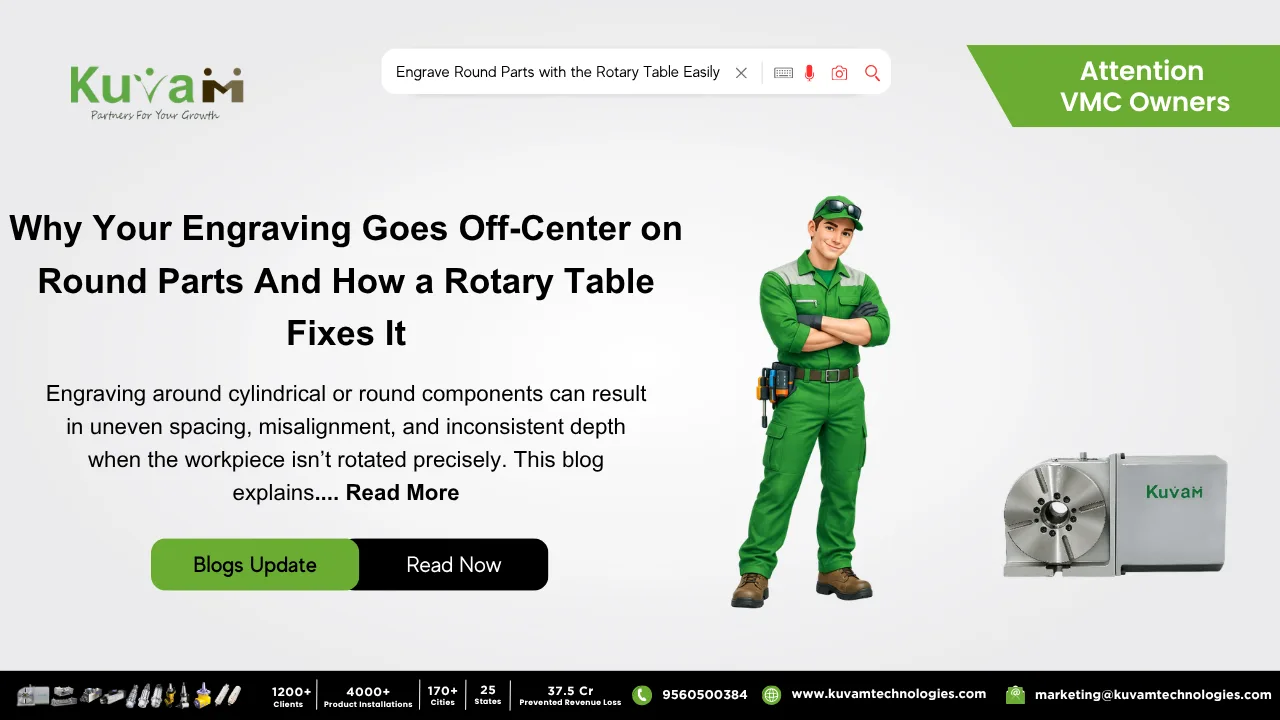

A Rotary Table is capable of making a machinist’s work easy. The problem isn’t always the person behind the machine. Sometimes it’s the machine setup behind the person and what it asks them to do without the right tool.
There’s a conversation that happens in production facilities far more often than anyone talks about openly. A senior machinist experienced, careful, someone the whole floor trusts hands over a batch of components. Inspection finds inconsistencies. Not dramatic failures. Subtle ones. Angular features that vary by a degree across the batch. Radial holes that drift slightly between the first part and the twelfth. Features that are correct on Tuesday and borderline on Thursday.
Management looks at the numbers. Leadership looks at the operator. And the machinist who did nothing wrong quietly absorbs the weight of a result that was never fully in their control to begin with.
This scenario is more common than the industry likes to acknowledge. And the culprit, in more cases than not, is not skill or attention. It is a setup that asks human hands and human judgment to perform a job that belongs to a mechanical system. Specifically, it is the absence of a Rotary Table and the invisible inconsistency that absence creates every single shift.
What Human-Dependent Angular Positioning Actually Costs
When a machinist needs to produce angular features evenly spaced holes around a pitch circle, slots indexed at defined intervals, faces milled at precise rotational offsets and there is no Rotary Table in the setup, they fall back on one of a handful of manual methods. They calculate X-Y coordinates for each feature and move the machine table by hand between cuts. They use a protractor or angle plate to reorient the part. They eyeball a degree marking on a chuck and trust that it holds.
Each of these methods depends on consistency of calculation, of physical movement, of attention. And consistency is exactly what humans cannot deliver at machine-precision levels across an eight-hour shift, a full production batch, or a high-pressure deadline. It is not a character flaw. It is biomechanics. Hands shake by micrometres. Eyes misread graduated scales by arc minutes. Concentration lapses at hour six in ways it never does at hour one. These are not failures. They are facts.
“When you ask a person to substitute for a precision mechanism, you get a person’s precision which is remarkable, but not the same thing. The Rotary Table doesn’t get tired. It doesn’t misread the dial at the end of a long shift. It holds the same position on part one and part one hundred.”
The result is a form of production variability that never quite goes away, no matter how experienced the team is. It shows up as scatter in inspection data. It shows up as rework batches that nobody can fully explain. It shows up as a nagging sense that quality on angular work is never quite as predictable as quality on everything else and the uncomfortable truth is that it won’t be, until the human dependency in the positioning step is replaced by a mechanical one.
What the Rotary Table is, Explained Plainly
A Rotary Table is a precision workholding device that mounts on your machine tool’s worktable and introduces a mechanically controlled axis of rotation. The workpiece is clamped to the table’s circular face, centered on its rotational axis, and rotated to each required angular position by turning a handwheel connected to an internal worm and worm gear drive.
The worm gear ratio, commonly 40:1 or 90:1 means the table moves by a precise, small fraction of a degree for each handwheel increment. A graduated dial and vernier scale on the table body allow the operator to read angular position to arc-minute accuracy. Between cuts, a locking mechanism clamps the table rigid, preventing any movement under cutting forces. The positioning is mechanical, repeatable, and independent of how the operator is feeling on any given day.
| MODELS FOR EVERY PRODUCTION NEED Manual Rotary Tables suit job shops where flexibility and low running cost matter most. Motorized variants introduce servo-driven positioning for faster, more repeatable operation on production batches. CNC-integrated models function as a true fourth axis within the machine’s control enabling continuous arc milling, helical interpolation, and programmable angular cycles. Tilting models add a second inclination axis, extending reach into compound-angle work. Across all types, the core principle is unchanged: mechanical control replaces human estimation. |
The Before and After: Where the Difference Shows Up
| WITHOUT ROTARY TABLE | WITH ROTARY TABLE |
| ✗ Angular positions calculated manually per part, creating risk of arithmetic errors | ✓ Angular positions read directly from precision graduated dial no calculation required |
| ✗ Operator fatigue introduces positional drift across long production runs | ✓ Mechanical worm gear holds consistent accuracy across every part in the batch |
| ✗ Inspection scatter on angular features forces rework cycles and delayed delivery | ✓ Stable repeatability tightens inspection results and reduces rework to near zero |
| ✗ Experienced machinists blamed for variability that belongs to the setup | ✓ Operators freed to focus on cut quality the work their skill actually serves |
| 90:1 Worm gear ratio on high-precision models delivering arc-minute angular resolution | 100% Mechanical positioning zero dependence on operator estimation between cuts | 4th Programmable axis capability unlocked on 3-axis mills with CNC Rotary Table |
Giving Your Machinists the Tool the Setup Was Missing
There is something worth saying directly here, because it rarely gets said: the machinists who have been producing angular work without a Rotary Table have not been failing. They have been compensating and compensating remarkably well for a gap in the production setup that was never their responsibility to fill. The inconsistency in results was not a skills problem. It was a tooling problem. And tooling problems have tooling solutions.
When a Rotary Table is introduced into that workflow, something shifts beyond the inspection numbers. Operators stop carrying the anxiety of knowing that their positioning on cut forty-seven might not match their positioning on cut twelve. They stop double-checking calculations that should never have been manual in the first place. They start doing what experienced machinists do best reading the cut, managing the feed, catching the subtle signals that no instrument measures but every good machinist senses.
The Rotary Table does not replace the person. It removes the part of the job that was always wrong to ask a person to do and in doing so, it gives the person back the full weight of what they’re actually good at.
Consistency in manufacturing is not a human virtue. It is a mechanical property. The Rotary Table is where that property lives and where variability in angular work quietly ends.