
Why Automatic Tool Changers Are Essential for Modern Manufacturing
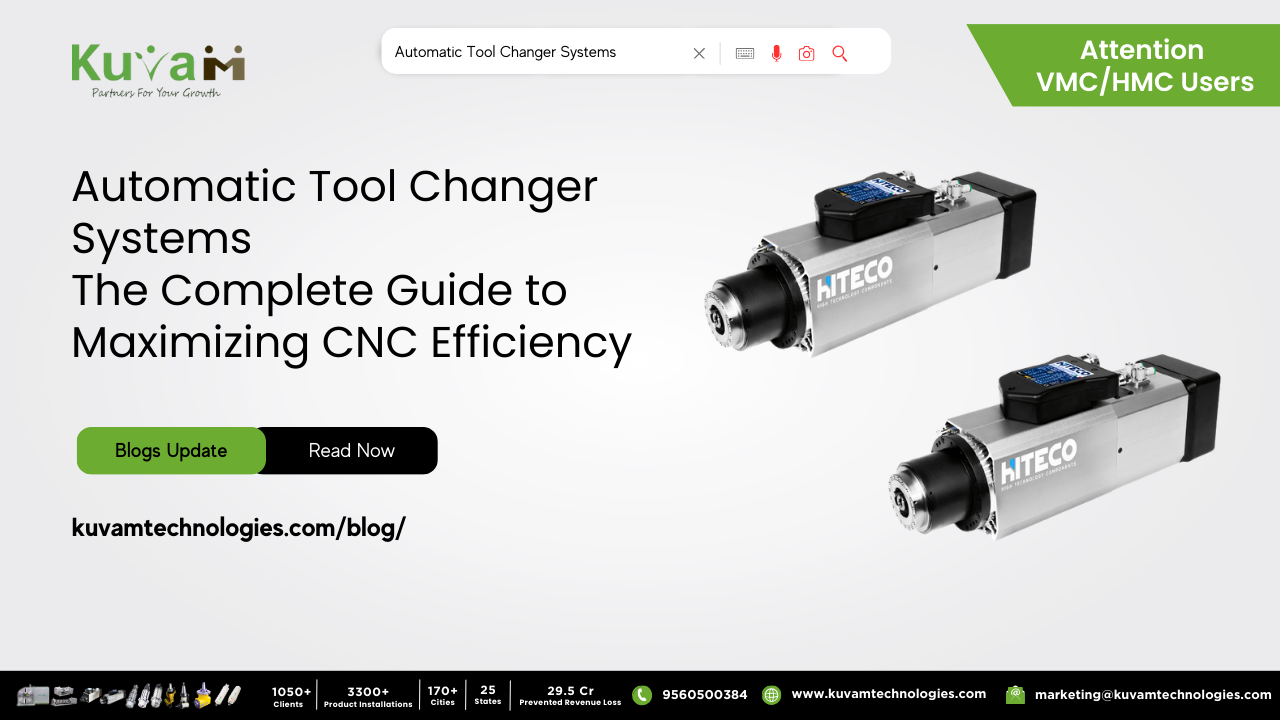
The automatic tool changer (ATC) is one of the most transformative technologies in CNC machining. By eliminating manual tool changes, ATC systems reduce cycle times by 30-50%, enable lights-out manufacturing, and dramatically improve productivity. For manufacturers operating vertical machining centers (VMC) and horizontal machining centers (HMC), the right automatic tool changer system can deliver payback in months through increased throughput and reduced labor costs.
Kuvam Technologies specializes in providing high-performance automatic tool changer systems for both VMC and HMC applications. Our ATC solutions feature tool-to-tool times as fast as 0.8 seconds, magazine capacities from 20 to 60 tools, and proven reliability across 1,050+ manufacturing installations throughout India. With proper ATC implementation, manufacturers can save up to ₹2.2 crores in revenue loss while doubling machine utilization.
Understanding Automatic Tool Changer Technology
How Automatic Tool Changers Work
An automatic tool changer system consists of three main components: the tool magazine, the tool change arm mechanism, and the control system. The tool magazine stores cutting tools in standardized holders (typically BT, CAT, DIN, or HSK tapers). When the CNC program calls for a tool change, the control system commands the magazine to position the correct tool, the change arm extracts the current tool from the spindle and inserts the new tool, and machining resumes—all within seconds.
Modern ATC systems use servo motors for precise magazine positioning, ensuring accurate tool selection every time. The tool change arm typically employs a dual-gripper design that simultaneously holds both the tool being removed and the tool being installed, minimizing change time. Hydraulic or pneumatic clamping mechanisms secure tools in both the magazine and spindle, preventing movement during high-speed machining operations.
Critical ATC Performance Parameters
- Tool-to-Tool Time: The complete duration from removing one tool to cutting with the next—faster times reduce non-productive periods
- Magazine Capacity: Number of tools available without operator intervention—higher capacity enables longer unmanned operation
- Maximum Tool Weight: Critical for heavy tooling like large diameter face mills, boring heads, and multi-tooth cutters
- Tool Diameter Capacity: Both with adjacent tools present and solo—determines the range of cutter sizes accommodated
- Tool Length Capacity: Affects ability to use extended-reach tooling, deep-hole drills, and special application cutters
- Reliability: Measured in mean cycles between failures—essential for lights-out manufacturing and production environments
VMC Automatic Tool Changer Systems: Vertical Machining Centers
Vertical machining center tool changers face unique challenges, including gravity effects on tool gripping, chip management around the magazine, and space constraints above the machine. Kuvam Technologies offers two proven VMC automatic tool changer models designed specifically for these requirements.
HYD-320: 20-Tool VMC Automatic Tool Changer
The HYD-320 represents the ideal automatic tool changer for small to medium VMC applications. With 20-tool capacity and BT30 (#30 taper) compatibility, this ATC system delivers exceptional performance for precision component manufacturing, tool and die work, and general job shop operations.
- Tool Magazine Capacity: 20 tools in compact carousel configuration
- Tool Taper: BT30 (#30) for precision tooling and reduced mass
- Maximum Tool Diameter (adjacent): 67mm, allowing standard end mills and drills
- Maximum Tool Diameter (solo): 102mm, accommodating face mills and larger cutters when adjacent pockets are empty
- Maximum Tool Weight: 4 kg, sufficient for most BT30 tooling, including holders
- Maximum Tool Length: 200m,m enabling standard and extended reach applications
- Tool-to-Tool Time: 0.8 seconds at 60Hz—among the fastest in the industry
- Driving System: Electric motor-driven magazine for reliability and speed
- Tool Arm Length: 390mm optimized for BT30 spindle nose dimensions
- Orientation Angle: 90°, providinga straight-line tool exchange path
- Weight: 180kg—manageable installation on standard VMC structures
The HYD-320 automatic tool changer excels in applications requiring frequent tool changes between operations. With sub-1-second tool-to-tool time, the ATC system adds minimal overhead to cycle times. The 20-tool capacity accommodates complete tooling packages for complex parts including drills, taps, reamers, end mills, and face mills. Electric motor drive ensures consistent performance over millions of cycles with minimal maintenance requirements.
HYD-424: 24-Tool Heavy-Duty VMC Automatic Tool Changer
For applications demanding larger tooling capacity and BT40 compatibility, the HYD-424 delivers professional-grade performance. This automatic tool changer system handles heavier tools and larger diameter cutters while maintaining rapid tool change times essential for production environments.
- Tool Magazine Capacity: 24 tools providing extended unmanned operation capability
- Tool Taper: BT40 (#40) for increased rigidity and clamping force
- Maximum Tool Diameter (adjacent): 78mm, accommodating larger end mills and cutters
- Maximum Tool Diameter (solo): 135mm for face mills, shell mills, and large diameter tools
- Maximum Tool Weight: 8kg, handling heavy tooling, including multi-insert face mills
- Maximum Tool Length: 300m,m enabling deep-hole drilling and extended reach operations
- Tool-to-Tool Time: 1.31 seconds at 60Hz balancing speed with heavier tool mass
- Driving System: Electric motor-driven magazine with enhanced torque for heavier tools
- Tool Arm Length: 530mm, accommodating larger BT40 spindle configurations
- Orientation Angle: 65° optimized for BT40 tooling clearance and exchange dynamics
- Weight: 280kg—robust construction for industrial production environments
The HYD-424 automatic tool changer is the workhorse for production VMC operations. The 24-tool capacity enables complete tooling packages for complex parts without operator intervention, supporting lights-out manufacturing strategies. BT40 compatibility provides the rigidity necessary for heavy roughing operations in steel and difficult materials. Tool-to-tool time under 1.5 seconds maintains high productivity even with frequent tool changes.
HMC Automatic Tool Changer Systems: Horizontal Machining Centers
Horizontal machining center tool changers benefit from gravity-assisted tool retention and superior chip evacuation. However, HMC applications typically demand larger tool magazines (32-60 tools) and heavier tool capacity to support the complex multi-sided machining operations these machines perform. Kuvam Technologies provides comprehensive HMC automatic tool changer solutions designed for these demanding requirements.
HYHC-(40#): Professional HMC Automatic Tool Changer
The HYHC series automatic tool changer is specifically engineered for horizontal machining centers, offering larger magazine capacities and enhanced tool handling capabilities essential for complex manufacturing operations.
- Tool Taper Compatibility: BT40, CAT40, DIN40—supporting diverse tooling standards
- Maximum Tool Diameter (adjacent): Ø75mm for standard production tooling
- Maximum Tool Diameter (solo): Ø125mm, accommodating large face mills and boring heads
- Maximum Tool Length: 300m,m enabling extended reach and deep-hole operations
- Maximum Tool Weight: 8kg handling heavy industrial tooling
- Magazine Capacity Options: 32-tool, 40-tool, or 60-tool configurations
- Magazine Rotation: Servo motor-driven for precise positioning and reliability
- Tool Arm Mechanism: Hydraulic operation providinga powerful tool extraction and insertion force
- Applications: Multi-sided machining, complex castings, transmission cases, engine blocks
The HYHC automatic tool changer system represents the optimal solution for HMC operations requiring extended tool capacity and heavy-duty performance. The 60-tool configuration enables complete tooling packages for complex parts with multiple operations across all four sides, supporting true lights-out manufacturing. Servo-driven magazine rotation ensures reliable tool selection even after thousands of cycles, while hydraulic tool arm operation provides the force necessary to overcome any spindle taper adhesion or tool holder resistance.
Automatic Tool Changer Selection Guide
Selecting the appropriate automatic tool changer requires careful analysis of current and future manufacturing requirements. Consider these critical factors to ensure optimal ATC system performance and return on investment.
Magazine Capacity Requirements
Tool magazine capacity directly impacts unmanned operation duration and setup frequency. Calculate your requirements based on typical part complexity and desired automation level:
- 20-24 Tools: Suitable for simple parts (3-6 operations), job shops, prototype work—operator typically present
- 32-40 Tools: Medium complexity parts (8-15 operations), lights-out shifts, production environments
- 60+ Tools: Complex parts (20+ operations), extended unmanned operation, multiple part types without tool changes
Tool Weight and Diameter Capacity
Assess your largest and heaviest tools to ensure ATC compatibility:
- Survey existing tooling: Catalog the maximum diameter, weight, and length of current tools
- Plan for growth: Allow 20-30% capacity margin for future tooling additions
- Consider special tools: Large boring heads, indexable face mills, extended reach tools
- Account for holder weight: BT40/CAT40 holders add 1-2kg, BT50/CAT50 add 3-5kg
Tool Taper Standardization
Consistency in tool taper selection provides long-term benefits:
- BT30: Precision work, aluminum machining, lighter cutting—most compact and economical
- BT40: General manufacturing, steel and cast iron—best balance of rigidity and versatility
- BT50: Heavy roughing, large components—maximum rigidity and torque transmission
- HSK: High-speed machining, automatic face-contact—superior at speeds above 12,000 RPM
- Note: Standardizing on one taper across multiple machines reduces tooling inventory and simplifies setups
Machine Integration Considerations
- Spindle compatibility: Verify ATC mechanism matches spindle nose configuration and orientation angle
- Physical space: Ensure adequate clearance above VMC or beside HMC for magazine installation
- Control system: Confirm CNC controller supports required ATC functions and tool management features
- Chip management: Consider magazine location relative to chip flow and coolant spray patterns
- Electrical requirements: Verify power supply matches ATC motor and control specifications
Maximizing ATC System Performance and ROI
Implementing an automatic tool changer represents a significant investment that delivers returns through increased productivity, reduced labor, and improved part quality. Kuvam Technologies customers have documented payback periods of 6-18 months through strategic ATC utilization.
Cycle Time Reduction Strategies
Optimize part programs to minimize tool change frequency and duration:
- Tool sequencing: Group operations by tool type to reduce total tool changes per part
- Magazine positioning: Place frequently-used tools in adjacent pockets to minimize magazine rotation time
- Tool duplication: For high-volume production, load duplicate tools to enable continuous operation during tool life changeover
- Tooling standardization: Reduce total tool count through multi-purpose cutters and a standardized tooling strategy
- Program optimization: Eliminate unnecessary tool changes through improved CAM programming and operation consolidation
Lights-Out Manufacturing Implementation
Automatic tool changers enable extended unmanned operation when properly implemented:
- Tool life management: Implement tool life counters and automatic tool replacement for worn cutters
- Part handling: Integrate robotic loading/unloading or pallet systems to eliminate manual intervention
- Process monitoring: Add sensors for tool breakage detection, vibration monitoring, and power consumption tracking
- Remote monitoring: Implement camera systems and remote access for production oversight
- Backup tooling: Load duplicate tools for critical operations to prevent single-point failures
Labor Productivity Gains
ATC systems transform operator roles from manual machine tending to higher-value activities:
- Multi-machine operation: One operator manages 2-4 machines with ATC systems versus 1 machine manually
- Setup time reduction: 30-60 minutes saved per setup through the elimination of manual tool mounting
- Quality improvement: Consistent tool positioning eliminates setup-to-setup variation
- Reduced training: Less skilled operators handle routine operations while experienced personnel focus on complex setups
- Safety enhancement: Operators avoid exposure to cutting tools, chips, and coolant during tool changes
Quantified ROI Calculations
Calculate your automatic tool changer return on investment using actual production data:
- Time savings: (Minutes saved per part) × (Parts per year) × (Labor rate + overhead) = Annual labor savings
- Capacity increase: (Additional productive hours) × (Machine hour rate) = Annual capacity value
- Quality improvement: (Scrap reduction %) × (Annual material + labor) = Quality savings
- Overtime reduction: (Eliminated overtime hours) × (Premium labor rate) = Overtime savings
- Typical payback: 6-18 months with 200-400% annual ROI in production environments
ATC System Maintenance and Reliability
Automatic tool changer reliability is critical for production operations. Proper maintenance ensures consistent performance and prevents costly downtime. Kuvam Technologies provides comprehensive maintenance guidance and support services.
Daily Maintenance Tasks
- Clean magazine pockets: Remove chips and coolant residue that can interfere with tool gripping
- Inspect tool grippers: Check for wear, damage, or foreign material buildup
- Verify magazine rotation: Ensure smooth operation without binding or unusual noise
- Check tool identification: Confirm ATC recognizes all tools correctly and positions accurately
Weekly Maintenance Tasks
- Lubricate moving parts: Apply specified lubricant to gripper mechanisms and pivot points
- Inspect hydraulic/pneumatic systems: Check for leaks, verify pressure levels, and examine hose condition
- Clean sensors and switches: Remove contamination from position sensors and limit switches
- Test tool retention: Verify tools are securely held in the magazine and spindle under load
Monthly Maintenance Tasks
- Measure tool change time: Track for degradation, indicating wear or misalignment
- Inspect tool arm bearings: Check for excessive play or noise indicating wear
- Verify positioning accuracy: Ensure magazine indexes to correct positions consistently
- Clean and inspect the magazine drive: Check motor, belts/gears, and mechanical components
Annual Maintenance Tasks
- Complete disassembly and cleaning: Remove all components for thorough inspection
- Replace wear items: Grippers, springs, seals, and other consumable components
- Bearing replacement: Install new bearings in the tool arm and magazine mechanisms
- Calibration and alignment: Professionally verify and adjust all positioning and timing parameters
- Professional inspection: Consider factory-authorized service for critical production ATCs
Common ATC Problems and Solutions
Understanding common automatic tool changer issues enables rapid troubleshooting and minimizes downtime. Here are the most frequent problems and their solutions:
Tool Not Releasing from Spindle
- Cause: Insufficient drawbar force, contaminated taper, tool holder adhesion
- Solution: Clean spindle taper thoroughly, verify hydraulic/pneumatic pressure, check drawbar mechanism
- Prevention: Regular taper cleaning, proper tool holder maintenance, and correct pullstud torque
Tool Drops from Gripper
- Cause: Worn grippers, incorrect gripper adjustment, contaminated tool holder V-flange
- Solution: Inspect and replace worn grippers, adjust gripper spring tension, and clean tool holders
- Prevention: Scheduled gripper replacement, maintain clean tool holders, and proper tool weight within limits
Magazine Positioning Errors
- Cause: Encoder problems, worn positioning mechanism, debris in the magazine track
- Solution: Verify encoder operation, clean the magazine mechanism, and recalibrate positioning
- Prevention: Keep the magazine area clean, perform regular encoder inspections, and protect from coolant exposure
Slow or Inconsistent Tool Change Time
- Cause: Low air/hydraulic pressure, mechanical binding, worn bearings
- Solution: Check pressure supply, lubricate moving parts, and inspect for mechanical wear
- Prevention: Maintain correct pressure, scheduled lubrication, and bearing replacement intervals
Why Choose Kuvam Technologies for Automatic Tool Changers
Kuvam Technologies delivers complete automatic tool changer solutions backed by technical expertise, quality assurance, and comprehensive support. Our proven track record includes 1,050+ satisfied clients and 3,300+ successful installations throughout India.
Expert Application Engineering
Our technical team analyzes your specific requirements, including part complexity, production volumes, and machine specifications, to recommend the optimal ATC configuration. We consider current and future needs to ensure your investment delivers maximum long-term value.
Quality Assurance Process
Every automatic tool changer undergoes comprehensive testing, including tool change time verification, positioning accuracy measurement, grip force testing, and reliability cycling. Products are verified free from manufacturing defects and properly configured before shipment.
Complete Support Services
- Installation and commissioning: Professional setup ensuring optimal performance from day one
- Operator training: Comprehensive instruction covering operation, basic maintenance, and troubleshooting
- Maintenance programs: Preventive maintenance schedules and professional service support
- Spare parts availability: Fast delivery of consumables and replacement components throughout India
- Technical support: Remote and on-site troubleshooting assistance when needed
Contact Kuvam Technologies
- Head Office: Block G-293, Sector-63, Noida, Uttar Pradesh, India
- Phone: +91 120 4571546
- Email: marketing@kuvamtechnologies.com
- Website: www.kuvamtechnologies.com
Conclusion
Automatic tool changer systems represent one of the most impactful investments in CNC machining technology. From 20-tool VMC configurations to 60-tool HMC systems, the right ATC solution dramatically improves productivity, enables lights-out manufacturing, and delivers rapid return on investment.
Kuvam Technologies provides complete automatic tool changer solutions, including expert selection guidance, quality-assured products, professional installation, and ongoing support. With proven reliability across 1,050+ installations and documented savings of up to ₹2.2 crores per machine, our ATC systems deliver the performance and value manufacturers demand.
Contact Kuvam Technologies today to discuss your automatic tool changer requirements and discover how the right ATC system can transform your machining operations, reduce cycle times, and maximize profitability.