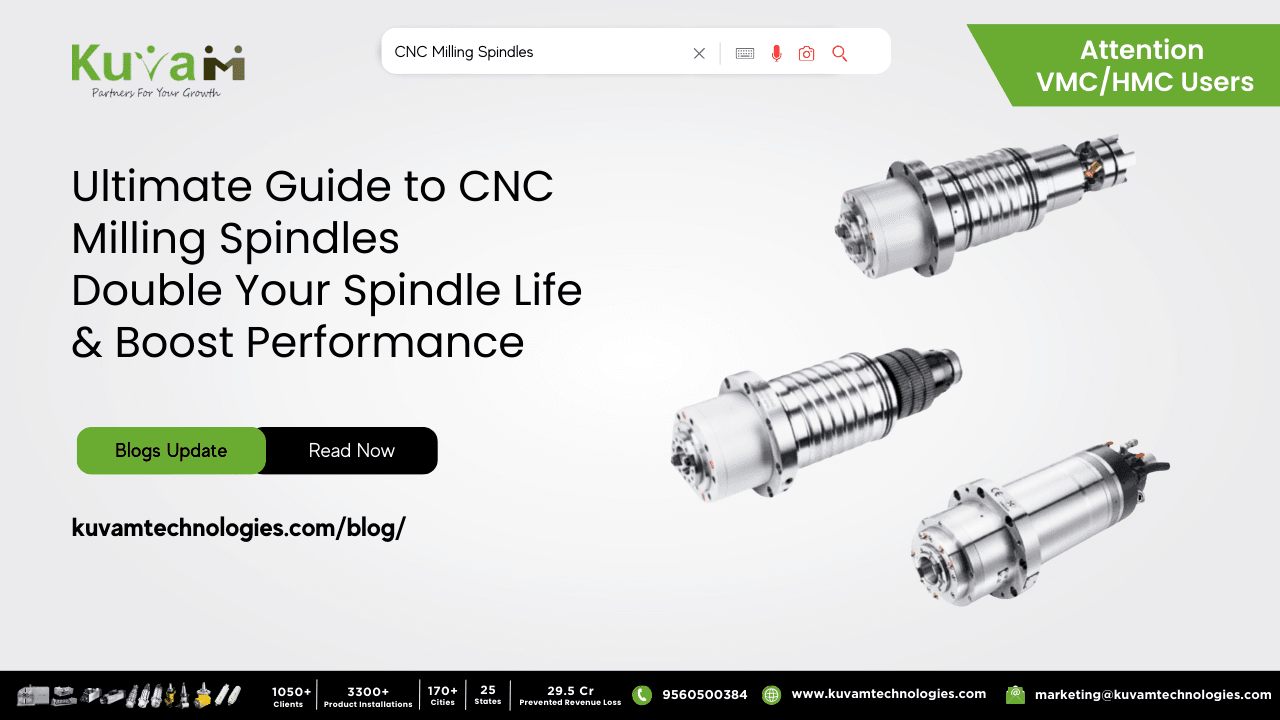
If you’re working with a CNC machine, you know the spindle is a very big deal. It’s the part that holds the cutter and makes it spin, and frankly, it decides how good your final product will be. But with so many options available in the market, how do you pick the right CNC spindle for your specific work?
Here at Kuvam Technologies, this is a question we get all the time. Getting this choice right can be a complete game-changer. An ideal spindle used by a woodworker constructing fine furniture looks worlds apart from what a stone carver requires for a block of granite, and both of those spindles are light years from what a die engraver needs to engrave a metal die. This guide will help you visualize the most distinguishable characteristics, enabling you to make an informed decision.
What Makes a Spindle Work?
Before we begin with all the details, let’s first have a bite-sized understanding of what a CNC spindle is. It is an electric motor that spins at high speed. The performance of the CNC spindle depends on several key aspects:
- Power (kW or HP): Think of this as the strength of a spindle. If it has more power, it can cut through certain materials without taxing the spindle’s rotation speed.
- Speed (RPM): This is how fast it spins. High speed is great for clean cuts and fine details, while a lower speed with more power is better for hard materials.
- Runout Accuracy: This is a measure of how straight the cutting tool spins. A low runout is very important for precise work because it ensures the tool spins perfectly without any wobble.
At the end of the day, a smart CNC spindle selection means finding the right balance of these things. It’s a common mistake to think one spindle can do everything. While some industrial CNC spindles are quite versatile, a specialized one is always better for high-quality work.
CNC Spindle Selection for Woodworking Applications
Woodworking needs a spindle that’s both fast and powerful. You want clean cuts that don’t tear or burn the wood.
- High RPM is Your Friend: The best CNC spindle for woodworking usually spins between 18,000 and 24,000 RPM, and sometimes even more. This high speed gives you that smooth finish and stops the bit from “bouncing” on the wood. When you’re using very small bits for fine details, a high-speed CNC spindle is a must for getting sharp lines.
- Balancing Power and Torque: A spindle with 2.2 kW to 4.5 kW is a good starting point for most workshops. This power is enough to handle larger bits and harder woods like oak without the motor getting stuck. If you plan to do deep cuts, a bit more power is always a good investment.
- Cooling: Essentially, both air-cooled and water-cooled spindles will work fine. Air-cooled is easier to install. Water-cooled is quieter; it maintains a better overall constant temperature, which is nice if you are working or running for longer hours.
For woodworking, the proper spindle will have the perfect combination of revs and power to machine various materials and deliver a perfect finish.
CNC Spindle Selection for Stone Carving and Heavy-Duty Materials
Carving hard materials like granite and marble is a whole different ballgame. This kind of work isn’t about speed; it’s about pure strength and a spindle that can handle tough conditions.
- Power is Everything: A CNC spindle for stone carving needs a lot of power to cut through the material without stopping. You’ll need at least 6 kW, and often up to 9.0 kW or more with water cooling. This power gives it the torque needed to push through tough stone without any issues. Please do not forget to add corrosion-resistant additives like Glycol to prevent rusting of spindle.
- Lower RPM, More Torque: Unlike woodworking, a high-speed CNC spindle is not required here. The ideal RPM range for stone is much lower, typically from 8,000 to 18,000 RPM. The focus is on the muscle to cut through the stone, not on speed for a smooth finish.
- Built to Last: Abrasive stone dust is a spindle’s biggest enemy. The bearings and seals must be extra strong to stop dust from getting inside and causing damage. Our industrial CNC spindles at Kuvam Technologies are built with strong seals and heavy-duty bearings to handle the toughest stone-cutting jobs.
Spindles for Die Engraving: Precision and Speed
Die engraving, used for making moulds and stamps, is all about extreme accuracy. The materials are usually hard metals, and the cutting tools are very small. Every single detail matters.
- Blazing Speed: When carving should be done at high speed, you need a high-speed CNC spindle that can reach high RPMs, sometimes exceeding 18,000 RPM, so that you can carve with micro-tools with extremely fine detail and a mirror-like finish.
- Super Low Runout: The amount of runout is the most important consideration for this activity. You will need a spindle with almost no runout—0.005mm or less is ideal. Even a tiny amount of runout can ruin a precise engraving because you will be using fragile, small tools to begin with.
- Superior Temperature Control: For long (time) duration, high-RPM projects, we highly recommend using a water-cooled spindle to manage a stable temperature. A stable temperature is very important to maintain tight tolerances when die engraving.
Final Tips for Making the Right CNC Spindle Selection
At the end of the day, your CNC spindle selection should be based on what you do most often.
- Check Your Needs: Are you a generalist or a specialist? If you mainly work with wood, an air-cooled spindle optimized for that will be the best choice. If you do a bit of everything, look for a spindle with a wide RPM range and enough power to handle your tougher jobs.
If you want to do stone carving, go for a water-cooled spindle for better cooling and adequate cooling of the spindle.
- Don’t Go for Cheap: A good spindle is a long-term investment. Don’t be tempted by cheap alternatives that can break down quickly. At Kuvam Technologies, we are confident in the quality and durability of our industrial CNC spindles.
- Ask an Expert: But if you are still unsure about the different Types of CNC spindles, please contact our team. We want to help you find the best spindle for the best quality results.
Frequently Asked Questions (FAQs)
1. What is CNC spindle selection, and why is it important?
CNC spindle selection is the process of choosing the right spindle based on your machining needs—material type, cutting speed, power, and precision. The right spindle improves quality, reduces tool wear, and increases productivity.
2. Which CNC spindle is best for woodworking?
For woodworking, a high-speed spindle (18,000–24,000 RPM) with 2.2 kW to 4.5 kW power works best. Both air-cooled and water-cooled spindles are suitable depending on your workload.
3. What kind of CNC spindle is suitable for stone carving?
Stone carving requires a high-power spindle (6 kW to 9 kW or more) with lower RPM (8,000–18,000 RPM) and strong dust-proof seals. Water-cooled spindles are preferred for heavy-duty stone machining.
4. Which spindle is best for die engraving and precision work?
Die engraving needs a high-speed spindle with extremely low runout (0.005 mm or less) and excellent temperature control. Water-cooled spindles are ideal for long-duration engraving jobs.
5. Does a single CNC spindle work for all materials?
No. Although some spindles are versatile, each material has different requirements. Wood needs high speed, stone needs high torque, and engraving needs high precision. A specialized spindle always performs better.