
A Smarter Way to Machine Complex Angles in VMC
Have you ever opened a part drawing and thought, “How in the world are we going to machine this?” We all have been there. It is that moment when there is a deep pocket on the side, a perfect angle bore, or some similar combination of features intersecting that makes you rethink your entire existence. A VMC (Vertical Machining Centre) in a traditional three-axis format can be an awesome piece of machinery, but there are limitations. When faced with the need to machine complex angles in VMC with a conventional setup, you will find yourself going through the same cycle of clamping and unclamping or repositioning and clamping again while looking to achieve maximum accuracy.
But what if you could change all of that without buying a whole new machine?
At Kuvam Technologies, we’ve seen countless clients solve this exact problem with a surprisingly simple solution: the angular head. It’s a tool that takes your trusted VMC and gives it a new superpower, allowing you to reach places you never thought possible.
What is an Angular Head, and Why Is It a Big Deal?
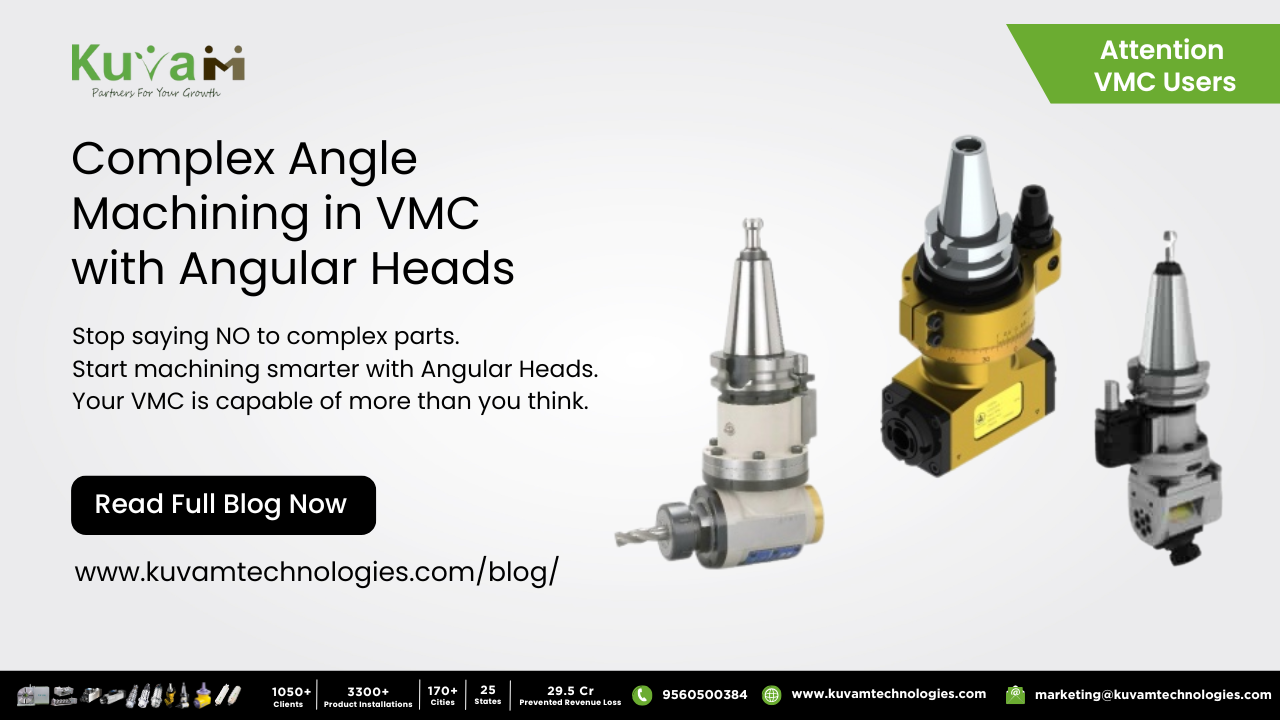
Think of an angular head as a highly specialised, heavy-duty extension for your VMC’s spindle. It has a set of high-precision gears inside that take the rotation from your machine’s spindle and redirect it at a fixed angle usually 90 degrees. This allows a cutting tool to work on the side of a part while it’s held firmly in a vice.
What makes angular heads for VMC so revolutionary is the fact that they eliminate the need to re-fix a part. Instead of having to remove the piece, rotate it at the bench, and then try to line it up perfectly for the next operation which is time-consuming and rife for human error you can machine multiple faces at one time in a continuous setup. It is not only about saving time; it is also about making better parts.
Any time that you re-clamp, you typically induce a small amount of runout or positional shift in the work. Over a complex job, those errors add up. With a part secured in one place, an angular head allows you to be sure that each part feature you machine is in perfect alignment with all parts, enabling tighter tolerances and a better quality finished parts.
The Potential of Complex Angle Machining in VMC
The magic of angular heads becomes clear when you start approaching jobs that would normally be impossible or at least incredibly difficult. They are the key to complex angle machining in VMC. Suddenly, you can:
- Drill and Tap on the Side: Imagine a large block that needs a series of threaded holes on its vertical face. Without an angular head, you’d need a secondary operation or a rotary table. With one, you can perform the drilling and tapping right where the part is already clamped.
- Create Undercuts and Hidden Features: An angular head can reach behind a flange or into a tight corner, allowing you to machine a feature that is completely hidden from your main spindle.
- Perform Multi-Sided Milling: This is where the efficiency really shines. For a part that needs a pocket on one side and a slot on another, an angular head allows you to complete both tasks in a single setup. This is why multi-face milling in VMC has become so much more common in shops that have adopted this technology.
And while there are various heads for different jobs, the 90-degree angle head for VMC is the most popular for a reason. It’s the go-to tool for all those side-milling and drilling jobs that are so common in a wide range of industries, from aerospace to mold making.
Indexable Heads
As technology evolves, so do the tools. While a fixed-angle head is a solid investment, the latest innovation is the indexable angular head VMC. This is the absolute best in versatility. The heads can be adjusted to multiple lockable angles it can go to 0°, 45°, 90 °, and all allowing for an even broader variety of more complex projects with a single attachment. This is ideal for shops experiencing highly variable project types and needing maximum versatility from their tooling.
At Kuvam Technologies, we’ve seen how these tools can completely change a shop’s outlook. They enable you to say “yes” to more jobs, improve your efficiency, and deliver parts with greater precision. It’s about working smarter, not just harder.
Making the Right Choice: Key Considerations
If you are thinking about adding an angular head to your shop, here is what you want to consider:
- Spindle Taper: First, be sure that the head matches the spindle taper on your machine if it has one (ex., CAT40, BT30, HSK63).
- Speed and Power: ou need to make sure that the head’s maximum RPM and torque ratings are suitable for your machining needs. Some job types need to spin very fast, for light materials, and some jobs require the ability to generate high torque when cutting tough metals.
- Rigidity: Look for a rugged design with high-quality gears and bearings. A rigid head means less chatter, a flame finish, and a longer tool life.
- Your Typical Work: Do you need to mostly do side milling? A simple standard 90-degree head is fine if you are side milling most of the time. Do you have jobs with angles that vary from job to job? An indexable head may be more suited for that work.
In a competitive marketplace, finding ways to enhance efficiency and capability is a must. Machining complex angles in VMC accurately and quickly is a significant competitive advantage. An angular head is not just another tool; it is an investment that leverages the maximum performance from existing equipment. An angular head will simplify complex processes, boost capacity, and ultimately help produce better parts faster! Now, if you want to stop turning down difficult jobs and want to start making difficult jobs, you should explore the power of angular heads.
FAQs on Complex Angle Machining in VMC Using Angular Heads
1. What is an Angular Head in VMC machining?
An angular head is a precision attachment fitted to a VMC spindle that redirects the spindle’s rotation—usually by 90°—to enable machining on the side faces of a part without reclamping.
2. Why are angular heads important for complex angles in VMC machining?
Angular heads eliminate the need for multiple setups. This reduces human error, saves time, and ensures accurate alignment between features, making them ideal for machining complex angles and multi-sided operations.
3. How does an angular head improve accuracy?
By allowing machining in a single setup, angular heads prevent the runout and positional shifts that occur during repeated clamping and unclamping. This ensures tighter tolerances and better-quality finished parts.
4. Can angular heads perform drilling and tapping on side faces?
Yes. Angular heads allow drilling, tapping, and milling operations on vertical or hard-to-reach faces without rotating or repositioning the workpiece.
5. What types of operations can be done using an angular head?
You can machine side bores, drill and tap vertical faces, create undercuts, access hidden features, mill multiple faces, and perform various angled machining tasks directly on a VMC.
6. What is the difference between a fixed-angle and an indexable angular head?
A fixed-angle head (usually 90°) is ideal for regular side milling and drilling.
An indexable angular head allows multiple lockable angles (0°, 45°, 90°, etc.), offering more flexibility for shops handling diverse or complex projects.