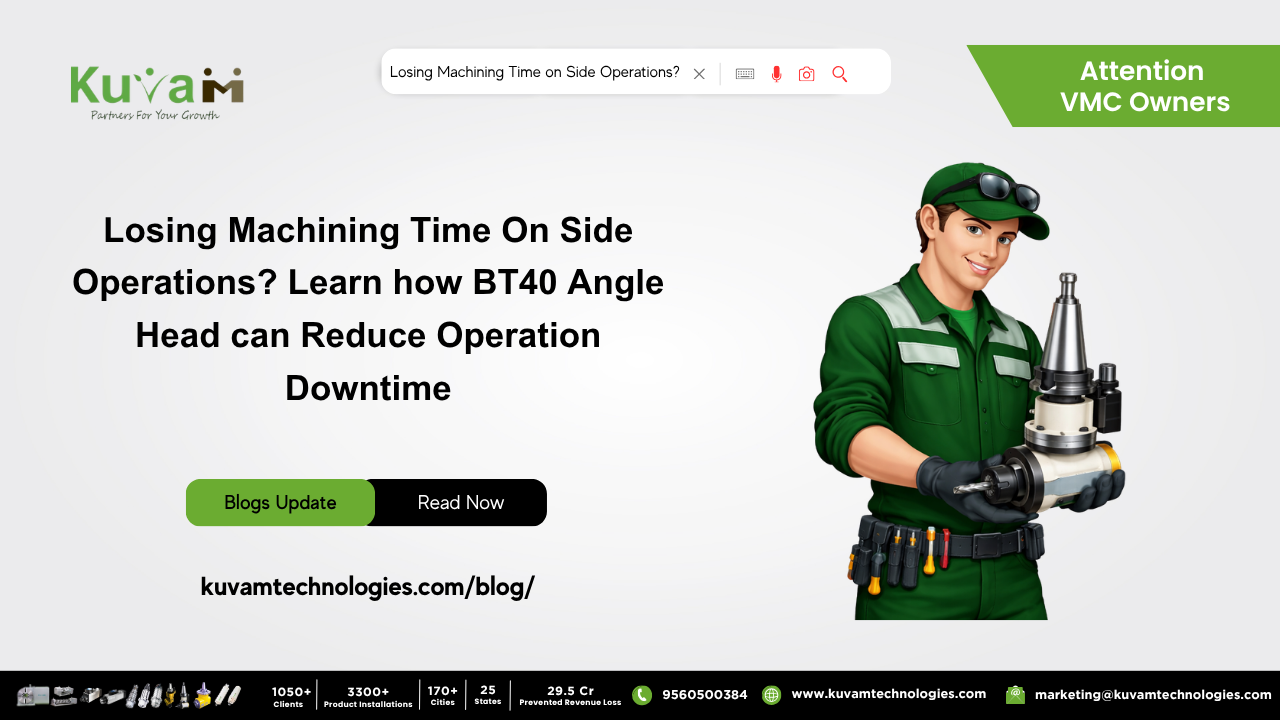

When your spindle can’t reach the cut, that is when the Angle Head comes in. Most shops rework the whole setup. But suppose what if the problem was never be the setup it was the tooling ?
Picture this: when a complex part arrives on your machining centre. The geometry is tight a cross-hole needs to be drilled at 90 degrees to the spindle axis, or a slot has to be milled into a recessed cavity that a standard tool simply cannot reach. The answer? Either pull the part, set it up on another machine, and start the whole process over or send it outside. Neither option is cheap. Neither is fast.
This is a problem that plays out in shops every single day, across industries from automotive to medical device manufacturing. It doesn’t make headlines. It doesn’t show up as one dramatic loss. Instead, it bleeds away in extra setups, extended cycle times, transfer costs, and the kind of scheduling delays that make delivery promises feel like guesswork.
Why Standard Tooling Fails in Tight Geometry?
Most machining centres are built for axial cutting the spindle drives a tool in a straight line, and that’s where its power lives. It’s an elegant system, right up until a component demands a cut that runs perpendicular to, or offset from, that axis. The moment you need to drill sideways, mill an angled feature, or reach into a pocket with limited vertical clearance, the conventional spindle becomes the obstacle rather than the solution.
Shops typically handle this one of three ways: they redesign the fixturing to tilt the part, they transfer the workpiece to a second machine, or they outsource the operation entirely. Each approach adds lead time. Each one multiplies the opportunities for error. And each one quietly inflates the cost of a part that looked simple on paper.
“Every time a part leaves your machine before it’s finished, you’ve already started losing money in handling, in re-fixturing, in the time your operator spends setting up something that should have stayed in one place.”
What is an Angle Head and How Does it Actually Work?
An Angle Head is a precision tool-holding attachment that mounts directly onto your existing machine’s spindle. It redirects the rotational power of the spindle through an internal gear or bevel gear mechanism, transmitting that torque to a secondary output spindle oriented at a fixed angle most commonly 90 degrees, though other angles are available depending on the application.
In practical terms, it means your machine can now cut in a direction it couldn’t before without moving the workpiece, without changing the setup, and without routing the job to a different station. The angle head accepts standard tooling through its output spindle, so your existing end mills, drills, and boring bars work exactly as they would in a normal setup.
The Real-World Difference on the Shop Floor
When an angle head is introduced into a workflow that previously required secondary setups, the change is immediate and visible. A part that needed three operations on two machines can often be completed in a single setup. Cross-holes, radial features, angled slots, and deep-cavity work all of it becomes reachable from the primary machining centre.
50%
Average reduction in setups for complex multi-feature parts
1
Machine needed where two or three were required before
90°
Standard output angle — redirecting spindle power precisely
There’s also a quality argument that’s easy to underestimate. Every time a workpiece is unclamped and moved to another machine, there is a re-referencing step and that step introduces positional uncertainty. Keeping a part in a single setup eliminates that uncertainty entirely. Features machined in the same clamping are inherently more concentric, more perpendicular, and more dimensionally consistent than those machined across multiple setups. For industries where tolerances are measured in microns, that difference is not academic.
Who Genuinely Benefits Most?
Angle heads are especially valuable in aerospace and defence component machining, where complex prismatic parts with dozens of features are the norm, not the exception. Medical device manufacturers dealing with intricate implant geometries and strict traceability requirements benefit enormously from single-setup machining. Automotive tooling and die shops, mould makers working with deep cavities, and general job shops running varied short-run work all find the investment pays back faster than expected.
Even shops that run three-axis machines not five-axis can unlock a meaningful portion of four- and five-axis capability through a well-chosen Angle Head. It doesn’t replace full multi-axis machining, but for specific feature types, it delivers a substantial portion of the benefit at a fraction of the machine investment.
Is it The Right Move for Your Shop?
The honest answer depends on how often unreachable features are disrupting your workflow. If secondary setups are a daily occurrence, if transfer jobs are quietly consuming hours that don’t show up in your cycle time reports, or if customers are pushing for tighter tolerances your current process can’t reliably deliver, the angle head is worth a serious look. It won’t solve every machining challenge. But for the specific problem of accessing geometry that a straight spindle simply cannot reach, it is one of the most efficient, cost-effective tooling investments a shop can make.
Sometimes the most productive change in a workshop isn’t a new machine it’s the right attachment on the one you already have.
The most expensive setups are the ones that shouldn’t have been necessary in the first place. An angle head is how you start eliminating them one feature at a time.