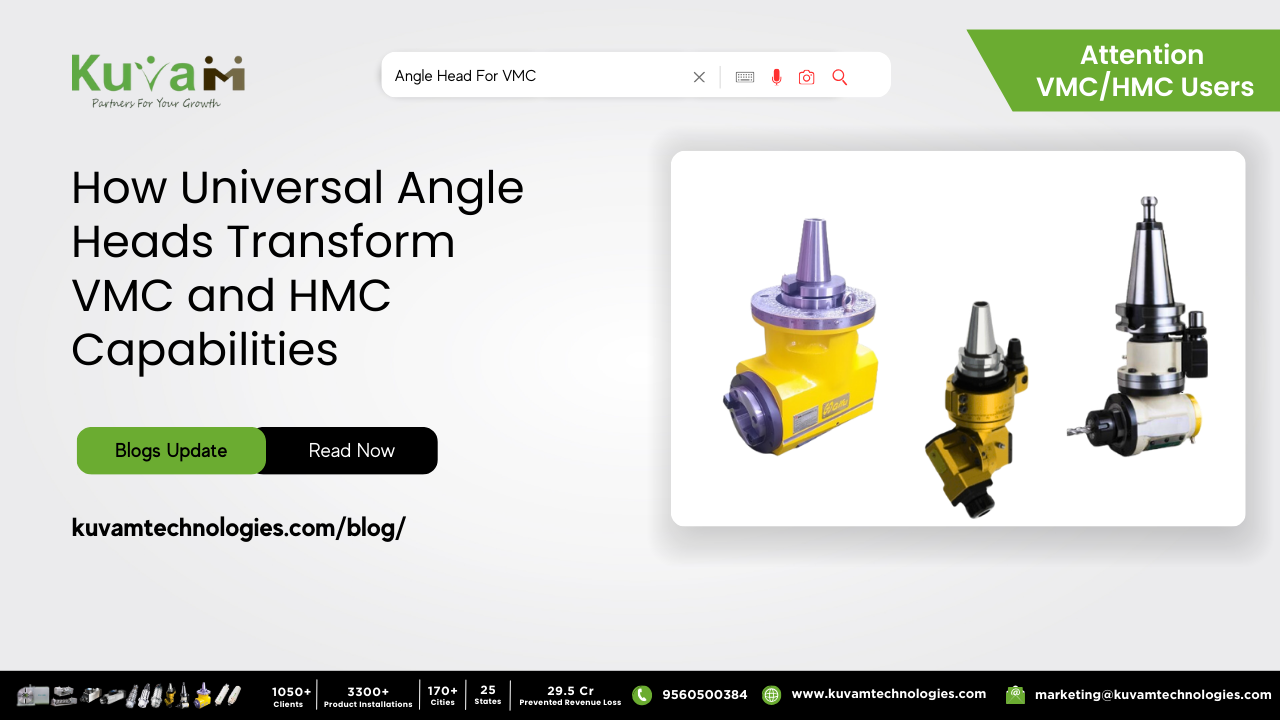

In today’s competitive manufacturing environment, CNC shops are continually seeking ways to enhance productivity, minimise setup time, and machine complex features without incurring the expense of new equipment. This is where an Angle Head for VMC and HMC machines becomes a powerful productivity tool. Universal angle heads allow machining at multiple angles in a single setup, transforming standard Vertical Machining Centres (VMCs) and Horizontal Machining Centres (HMCs) into highly flexible, multi-angle machining solutions.
This article explains how universal angle heads work, their real-world applications, and the clear before-and-after productivity improvements they bring to CNC operations.
What Is an Angle Head and Why Does It Matter in CNC Machining
The CNC angle head is an attachment of CNC machines that changes the orientation of the machine spindle at any number of angles (most frequently 90°). Universal Angle heads allow you to create additional angles of tolerance by adjusting, as well. Once installed in vertical and horizontal machining centres, these add a new capability, allowing for the possible machining of parts at other locations that would be otherwise unreachable using conventional means of manufacture, such as drilling, milling, tapping, and slotting, as well as other machining processes.
In general, universal angle heads have a greater versatility in use in that they can accomplish multiple-angle machining in a single machine setup. Manufacturers with angle heads on their VMC and HMC machines can utilise 5-axis machining without the expense and complexity of purchasing an entirely new machine.
For the present-day precision machine tool industry, any increase in production from the related use of angle heads will ultimately result in a significant improvement in the quality of product created, as well as in cycle times and day-to-day handling of materials.
Multi-Angle Machining Explained
Multi-angle machining refers to performing machining operations on different faces or at various angles in a single setup. Traditionally, this required:
- Multiple fixtures
- Repositioning the workpiece
- Additional machine downtime
With a universal angle head, these challenges are eliminated.
By using an Angle Head for VMC, machinists can access side faces, angled surfaces, and internal features without removing the component from the machine. This significantly reduces setup changes, improves repeatability, and minimises alignment errors.
Multi-angle machining is especially useful for complex components with holes, slots, or pockets on multiple faces—common in aerospace, automotive, and heavy engineering applications.
How Universal Angle Heads Enhance VMC and HMC Capabilities
A universal angle head dramatically expands what a standard CNC machine can do. Instead of being limited to vertical or horizontal operations, manufacturers gain the ability to machine complex geometries on existing equipment.
Key capability enhancements include:
- Side drilling and milling on VMCs
- Angular machining without rotary tables
- Improved accessibility to hard-to-reach features
- Reduced dependence on 4th or 5th axis machines
By integrating an Angle Head for VMC and HMC, shops can increase machine utilisation and handle more complex jobs without investing in new capital equipment. This makes angle heads a cost-effective and scalable solution for growing production demands.
Real-World Applications of Angle Head For VMC And HMC
Universal angle heads are widely used across industries where precision and efficiency are critical.
Aerospace Industry
Aerospace components often require holes and slots at specific angles on structural parts. An Angle Head for VMC and HMC allows these operations in one setup, ensuring high positional accuracy and reduced cycle time.
Automotive Manufacturing
Engine blocks, transmission housings, and brackets often require side machining. Angle heads enable efficient machining of these features without additional fixtures or machines.
Mould and Die Making
Mould cavities and side features can be machined directly using angle heads, improving surface finish and reducing manual rework.
Heavy Engineering and General Manufacturing
Large components with multiple machining faces benefit greatly from angle heads, especially when repositioning the part is time-consuming or risky.
Before and After Productivity Comparison
Before Using an Angle Head
- Multiple setups required
- Frequent part handling and repositioning
- Longer cycle times
- Increased risk of alignment errors
- Lower overall machine efficiency
After Using an Angle Head For VMC And HMC
- Single-setup machining for multiple faces
- Reduced setup and handling time
- Improved dimensional accuracy
- Shorter cycle times
- Higher machine utilisation and throughput
Many manufacturers report significant productivity improvements simply by integrating a universal angle head into their existing CNC workflow.
Key Benefits of Using a Universal Angle Head
Using an Angle Head for VMC offers several measurable advantages:
- Reduced setup time by eliminating multiple clamping operations
- Improved accuracy due to fewer repositioning errors
- Higher productivity through faster cycle times
- Cost savings by avoiding investment in additional CNC machines
- Increased machining flexibility for complex and angular features
- Better surface finish through stable and controlled machining
These benefits make universal angle heads a strategic investment for any CNC shop focused on efficiency and growth.
How to Choose the Right Angle Head for Your VMC or HMC
Selecting the right angle head is critical for performance and reliability. Consider the following factors:
- Machine compatibility (spindle interface such as BT, CAT, HSK)
- Torque and speed requirements based on the application
- Fixed vs universal angle head depending on machining needs
- Rigidity and build quality for precision operations
Kuvam Technologies offers high-precision universal angle heads designed for VMC and HMC applications, ensuring durability, accuracy, and seamless machine integration. You can explore their solution here:
Conclusion:
A universal Angle Head for VMC and HMC machines is a powerful tool that transforms standard CNC equipment into flexible, multi-angle machining centres. By enabling complex operations in a single setup, angle heads reduce downtime, improve accuracy, and significantly boost productivity.
For manufacturers seeking to expand machining capabilities without heavy capital investment, universal angle heads offer an intelligent, cost-effective solution. With the right angle head, your existing VMC or HMC can handle more complex jobs, deliver better quality, and stay competitive in modern manufacturing.
FAQs: Angle Head for VMC
Q1: What is an Angle Head for VMC and HMC machines?
An Angle Head For VMC And HMC is a CNC attachment that changes the direction of the spindle, allowing machining operations like drilling and milling at different angles without repositioning the workpiece.
Q2: How does a universal angle head improve CNC productivity?
A universal angle head enables multi-angle machining in a single setup, reducing setup time, minimising part handling, and improving overall machining accuracy and cycle time.
Q3: Can an angle head replace a 4th or 5th axis machine?
While an angle head does not fully replace a 4th or 5th axis machine, it provides a cost-effective alternative for many angular machining operations, especially on VMC and HMC machines.
Q4: What industries benefit most from using an Angle Head for VMC?
Industries such as aerospace, automotive, mould and die, and heavy engineering benefit greatly due to the need for side machining, angled drilling, and complex component features.
Q5: What machining operations can be performed using an angle head?
An angle head can perform drilling, tapping, milling, slotting, and boring operations on angled or side faces of a component.
Q6: How do I choose the right angle head for my VMC or HMC?
Choosing the right angle head depends on machine compatibility, spindle type, required torque, speed, and the specific machining application.