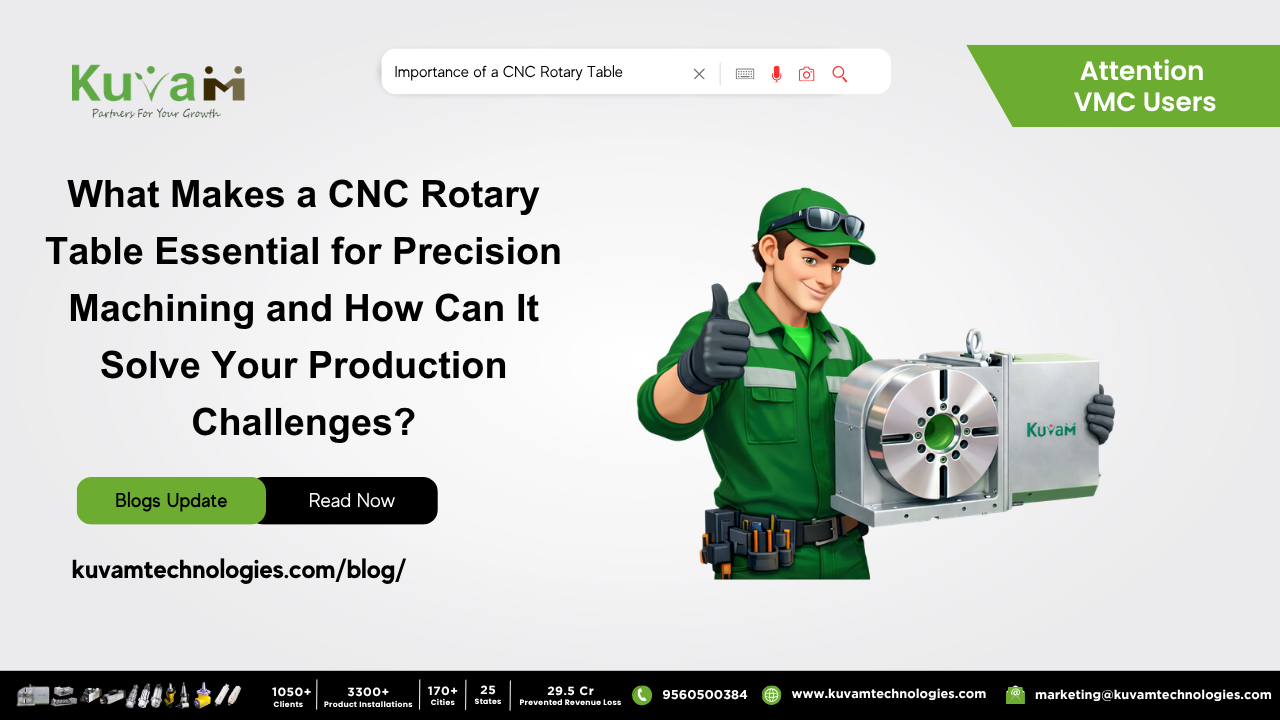

A CNC Rotary Table has become a very important part of the machining industry. Nowadays, the manufacturing environment is highly competitive and achieving precision, efficiency, and consistency is not just an advantage—it’s a necessity. Many manufacturers face challenges like complex part geometries, multiple manual setups, longer cycle times, and inconsistent accuracy. All these challenges lead to the waste of time and resources, resulting in significant losses in production. This is where a CNC Rotary Table becomes a game-changing solution.
Understanding the CNC Rotary Table
A CNC Rotary Table is a precision positioning device used in machining centres, such as VMCs (Vertical Machining Centres), HMCs (Horizontal Machining Centres) and CNC (Computer Numerical Control). It enables rotational movement of the workpiece along additional axes, commonly known as the 4th and 5th axes. This allows accurate, precise and efficient machining operations to be performed from multiple angles without manually repositioning the part. With the help of a CNC Rotary Table, you can enhance precision and efficiency in production.
Common Challenges in Machining
Before understanding how CNC Rotary Tables help, let’s look at some common problems manufacturers face in machining:
- Multiple Setups: Complex parts often require repositioning, increasing time and error risk.
- Reduced Accuracy: Manual clamping and realignment lead to inconsistent work.
- Higher Cycle Time: Repeated setups take time and thus slow down production.
- Limited Capability: Standard 3-axis machines struggle with multi-face machining operations.
- Human Error: Errors can be made by the handler of the machine.
- Wear and Tear: Standard machines have a low tool life.
These challenges not only affect productivity but also increase operational costs and rejection rates.
How CNC Rotary Tables Solve These Problems?
- Eliminates Multiple Setups
One of the biggest advantages of a CNC Rotary Table is its ability to machine multiple faces of a component in a single setup. This significantly reduces setup time and minimises human error.
Result: Faster production, improved consistency and saves resources.
- Enhances Precision and Accuracy
Since the workpiece remains clamped in one position, the chances of any misalignment are reduced drastically. CNC-controlled rotation ensures accurate positioning every time, which leads to better efficiency and precision.
Result: High precision machining with tight tolerances.
- Reduces Cycle Time
By enabling continuous or indexed rotation, machining operations can be performed seamlessly without stopping for repositioning. In simple terms, we can say that the need to change the position of the machine is eliminated.
Result: Increased output and better machine utilisation.
- Expands Machine Capability
Adding a rotary table effectively converts a 3-axis machine into a 4-axis system. This opens up the possibility of machining complex geometries such as cams, gears, turbine parts, and intricate profiles.
Result: Greater flexibility and capability without investing a huge amount of capital in a new machine.
- Improves Automation
CNC Rotary Tables can be integrated with automation systems, allowing for unattended operations and mass production. This is a really helpful feature as it eliminates the need for constant observation.
Result: Reduced labour dependency and increased productivity.
Applications Across Industries
CNC Rotary Tables are widely used in industries such as:
- Automotive: For machining engine components, gears, and shafts
- Aerospace: For complex, high-precision parts
- Medical: For implants and surgical instruments
- General Engineering: For fixtures, moulds, and custom components
- Stone Cutting: For precise and accurate cutting
Types of CNC Rotary Tables
Depending on your application, different types of rotary tables can be used:
- 4th Axis Rotary Table: Ideal for indexing and continuous rotation
- Tilting Rotary Table: Allows angular positioning for 5-axis-like operations
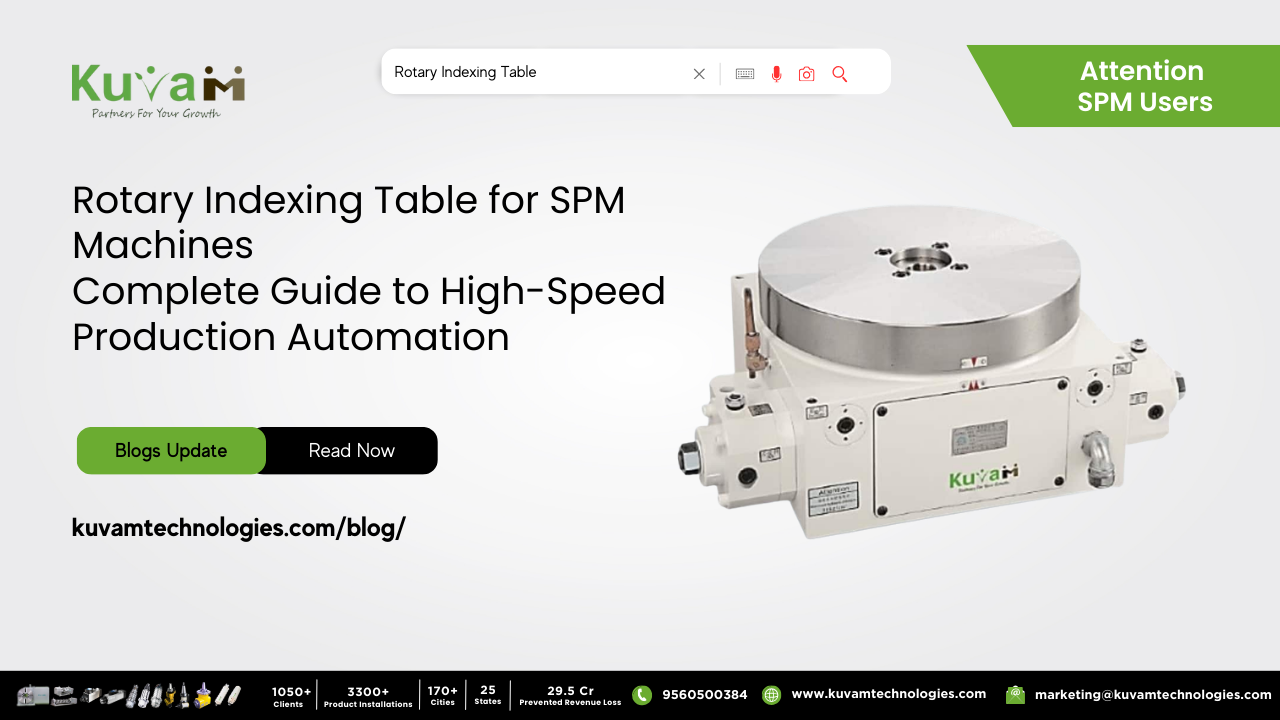
- Indexing Rotary Table: Suitable for repetitive and fixed-angle operations
- Rotary Production Systems: Designed for high-volume automated production
- Hydraulic Rotary Indexing Table: Built for serious heavy lifting and unwavering consistency
Choosing the right type depends on your machining requirements, part complexity, and production volume.
Key Considerations Before Buying
When selecting a CNC Rotary Table, consider the following:
- Load Capacity: Make sure the rotary table can support the weight of your workpiece.
- Accuracy & Repeatability: Essential for maintaining consistent and precise machining results.
- Speed & Torque: Key factors that influence overall machining performance and efficiency.
- Compatibility: It should be suitable for integration with your existing CNC machine.
- Automation Capability: Important for scaling operations and enabling future automation.
Final Thoughts
A CNC Rotary Table is not just an accessory—it’s a strategic investment that transforms your machining capabilities. By reducing setup time, improving accuracy, enhancing precision and enabling complex operations, it directly addresses the core challenges faced by modern manufacturers.
If your current machining process involves frequent repositioning, human errors, inconsistent results, or limited capabilities, integrating a CNC Rotary Table can be the solution you need. It enhances productivity, reduces costs, and positions your business for higher efficiency and growth.
In a world where precision and speed define success, adopting advanced solutions like CNC Rotary Tables ensures you stay ahead of the competition.