
The Rotary Table is considered to be very helpful in shortening long cycles. Slow turnaround on complex components rarely comes from a lack of effort. It usually comes from a setup process that fights the geometry of the part at every step and a tool gap nobody has yet named.
Every manufacturer knows the conversation. A loyal customer is one you have worked hard to keep calls to ask why a batch of precision components is running two days behind schedule. You explain it as best you can: the setup was more involved than anticipated, a few parts needed rework, the geometry required extra care. The customer listens politely. But somewhere beneath the courtesy, you both know that “more involved than anticipated” is starting to sound like a pattern.
And it is. Not because the team isn’t working hard they are. Not because the machines are unreliable they run well. The pattern exists because a certain class of component, one with curved features, precisely spaced radial holes, or angular geometry referenced to a central axis, consistently breaks the rhythm of the production floor. It takes longer to set up. It requires more verification between operations. And when it doesn’t pass inspection on the first attempt, the time lost to rework almost always pushes the delivery past the promised date.
The root cause of this pattern is rarely discussed as directly as it deserves to be: the production setup is asking machinists to manually manage rotational geometry and manual management of rotational geometry is inherently slow, inconsistent, and inspection-heavy. Until that changes, the delivery problem won’t go away, no matter how experienced the team or how capable the machines.
Why Rotational Geometry Breaks Production Rhythm?
A standard machining setup is optimised for linear geometry. The machine moves in X, Y, and Z. The fixtures hold the part in a fixed orientation. The cuts follow straight lines and the operator works methodically through a sequence. It is a reliable, predictable system for parts that conform to it.
But introduce a component that demands features placed at specific angular positions around a central axis say, eight holes spaced at 45-degree intervals on a bolt circle, or a series of milled flats indexed precisely around a housing and the linear setup immediately becomes inadequate. The machinist must now calculate angular coordinates, manually reposition the part or the table between each cut, verify each position before cutting, and hope that the accumulated small errors across the full sequence stay within the tolerance band.
Each repositioning step takes time. Each verification step takes time. And every time a part fails inspection because one feature drifted slightly out of position, every minute of that setup time is spent again. The geometry hasn’t changed. The difficulty hasn’t reduced. The delivery date, however, is now under pressure.
“The time a manufacturer loses on rotational geometry is rarely counted correctly. It hides in setup minutes, verification passes, and rework cycles — scattered across the production record in ways that never add up to one visible number. But it adds up.”
What a Rotary Table is — and How It Changes the Equation
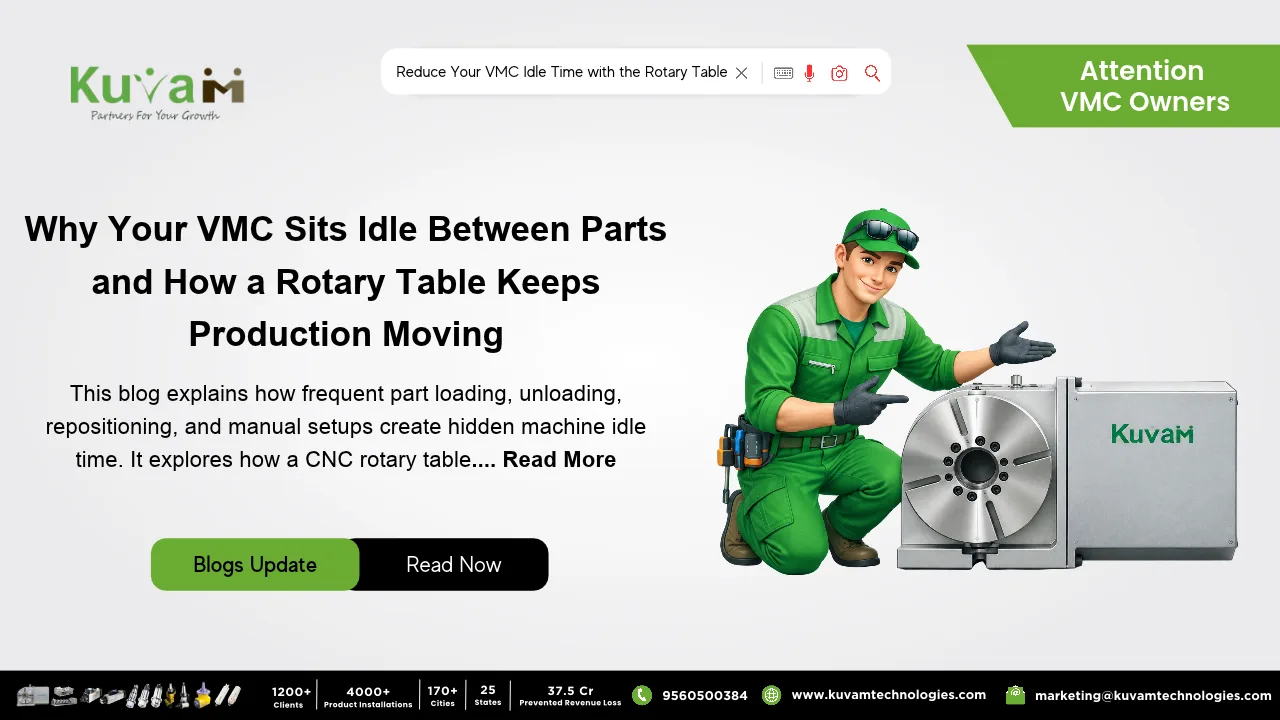
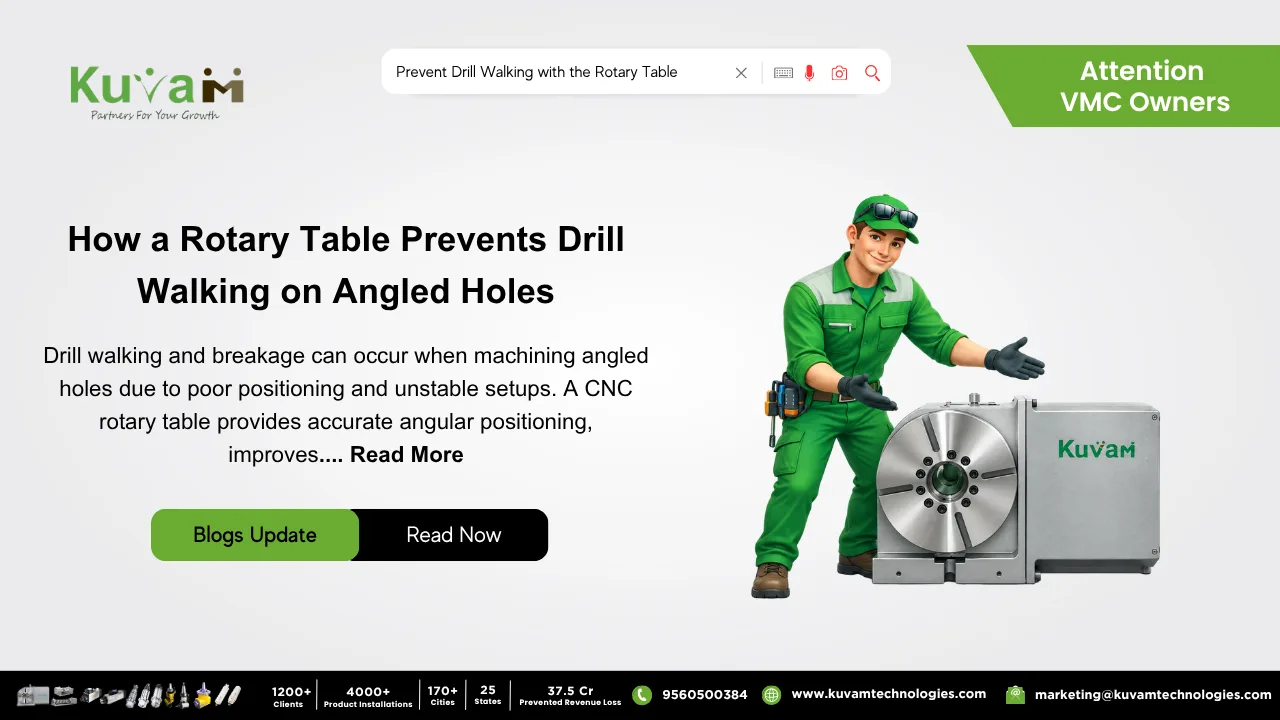
A Rotary Table is a precision workholding device that mounts on the bed of a milling machine or machining centre and adds a mechanically controlled rotational axis to the machine’s native linear movement. The workpiece is secured to the table’s circular surface, aligned to its rotational centre, and rotated to each required angular position by turning a handwheel that drives an internal worm and worm gear mechanism.
The worm gear operating at a typical ratio of 40:1 or 90:1 translates each handwheel turn into a precise, controlled angular increment. A graduated dial and vernier scale on the table body allow the operator to position the workpiece to arc-minute accuracy. At each position, a clamping mechanism locks the table completely rigid before the cut is made. The angular reference is mechanical and absolute — it does not drift, does not depend on calculation accuracy, and does not change between the first cut of the morning and the last cut of the shift.
| THE FULL PRODUCT RANGE Manual Rotary Tables are the most flexible option suited to job shops producing varied components where setup adaptability matters more than cycle speed. Motorized models add servo-controlled positioning for faster, more consistent indexing on production runs where the same angular sequence repeats across a large batch. CNC-integrated Rotary Tables function as a programmable fourth axis within the machine control system, enabling continuous arc interpolation, helical milling, and complex cam profile generation. Tilting variants add a compound inclination axis for work that requires angular positioning in more than one plane simultaneously. |
Where Production Time Actually Comes Back
| 40:1 Typical worm gear ratio providing controlled arc-minute angular resolution | 55% Typical setup time reduction on angular and circular components | 360° Continuous rotation range — no mechanical stops, infinite angular division |
When a Rotary Table replaces a manual coordinate approach to angular work, the first place time returns is the setup itself. Positioning the workpiece to a required angle becomes a matter of rotating the handwheel to the correct dial reading not computing and verifying a coordinate, not manually advancing a table and re-checking with a protractor. For a component with eight angular features, eight dial readings replace eight coordinate calculations and eight manual verification steps. Across a full production batch, that difference is not marginal. It is substantial.
The second place time returns is inspection. When angular positions are controlled mechanically, the part-to-part variation narrows to the repeatability of the table mechanism far tighter than any manual method can consistently achieve. First-pass inspection rates improve. Rework cycles become rare rather than routine. And the time that was previously spent correcting angular drift across a batch is returned to productive machining.
The Types of Work Where the Rotary Table Earns its Place Fastest
Flanges and pipe fittings Bolt holes must land at exact angular intervals on a precise pitch circle. Manual methods introduce drift across the full hole count, the Rotary Table eliminates it entirely. | Pump and compressor housings Radial port features and symmetrically placed faces require consistent angular indexing across heavy, awkward components exactly what the Rotary Table was built for. |
| Sprockets and gear blanks Even angular spacing between teeth and relief cuts demands mechanical division control not the accumulated approximation of manual repositioning across twenty or thirty cuts. | Tooling and fixture plates Precision location features placed at angular intervals must be exactly right the first time. A Rotary Table delivers the positional consistency that toolmaking demands. |
The common thread across all of these applications is not complexity for its own sake. It is the need to place features accurately around a centre point something that a linear machine setup approaches awkwardly, and that a Rotary Table handles as a matter of course.
Slow delivery cycle on rotational parts a capacity problem or a tooling problem?
In most cases, it is a tooling problem dressed as a capacity problem. Adding shifts, hiring additional operators, or investing in a faster machine will not resolve a delivery challenge that originates in a setup process that takes three times longer than it should and produces parts that require two inspection passes to clear. The bottleneck is not hours it is the method.
A Rotary Table does not require a significant capital commitment relative to the production problem it solves. It does not require retraining a team on a new machine platform. It mounts on the equipment the shop already owns and immediately changes the economics of every angular and circular component that runs across it. Shorter setups. Fewer rework cycles. Tighter inspection results. Delivery schedules that become promises a manufacturer can actually keep.
The customers who have been patient about late deliveries on precision parts are not going to wait indefinitely. The Rotary Table is the kind of fix that changes their experience fast enough to matter not in a year, but in the next production run.
Delivery reliability is built one setup at a time. When the setup finally has the right tool for the geometry it is producing, the schedule stops being a source of stress and starts being a competitive advantage.