
A Rotary Table can help in machining complex jobs. In a competitive manufacturing market, the shops that win complex angular work aren’t always the ones with the biggest machines. They’re the ones with the right attachment on an ordinary mill and the confidence it gives them to quote what others won’t.
It’s a particular kind of frustration, and most shop owners have felt it at least once. A request for quote lands on the desk a component with bolt hole patterns, radially arranged features, or curved profiles that need to be machined with genuine precision. The job is well within the team’s capability. The material is standard. But something about the setup uncertainty how long it will really take, how many parts might need rework, whether the quoted price can actually absorb the risk makes the number feel uncomfortable to commit to.
So the quote goes out a little high to protect margins. And then it comes back rejected, because a competitor down the road priced it lower and won the job. What the competitor knew, and what your shop hadn’t yet worked out, is that with a Rotary Table in the setup, the uncertainty disappears. The time is predictable. The rework risk is near zero. And the price that wins the job is the price a controlled, reliable process naturally produces.
This is the quiet competitive gap that a Rotary Table closes not just in production efficiency, but in quoting confidence. And for shops that handle angular and circular geometry regularly, that gap costs more in lost business than most production managers ever calculate.
The Quoting Problem Nobody Names Correctly
When a manufacturer consistently loses bids on complex angular parts, the instinct is to look at pricing strategy, overhead structure, or labour rates. These are worth reviewing. But the more fundamental question is this: why does the same class of job consistently carry more uncertainty than the rest of the work on the floor?
The answer almost always traces back to how angular and rotational geometry is handled in the setup. When there is no dedicated tool controlling angular positioning, no Rotary Table establishing a mechanical reference for every cut, the machinist is working from calculation and estimation. The setup time for a component with six angularly spaced features might be 45 minutes one day and 90 minutes the next, depending on how cleanly the calculations go, how many verification passes are needed, and whether any features need re-cutting after inspection. That variability makes confident quoting nearly impossible.
Shops that own a well-chosen Rotary Table don’t have this problem on angular work. They know from experience and mechanical reliability exactly how long the setup takes, how many parts will clear inspection on the first pass, and what the true cost of production is. That knowledge becomes pricing power. And pricing power is what wins competitive bids.
“Quoting confidence isn’t a personality trait. It’s a product of process reliability. When the process for angular work is mechanically controlled rather than manually estimated, the number on the quote sheet reflects a cost that the shop can actually hit — every time.”
What a Rotary Table is and Why it Creates that Reliability?
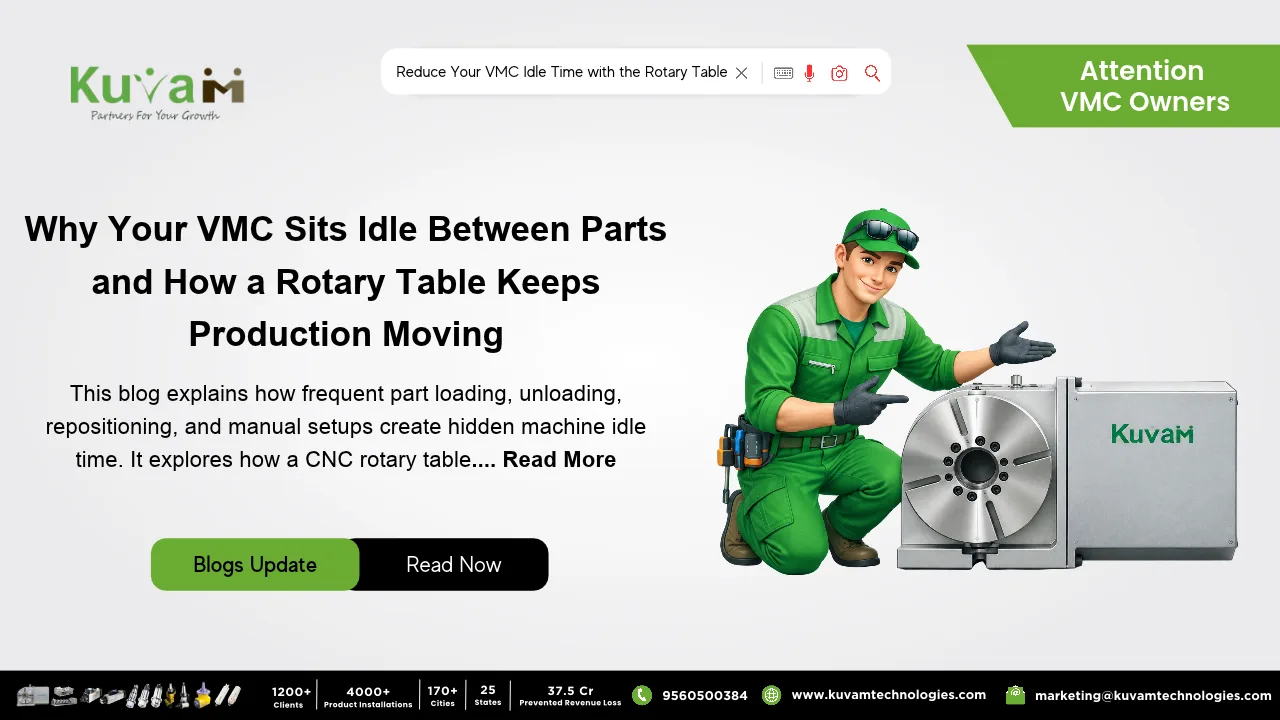
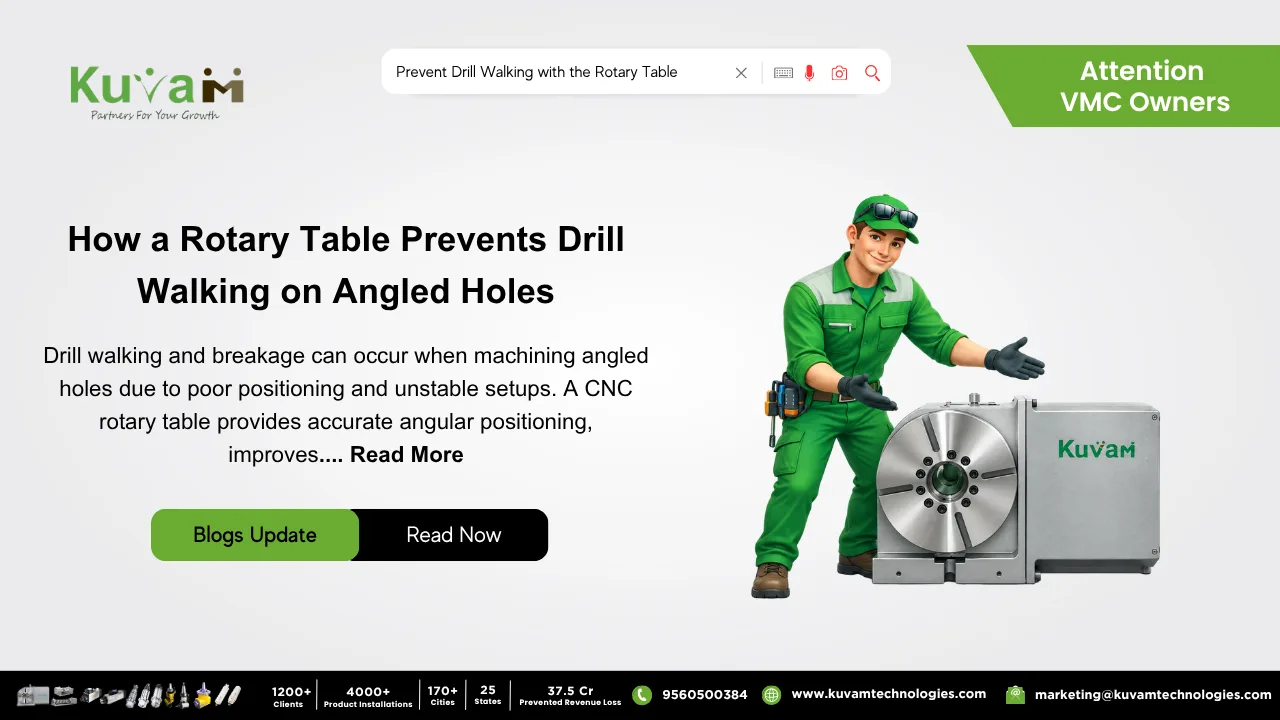
A Rotary Table is a precision workholding device that mounts directly onto the bed of a milling machine or machining centre. It holds the workpiece on a circular, graduated surface and rotates it under precise mechanical control to any required angular position before each cut. The rotation is driven by a worm and worm gear mechanism, typically at a gear ratio of 40:1 or 90:1, which means every handwheel turn produces a small, exact angular increment. A graduated dial and vernier scale on the table body allow the operator to read and set angular positions to arc-minute accuracy without any coordinate calculation.
Between cuts, a clamping system locks the table absolutely rigid no drift, no play, no movement under cutting forces. The workpiece lands at the same angular reference on part twelve as it did on part one, because the reference is mechanical, not human. That consistency is the foundation of the process reliability that translates into quoting confidence.
| CHOOSING THE RIGHT CONFIGURATION Manual Rotary Tables suit shops handling varied angular work where job types change frequently and setup flexibility matters most. Motorized models bring servo-driven speed and repeatability to high-volume runs where the same angular cycle repeats across large batches. CNC-integrated models add a programmable fourth axis to a three-axis mill unlocking helical interpolation, continuous arc milling, and cam profile work that would otherwise require dedicated multi-axis equipment. Tilting models introduce a compound angular axis for parts that need positioning in more than one rotational plane. |
Three Assumptions Shops Make About Angular Work and What the Rotary Table Corrects
| ASSUMPTION Complex angular parts always take unpredictable time to set up |
| With a Rotary Table, angular positioning follows a repeatable dial-reading sequence — not an open-ended calculation. Setup time becomes as predictable as any other standard operation on the floor. |
| ASSUMPTION Rework on angular features is an unavoidable cost of precision work |
| Rework on angular features is almost entirely a product of positioning inconsistency. Mechanical control through a Rotary Table removes the source of that inconsistency — and with it, the rework. |
| ASSUMPTION You need five-axis capability to compete on complex circular geometry |
| A Rotary Table mounted on a three-axis mill handles the majority of circular and angular feature work that manufacturers encounter in practice at a fraction of the capital cost of a five-axis machine. |
| 40:1 Worm gear ratio delivering arc-minute angular precision per handwheel increment | Zero Coordinate calculations needed angular positions read directly from graduated dial | 4th Effective axis added to a 3-axis mill with a CNC-integrated Rotary Table |
What Winning More Complex Work Actually Looks Like
For shops that introduce a Rotary Table into their workflow, the change with their quoting practice is one of the first things that changes. Jobs that previously carried a risk premium because the setup uncertainty demanded one can now be priced from a position of genuine process knowledge. The shop knows the setup time. It knows the first-pass inspection rate. It knows the actual cost. And that knowledge produces a quote that is competitive without being a gamble.
The second shift is in which jobs the shop chooses to pursue. Work with bolt hole patterns, radially arranged ports, equispaced flats, arc-shaped slots, and circular profiles stops being the kind of job that gets evaluated carefully before quoting and starts being the kind of job the shop actively looks for, because it is now profitable, predictable, and something the team can produce with confidence.
The third shift is subtler but perhaps the most durable: reputation. Customers who bring complex angular work to a shop and receive it back on time, within tolerance, and at a competitive price, do not typically go looking for another supplier. They come back. And they refer others. A Rotary Table does not just improve the economics of individual jobs it builds the category of work a shop becomes known for doing well.
The shops that consistently win complex angular work are not operating with fundamentally different talent or fundamentally better machines. They are operating with fundamentally better process control and a Rotary Table is one of the most direct routes to exactly that.