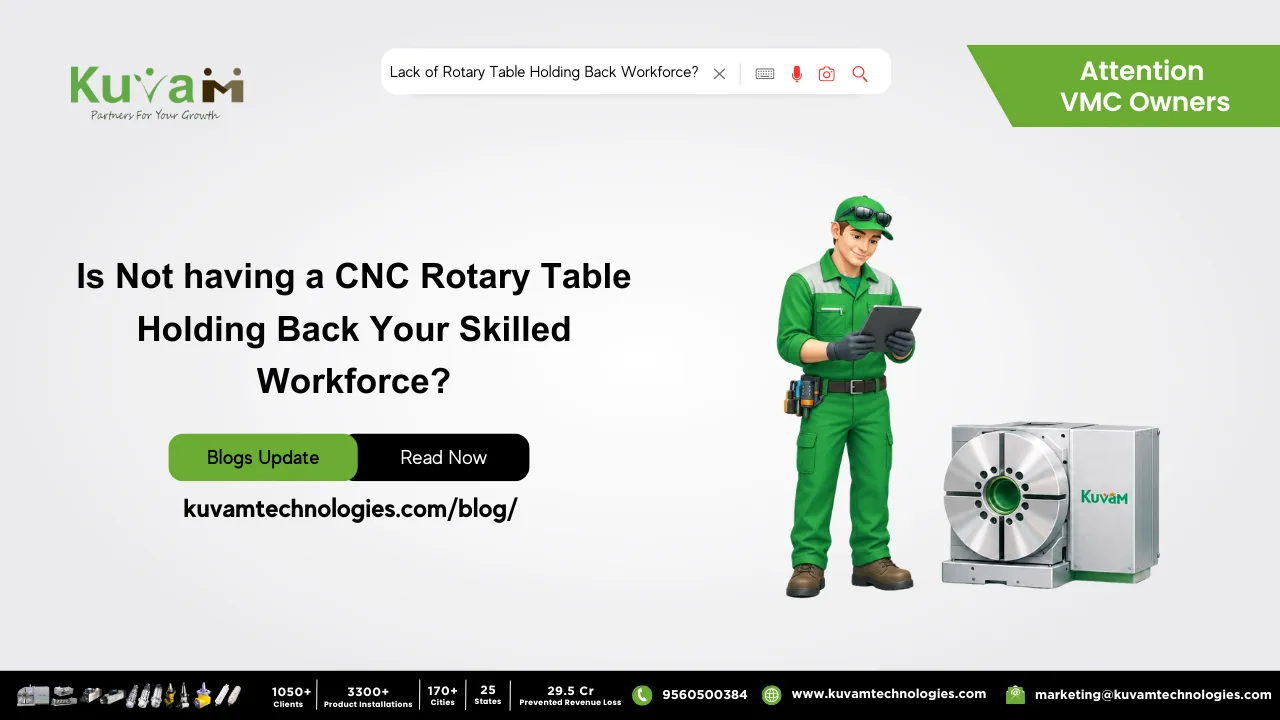

Hiring more machinists and buying more machines is the instinct when output stalls. But when the ceiling comes from a positioning gap in the setup, not a shortage of people or equipment, can a Rotary Table be the answer the workforce expansion never was.
Growth is supposed to feel good. New hires are on board. The machine count has increased. The order book is full. And yet, somewhere between the headcount expansion and the production targets, the output on complex angular parts hasn’t moved the way it should have. Throughput is better on simpler work. But the components with circular features, radially arranged holes, and precisely spaced angular geometry still move through the floor at the same pace they always did or slower, because now there are more people navigating the same constrained workflow.
This is a situation that catches manufacturers off guard, because it defies the intuition that more people and more machines should mean more output. And it does until the constraint isn’t capacity, but method. When the method for handling angular geometry is manual, adding operators doesn’t scale the output. It just means more people working within the same fundamental limitation. The ceiling doesn’t rise because the problem was never about the number of hands. It was about what those hands were being asked to do without the right tool.
The right tool, in the case of angular and circular machining, is a Rotary Table. And for growing shops that have invested heavily in people and equipment while the output on complex work quietly stagnated, it is often the only change that actually moves the ceiling.
Understanding Why Manual Scaling Fails on Angular Work
Most machining tasks scale reasonably well with headcount. Add an operator, and a second machine runs. Add a second machine, and throughput roughly doubles on the work that fills it. The logic holds for drilling, facing, linear milling, turning operations that fit cleanly into a standard three-axis setup and can be replicated across workstations without introducing new sources of error.
Angular work breaks this logic. The constraint on output for circular and angular components isn’t the number of operators it’s the time each operator spends managing positioning. When every angular feature requires a coordinate calculation, a manual repositioning, a positional verification, and occasionally a re-cut after a drift error, the bottleneck is embedded in the method itself. No additional operator can bypass it, because every additional operator faces the same method. Throughput scales with operators only when the method is already efficient. When it isn’t, scaling headcount scales the problem alongside the output.
“Adding people to an inefficient process doesn’t fix the process. It just means the inefficiency runs on more shifts. The ceiling on angular output doesn’t rise until the method changes and the method changes when a Rotary Table replaces estimation with mechanical control.”
What a Rotary Table is and What it Actually Changes in the Method?
A Rotary Table is a precision workholding device that mounts on the bed of a milling machine or machining centre and adds a mechanically controlled rotational axis to the machine’s existing linear movement. The workpiece is clamped on the table’s circular surface, aligned to the rotational axis, and rotated to each required angular position by turning a handwheel connected to an internal worm and worm gear drive typically at a ratio of 40:1 or 90:1. Each increment of the handwheel produces a precise, defined angular movement. A graduated dial and vernier scale on the table body allow the operator to read and confirm angular position to arc-minute accuracy.
What this changes in the method is fundamental. Instead of calculating coordinates, manually moving the machine table, verifying the result, and hoping the accumulated error across twelve features stays within tolerance the operator rotates the Rotary Table to a dial reading and cuts. The positioning step that previously demanded calculation, judgment, and multiple verification passes becomes a single mechanical action. It is faster, more accurate, and identical for every operator who uses the table regardless of their experience level or how late in the shift it is.
| PRODUCT RANGE OVERVIEW Manual Rotary Tables are the most adaptable option suited to varied job shop work where component types change frequently. Motorized models introduce servo-controlled positioning for production runs where the same angular sequence repeats consistently across large batches. CNC-integrated Rotary Tables extend a three-axis machining centre into genuine four-axis capability, enabling continuous arc interpolation, helical milling, and programmable angular cycles without additional machine investment. Tilting models add a secondary inclination axis for compound-angle applications where both rotational and angular positioning are required simultaneously. |
The Three Shifts a Rotary Table Creates in a Growing Shop
| From method-limited to capacity-limited throughput Once the Rotary Table replaces manual angular positioning, the constraint on complex-part output shifts from method to genuine capacity. Now, adding an operator or a machine actually increases throughput on angular work because the method no longer creates a ceiling that headcount cannot lift. |
| From experience-dependent to system-dependent quality Manual angular positioning produces results that vary with the operator’s experience, attention, and fatigue. Mechanical positioning through a Rotary Table produces results that depend on the system consistent for a new hire on their first week and a veteran at the end of a long shift, because the reference point is the same graduated dial for both. |
| From absorbed overhead to recovered margin The extra setup time, re-verification passes, and rework cycles on angular work represent real labour cost that gets absorbed into overhead rather than recovered as margin. When the Rotary Table eliminates those steps, that cost doesn’t disappear it converts into recovered capacity that can be priced into new work or absorbed as improved profitability on existing jobs. |
40:1 Worm gear ratio — precise arc-minute angular control per handwheel revolution | 1 Mechanical action replaces calculate, reposition, verify, and re-cut sequence | 4th Effective axis unlocked on a 3-axis mill with a CNC-integrated Rotary Table |
Is Your Output Ceiling a Capacity Problem or a Rotary Table Problem?
The distinction matters enormously, because the solutions are completely different. A capacity problem responds to investment in people and machines. A method problem does not it responds only to changing the method. And for shops where angular and circular components are a meaningful part of the work, the method for handling those components is almost always the undiagnosed constraint hiding behind what looks like a capacity gap.
The tell-tale sign is this: if output on simple linear work scales predictably with headcount and machine time, but output on complex angular parts doesn’t move at the same rate the bottleneck is the angular method, not the angular capacity. A Rotary Table is the intervention that breaks that distinction and allows complex work to scale the way everything else does.
For a growing shop trying to make sense of why investment in people and equipment hasn’t translated into proportional output on complex parts, the Rotary Table is rarely the first place anyone looks. It tends to be the last. But in the shops that have found it, it reliably turns out to have been the answer they needed before the first new hire ever walked through the door.
Growth without the right tooling is growth that runs into its own ceiling. The Rotary Table is what raises the ceiling on complex angular work and lets everything the shop has invested in finally perform the way it was meant to.