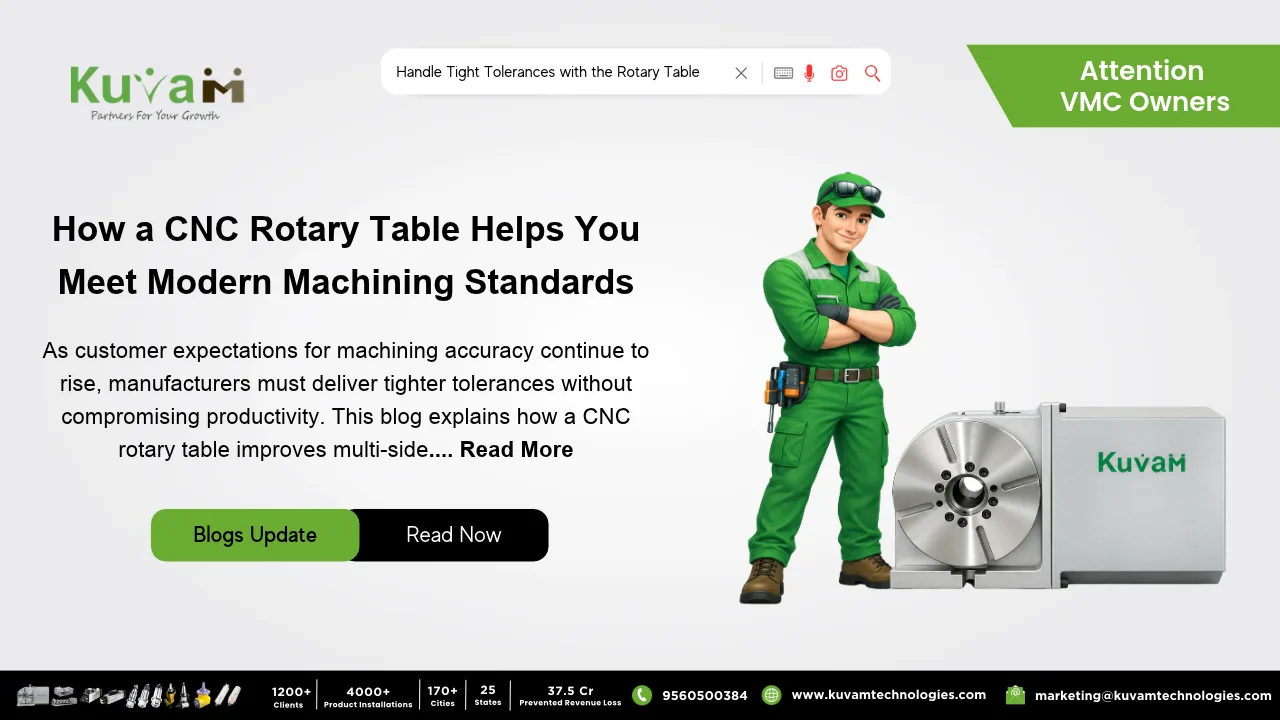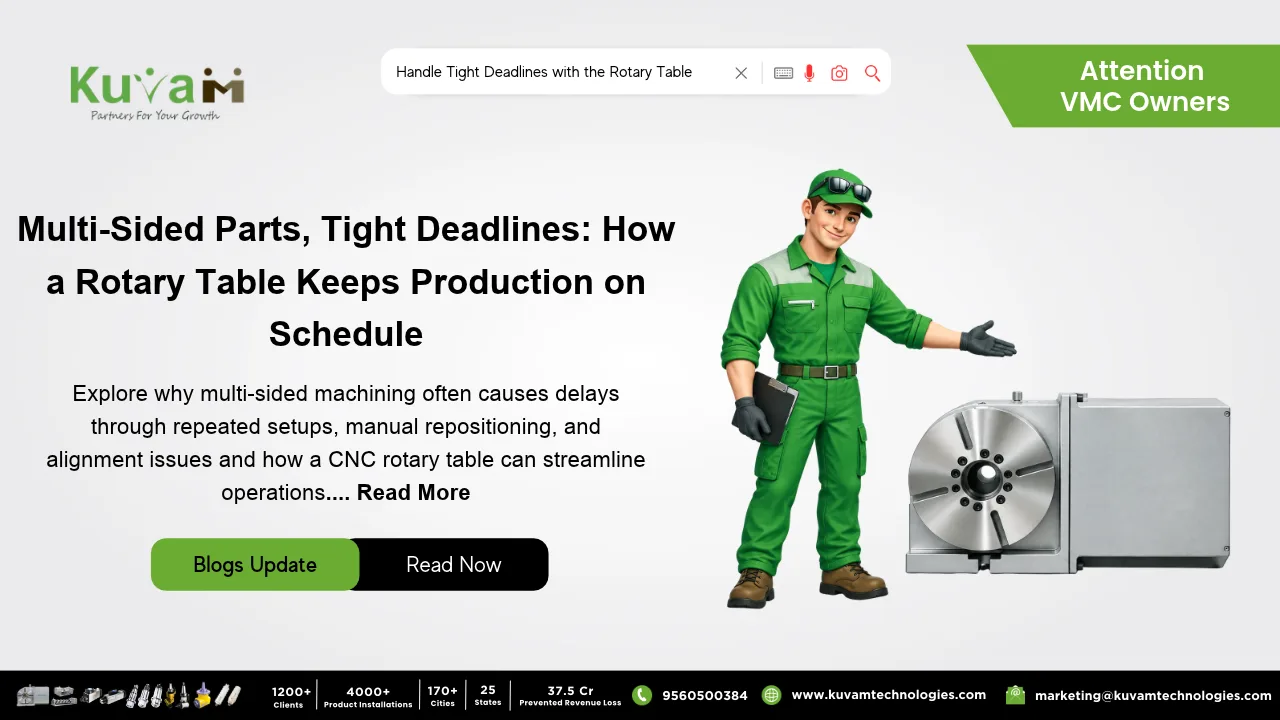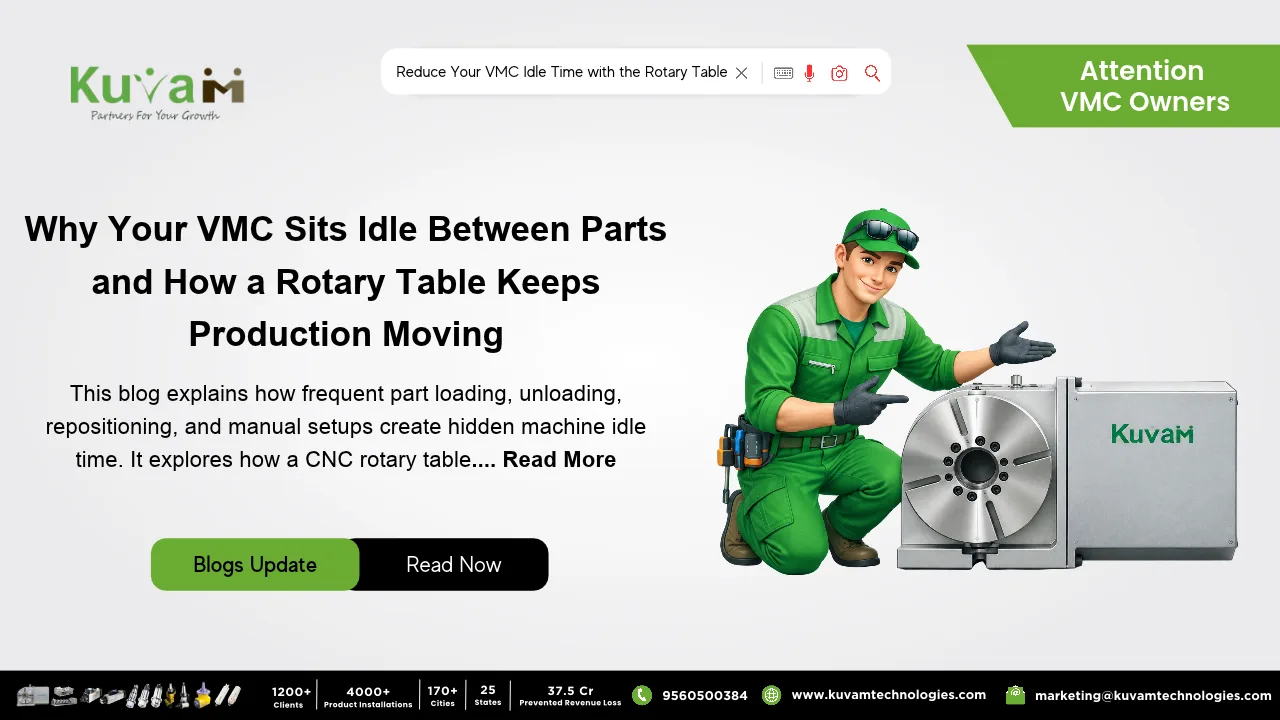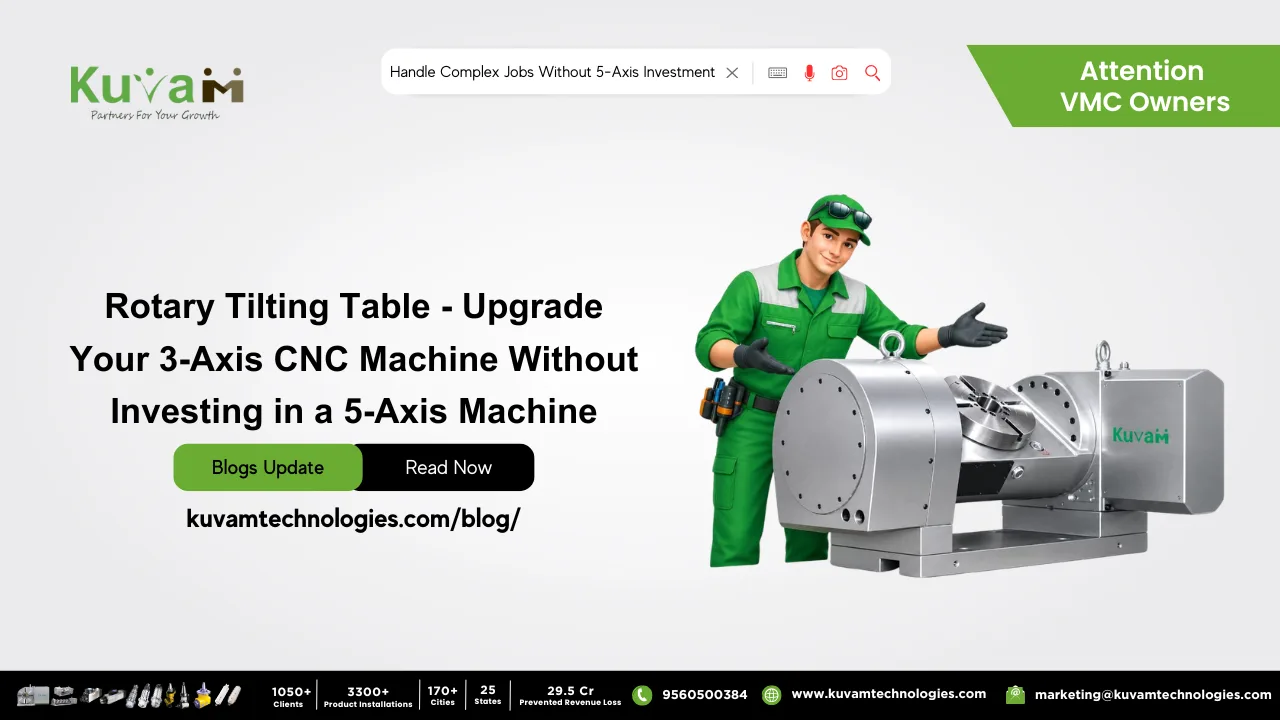

The Rotary Tilting Table is able to convert a 3-axis machine into a 5-axis machine. Most manufacturers can’t justify a five-axis machine for the volume of complex angular work they run. But they can’t afford to keep turning down those jobs either. The Rotary Tilting Table sits exactly in that gap and fills it precisely.
Every manufacturer who runs a three-axis mill has had the same conversation at least once. A request for quote arrives a component with compound-angle features, oblique bores, or geometry that sits on planes the machine simply wasn’t designed to reach without a radically different setup. The job is within the team’s skill set. The tolerances are tight but achievable. And the order volume is good enough to be worth pursuing.
But when the estimator works through the setup requirements, two or three machine transfers, custom fixturing for each orientation, re-indication time between operations, the tolerance risk that accumulates across four separate clamps, the quote either comes out too high to win or too low to make money. Either way, the shop walks away. And a competitor with better tooling takes the job.
This is the compound-angle capability gap. It sits between what a three-axis mill can naturally handle and what a five-axis machining centre is reserved for. And for most manufacturing businesses, it represents a meaningful volume of work that goes elsewhere every year, not because the team can’t do it, but because the setup cost of doing it without the right tool makes it uncompetitive.
The Rotary Tilting Table is the tool that closes that gap. Not by replacing the three-axis mill. By giving it two additional axes of workpiece positioning and with them, the ability to reach compound-angle geometry that was previously off the table entirely.
Why the Compound-Angle Gap is Wider than Most Shops Realise?
A standard three-axis mill moves its cutting tool in X, Y, and Z. A standard Rotary Table adds a fourth axis rotation of the workpiece around a vertical axis. These four axes together cover a very wide range of machining work. But there is a class of geometry they cannot reach: features that require the workpiece to be simultaneously rotated and tilted positioned at a compound angle that combines azimuthal rotation with angular inclination in a second plane.
Valves with port faces drilled at oblique angles to the body axis. Impeller blades with leading-edge features angled in two planes at once. Medical implants with bone-interface surfaces that must be machined on intersecting oblique planes. Die cavities with side features that run at compound angles to the parting surface. Each of these describes a workpiece where the required tool approach angle cannot be achieved through rotation alone the setup also needs to tilt.
Without a Rotary Tilting Table, every one of these jobs requires manual reorientation between operations. Parts get unclamped, repositioned by hand, re-indicated to a new datum, and re-clamped. Every one of those transitions is a source of error, a cost in time, and a risk to the tolerance relationship between features machined in different clampings.
“The compound-angle gap isn’t just a technical inconvenience. It’s a commercial ceiling a limit on the jobs a shop can compete for, price confidently, and deliver without absorbing multi-operation risk. The Rotary Tilting Table is what raises that ceiling.”
What a Rotary Tilting Table is and What Two Axes Really Mean?
A Rotary Tilting Table is a precision workholding device that mounts on the bed of a milling machine or machining centre and provides two independently controlled axes of workpiece positioning in a single unit. The first rotary axis drives the worktable surface through 360 degrees of rotation using a precision worm and worm gear mechanism, typically at a 40:1 or 90:1 ratio. The second tilt axis ilts the entire rotary assembly through its inclination range, typically 0 to 90 degrees or beyond, using a second independent worm gear drive oriented perpendicular to the first.
Both axes have graduated dials and vernier scales for direct angular readout to arc-minute precision. Both axes lock rigidly under cutting forces. Both can be set and adjusted independently or in combination, which means the workpiece can be brought to any compound angle within the table’s mechanical range from a single clamping, without the operator ever unclamping the part.
| MANUAL, MOTORIZED, OR CNC CHOOSING THE RIGHT MODEL Manual Rotary Tilting Tables are the most accessible entry point for both axes set by handwheel, suited to shops where compound-angle jobs are varied and the flexibility to handle any geometry matters more than cycle speed. Motorized models add servo-driven positioning to both axes, enabling faster, more repeatable setup on production batches where the same compound angle repeats. CNC-integrated models drive both axes under machine control, creating genuine five-axis positional capability on a three-axis platform to programmable compound-angle cycles, continuous contouring across two rotational axes, and full integration with the machine’s coordinate system. |
Before and After: What Changes When the Rotary Tilting Table Enters the Workflow?
| WITHOUT ROTARY TILTING TABLE | WITH ROTARY TILTING TABLE |
| ✗ Compound-angle jobs require 3–4 separate clampings, each adding re-indication time and tolerance risk | ✓ All compound-angle features reached from one clamping to tilt and rotate to the required position, cut, repeat |
| ✗ Quote prices on complex angular work absorb multi-setup risk, making them uncompetitive against better-equipped shops | ✓ Single-setup production reduces cost basis, enabling competitive quotes on work previously declined or lost |
| ✗ Tolerance stack from multiple clampings pushes angular feature relationships outside specification | ✓ Features machined in one clamping share a single datum positional relationships held to the table’s mechanical accuracy |
| ✗ Complex five-axis geometry requires machine investment of several hundred thousand to compete | ✓ Rotary Tilting Table delivers equivalent compound-angle positioning on existing three-axis equipment |
The Industries Where the Rotary Tilting Table Changes What’s Possible?
| Energy & power generation Turbine casings, impeller hubs, and manifold blocks with intersecting bores and compound-angle port faces that require tilt and rotation in the same setup. | Precision tooling & mould Die cavities, core inserts, and lifter components with angled side walls running at compound angles to the tool datum — reachable in one setup rather than three. |
| Defence & naval engineering Housings, brackets, and structural components with oblique mounting faces and compound-angle fastener patterns that demand simultaneous tilt and rotational indexing. | Research & prototype facilities One-off and low-volume components where compound-angle requirements change with every job — the Rotary Tilting Table handles all of them without dedicated fixturing. |
| 2 Fully independent precision axes — rotation and tilt — in one device | 5-axis Positional capability delivered to a 3-axis mill with CNC integration | 1 Clamping replaces the 3–4 setups compound-angle work previously demanded |
Is the Rotary Tilting Table the Bridge Your Shop’s Capability has been Missing?
The compound-angle jobs that have been going to competitors are not beyond your team’s skill. They are beyond your current setup’s reach. That is a very different problem and it has a very specific solution. The Rotary Tilting Table does not require retraining, does not require a new machine platform, and does not require a capital commitment that takes years to justify. It mounts on the equipment the shop already owns and immediately expands the category of work it can produce.
For manufacturing businesses where complex angular work represents a meaningful share of the market opportunity, the Rotary Tilting Table is one of the clearest and most immediate capability investments available. The jobs you have been declining or losing on price are not going to come back on their own. But with the right tooling in place, they become jobs the shop can quote confidently, produce reliably, and deliver at a price that wins.
The gap between a three-axis mill and a five-axis machine is not always measured in axes. Sometimes it is measured in the one attachment that lets the machine you already own do the work you have always been capable of just not yet equipped for.