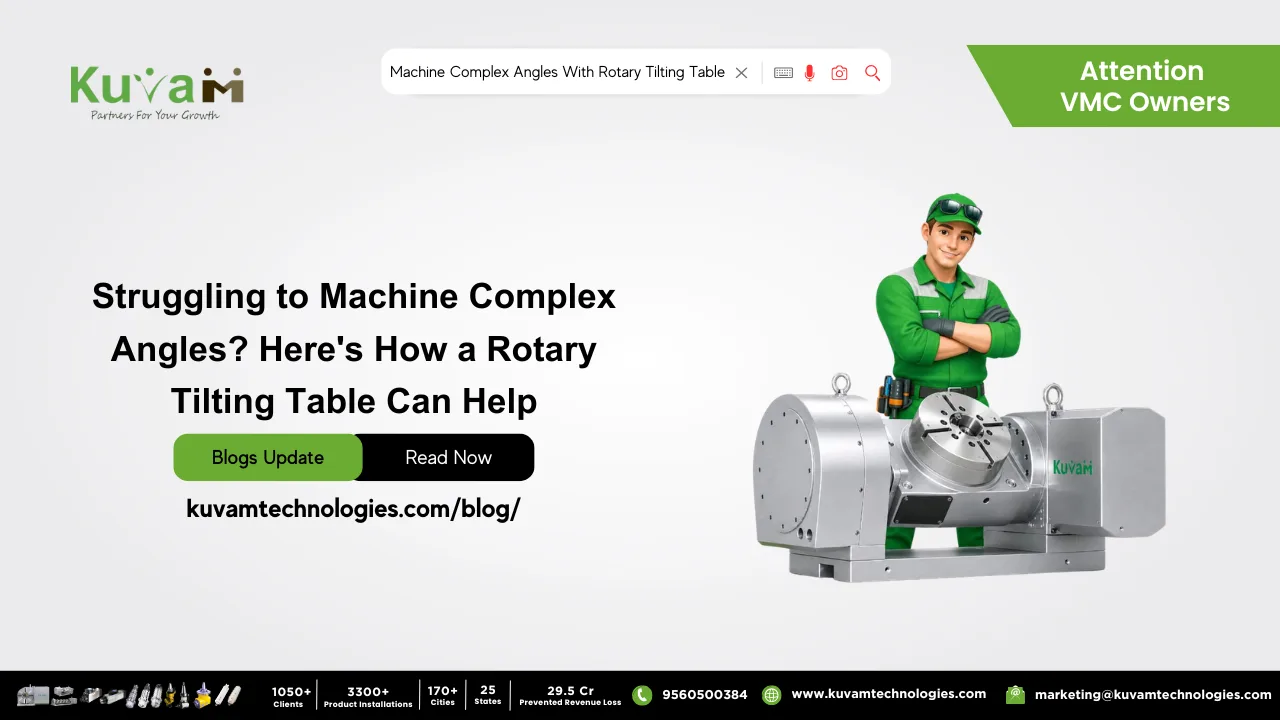

Single-axis rotation solves a lot but not as much as the Rotary Tilting Table. But when a component’s geometry demands positioning in two planes simultaneously angled and rotated at the same time — a Rotary Tilting Table is the tool that finally makes the setup possible without a five-axis machine.
Some parts arrive on the shop floor and immediately create a silence. Not the silence of a simple job the silence of an experienced machinist staring at a drawing and quietly calculating how many separate setups it would take to reach every feature. The angled face on one side. The radial hole pattern on the other. The compound-angle chamfer that sits somewhere between the two. Each feature, taken alone, is manageable. Together, they describe a component that needs to be positioned not just rotationally, but rotationally and angularly at the same time.
For shops without the right tooling, this kind of part follows a familiar and expensive path. It gets set up once, machined partially, unclamped, repositioned, re-indicated, machined again sometimes three or four times on different machines before all the features are complete. Every transition between setups adds time, introduces re-referencing uncertainty, and increases the cumulative tolerance risk on the finished component. The part that was straightforward on paper becomes one of the most labour-intensive jobs of the quarter.
The Rotary Tilting Table was built specifically for this problem. Not for simple angular work that is the territory of a standard Rotary Table. For the geometry that demands two axes of positioning simultaneously: rotation around a vertical axis and tilting around a horizontal one. Two degrees of freedom. One setup. And the kind of compound-angle capability that previously lived exclusively inside expensive five-axis machining centres.
What Compound-Angle Geometry Actually Demands and Why Single-Axis Tools Fall Short?
A standard Rotary Table gives a machinist rotational control and the ability to index a workpiece around a central vertical axis to any angular position. This handles bolt hole circles, equispaced slots, radial features, and circular profiles with precision and repeatability. For a very large proportion of angular machining work, it is exactly the right tool.
But some component geometries ask for more. A turbine blade root with features angled both longitudinally and transversely. A valve body with port faces drilled at compound angles to the main bore. A mould cavity with tapered side walls that run at angles in two planes. An aerospace bracket with mounting faces that sit on oblique planes no single axis of rotation can reach without repositioning.
For all of these, a single rotational axis is a partial answer. The workpiece can be rotated to the right azimuthal position, but it cannot simultaneously be tilted to the correct inclination without unclamping and physically reorienting the setup. The compound angle the combination of rotation and tilt is simply not accessible from a single-axis tool. And every time it requires a manual reorientation, the risk, the time, and the tolerance stack all increase.
“A component that needs to be positioned at a compound angle is not twice as hard as one that needs only rotation. It is categorically different because the two-axis setup either exists in the workflow or it doesn’t. The Rotary Tilting Table is the point where it starts to exist.”
What a Rotary Tilting Table is and How Two Axes Change Everything?
A Rotary Tilting Table is a precision workholding device that combines two independently controlled axes of positioning in a single compact unit. The rotary axis — driven by a precision worm and worm gear mechanism, typically at a 40:1 or 90:1 ratio — rotates the workpiece to any angular position around the vertical axis, exactly as a standard Rotary Table would. The tilting axis — a second worm gear drive oriented perpendicular to the first — tilts the entire rotary assembly to any required inclination angle, typically across a range of 0 to 90 degrees or beyond, depending on the model.
The result is a workpiece that can be positioned at any combination of rotation and tilt — any compound angle within the mechanical range of the table — without unclamping, without repositioning, and without transferring to a second setup. Both axes have graduated dials and vernier scales for direct angular readout. Both axes lock rigidly before cutting. And both axes can be set independently or in combination, giving the machinist complete control over the spatial orientation of the workpiece from a single clamping.
| INSIDE THE TWO-AXIS MECHANISM The rotary axis sits on top of the tilting axis, so the workpiece is first brought to the correct tilt angle and then rotated to the required azimuthal position — or vice versa, depending on the operation sequence. On manual models, both axes are set by handwheel and locked independently. On motorized and CNC-integrated models, both axes can be driven simultaneously under servo control, enabling compound-angle positioning in a single programmed motion. The base of the table mounts to the machine bed in standard T-slots, requiring no additional interface hardware. |
| Axis 1 — Rotation 360° angular indexing Worm-driven rotation to any azimuthal position — bolt circles, radial features, equispaced geometry — with arc-minute precision and rigid clamping between cuts. | Axis 2 — Tilt 0°–90°+ inclination control Independent worm-driven tilt of the entire rotary assembly — compound angles, oblique faces, angled bores — all accessible from the same workpiece clamping. |
The Applications Where a Rotary Tilting Table Earns Its Place Fastest
| Aerospace & Turbine Components Blade roots, housings, and brackets with features on multiple oblique planes that demand simultaneous rotation and inclination to machine correctly in a single setup. | Mould & Die Making Cavity walls, lifter pockets, and angled core features that run at compound angles to the parting line — accessible from one clamping rather than multiple machine transfers. |
| Valve and Manifold Bodies Port faces and intersecting bores angled in two planes simultaneously — configurations that defeat single-axis setups but fall cleanly within the Rotary Tilting Table’s range. | Medical Implants & Instruments Precision features on implant geometries and surgical instruments that require oblique approach angles to machine correctly without distorting the workpiece orientation. |
| 2 Independent precision axes – rotation and tilt in one compact device | 90°+ Tilt range on standard models — full oblique plane access from a single setup | 1 Clamping operation for compound-angle work previously requiring three or four |
Is the Rotary Tilting Table the Two-Axis Solution Your Compound-Angle Work has Needed?
If your shop regularly encounters components where a single rotational setup leaves features unreachable where the answer to “how do we get there?” is always “unclamp, reorient, re-indicate, and try again” then the Rotary Tilting Table is precisely the tool that ends that cycle. It does not approximate the compound-angle capability of a five-axis machining centre. For the specific category of work that requires simultaneous rotation and tilt, it delivers equivalent positional control at a fraction of the capital cost and without requiring a platform change for the rest of the shop’s workflow.
The machinists on your floor who have been quietly absorbing the stress of compound-angle setups recalculating, repositioning, re-checking are not struggling because the work is beyond their capability. They are struggling because the tool that belongs between them and that work has not yet arrived on the floor. The Rotary Tilting Table is that tool. And once it is there, the silence that descends when a compound-angle part arrives will stop being the silence of anxiety and start being the silence of a machinist who already knows exactly how to set it up.
Two axes of precision control, one rigid clamping, and the end of the compound-angle problem that has been slowing your most complex work down. That is what a Rotary Tilting Table brings to the floor — and what it keeps delivering on every job that comes after.