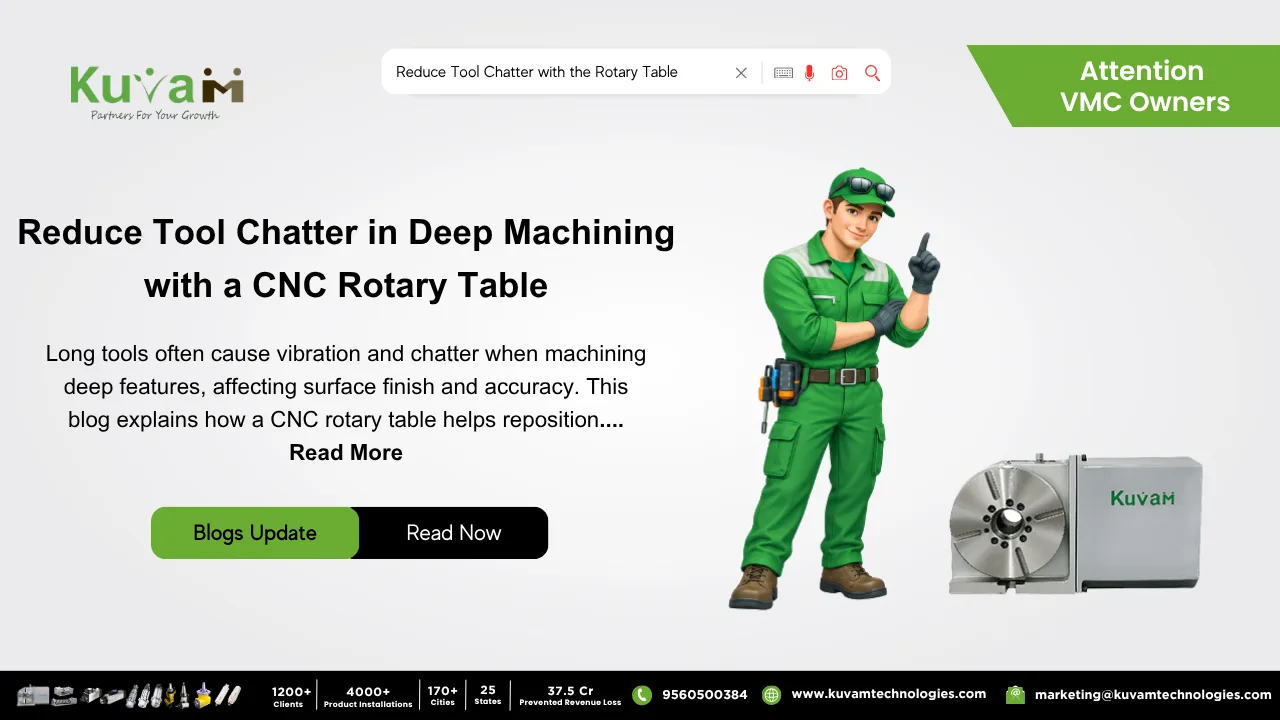

The Rotary Table allows for deep machining smoothly. You hear it before you see it. A low, nasty screech from somewhere inside the machine, and then the finish on the wall looks like the grooves on a record. Everybody’s had that moment of standing there with a hand hovering near the feed override.
Chatter has a hundred causes, and people love to argue about which one it is today. Speeds, feeds, a dull edge, a loose holder, a part that isn’t clamped as firmly as it looks. But a big share of it, on a certain kind of part, comes down to something simpler. The tool is hanging out too far.
The Cube You Can’t Argue With
A cutter sticking out of its holder behaves like a diving board. Deflection under load goes up with the cube of the length. Double the stick-out and you get roughly eight times the flex, not twice. That’s why a tool that cuts beautifully at an inch and a half can sound like a bag of bolts at three.
And the parts that demand long reach are everywhere. A pocket cut into the side wall of a housing. A port drilled in at an angle. A recess behind a flange where the spindle nose has no business going. With the part sitting flat in a vise, the tool has to travel down to the feature, so you buy a longer tool, and the physics start charging interest.
What People Do About It
The usual playbook is slower speeds, lighter passes, and a lot of patience. Some shops step the cut down in small increments so the tool never sees much load at full reach. Some buy extended-reach cutters with necked shanks, or damped holders that cost more than the mill’s first spindle. Some run the finishing pass twice and still end up with wall marks that need hand work.
It all works, kind of. None of it changes the real problem, which is that the cutter is a long way from where it’s being held. A rotary table goes after that directly.
Turn the Part, Not the Tool
This is where a Rotary Table earns its place on the mill. It’s a precision turntable that mounts to the machine bed, and it can be a plain manual one with a handwheel or a CNC one the control drives. A tilting model adds a second axis. The idea is to change the part’s orientation so the tool doesn’t need to reach.
Take that side wall pocket. On a vertical mill with the part flat, the pocket is three inches deep into a vertical wall, and you’re stuck hunting for an end mill with a long neck. Rotate the part 90 degrees on the table, and that same wall is now the top face. The pocket is a shallow one, a short stiff tool does the job, and chatter stops being a conversation.
A rotary table doesn’t make the cutter any stronger. It just takes the stick-out out of the equation.
A Housing, Start to Finish
Say you’ve got a cast housing with a side port that needs a three-inch-deep bore and a clean seat at the bottom. Flat in a vise, you’d be running a four inch stick-out and babysitting the cut. Clamped on a Rotary Table and turned so the port faces up, you can use a standard length boring tool at maybe an inch and a half of overhang. And because you are not crawling, the finish ends up improving, the cycle time also drops, and the tool ends up lasting longer.
Angled features work in a similar way. With the help of a tilting table, you can present a drilled-in-at-30-degrees hole square to the spindle, so a standard drill achieves what used to take a long one.
Where it Bites Back
There’s a catch people only find out after buying one, and it’s Z height. The part, the chuck or fixture, and the table all stack beneath the spindle, which reduces travel. You might not have enough space on a tiny mill to get a tool down to the task. Prior to placing an order for a rotary table, measure the stack.
Overhang shifts as well. If a long part is thrown on end and protrudes too far from the jaws, it may chatter on its own; thus, it should be supported by a tailstock or a firm rest. If the work is flexing, a rotating table won’t assist.
Additionally, a manual table works well for a single rotation, but a CNC rotary table ensures that every part is spun in the same way if the job requires multiple positions throughout a batch.
Picking One
Z height is reduced using a low-profile rotational table. Inquire about the weight and height of the table as well; a few inches of stack can determine whether it will fit under your spindle at all. A hefty casting hanging off the side puts significant leverage on the bearing, so pay attention to the load rating rather than merely the table diameter. Consider a tilting model if angled features are prevalent.
Generally speaking, it’s a warning indication if the long, thin tool in your drawer is used more than you would want.