
A single rejection is expensive, and a Rotary Table can prevent it. A pattern of them on angular features is existential. The shops that break that pattern rarely do it with tighter inspection, they do it by removing the source of the error before the part ever reaches the gauge.
The rejection call is one of the most demoralising moments in manufacturing. You produced the parts. You ran inspection. Most of them looked right. And then the customer’s quality team measures the bolt hole positions, or checks the angular spacing on the milled flats, or verifies the radial feature alignment and somewhere in that sequence, a number falls outside the tolerance band. The parts come back. The relationship takes a hit. And back on the production floor, the urgent question becomes: how do we make sure this never happens again?
The instinct in these moments is to add inspection steps. Tighten the in-process checks. Require a second sign-off before anything ships. These responses feel responsible, and in the short term, they do catch more errors before they leave the building. But they treat the symptom rather than the cause. The errors are still being generated, they are just being caught later, at the cost of more time, more labour, and more pressure on the quality team. The root cause, if it traces back to how angular positions are being controlled during machining, has not changed at all.
The Rotary Table is the intervention that addresses the cause. Not the inspection process. Not the measurement system. The positioning method itself, the point in the production sequence where the angular error either enters the part or is prevented from entering it altogether.
Why Angular Tolerance Failures are Disproportionately Common?
Tolerance failures on angular features are more common than failures on linear features for a straightforward reason: linear features are controlled by the machine’s native axes, which are consistent and well-calibrated. Angular features are not. When a machinist positions a workpiece for an angularly spaced cut using manual coordinate calculation or a handwheel estimate, the error sources multiply quickly calculation errors, physical positioning variance, and the accumulated drift of repeated repositioning across a multi-feature component.
Each individual error might be small. But they do not average out. They stack. And on a tight positional tolerance for a bolt hole pattern or a set of equispaced milled faces, a small stack of small errors is enough to push the feature out of specification, consistently, across multiple parts, in ways that are almost impossible to prevent without addressing how angular position is established in the first place.
“Inspection catches the error after it has already been machined into the part. The Rotary Table prevents the error from entering the part at all. These are not equivalent solutions where one is a filter, the other is a fix.”
What is Rotary Table and Why it is a Process Fix, Not an Inspection Fix?
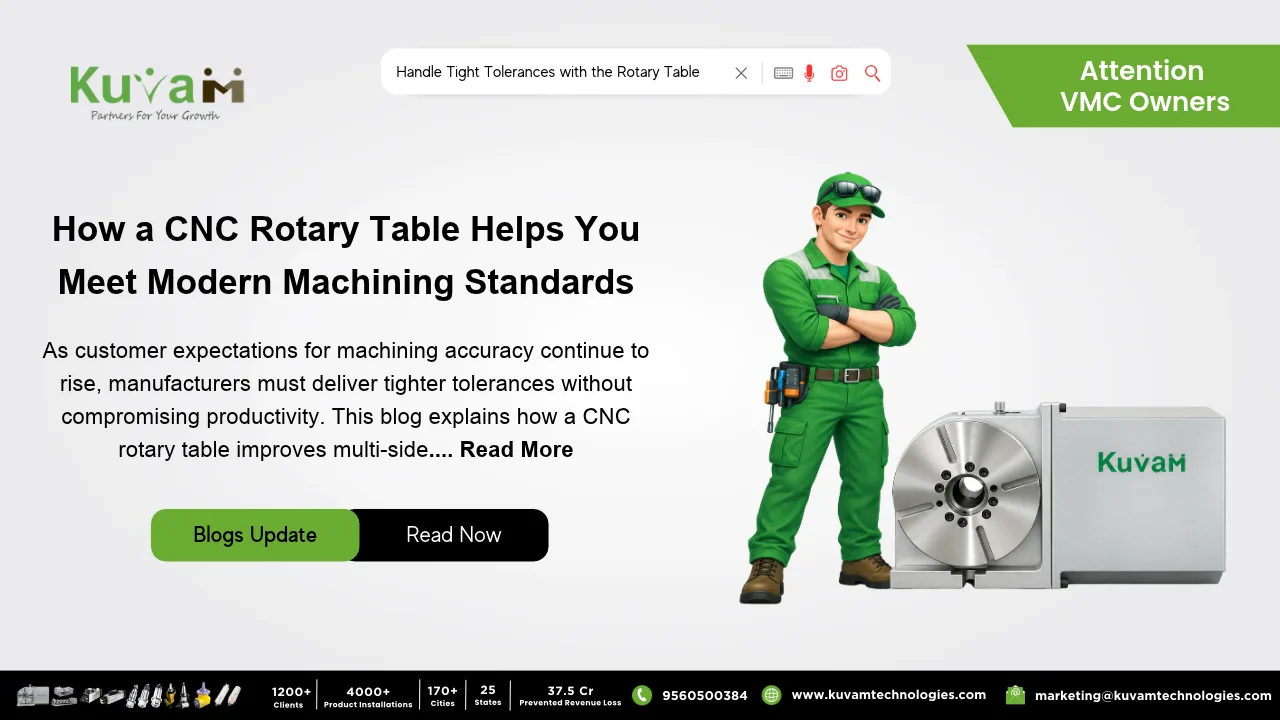
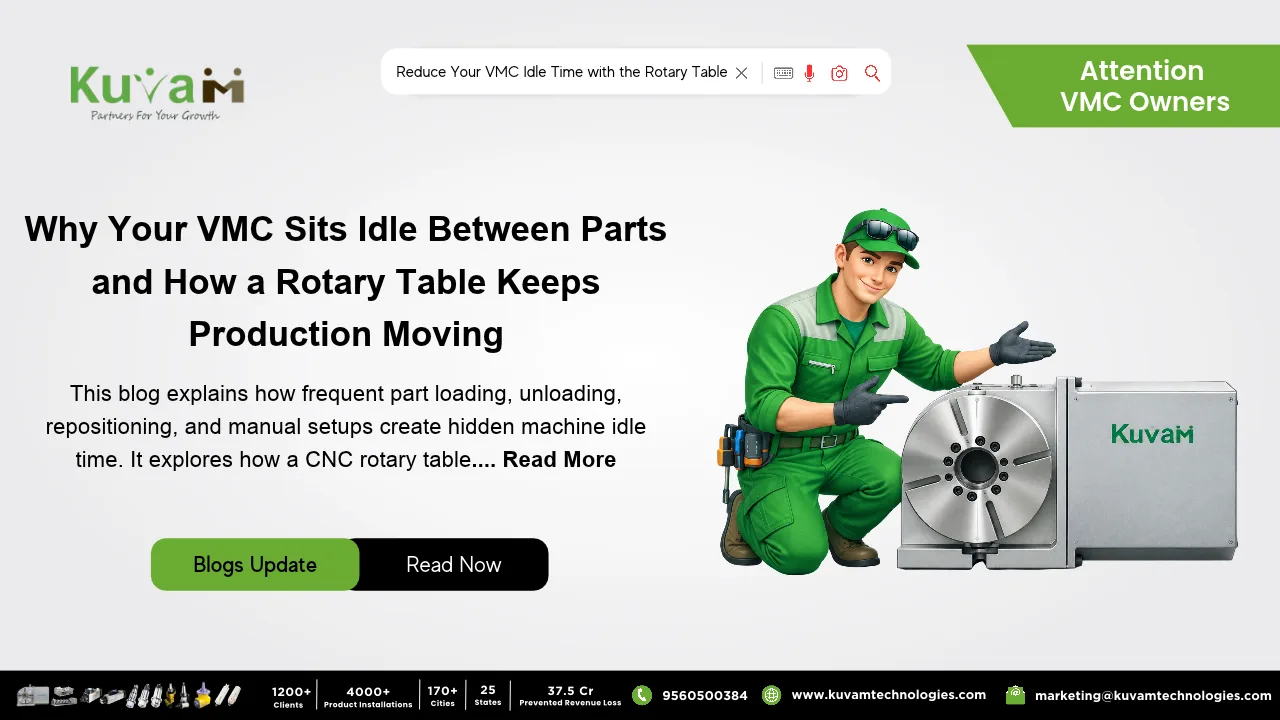
A Rotary Table is a precision workholding device that mounts on the bed of a milling machine or machining centre and introduces a mechanically controlled rotational axis for the workpiece. The part is secured on the table’s circular surface, centred on the rotational axis, and advanced to each angular position by turning a handwheel that drives an internal worm and worm gear mechanism — typically at a 40:1 or 90:1 ratio. Each handwheel increment produces a precise, repeatable angular step. A graduated dial and vernier scale allow the operator to set angular positions to arc-minute accuracy. A rigid clamping mechanism locks the table completely still before each cut.
The key word in all of this is mechanical. The angular reference is not estimated. It is not calculated by hand. It is not dependent on how carefully the operator moved the machine table or how accurately they read a protractor. It is defined by a precision gear mechanism and read from a calibrated graduated scale — the same way every time, for every operator, on every part in the batch.
| ROTARY TABLE CONFIGURATIONS Manual Rotary Tables provide the most flexible option for varied angular work where component types change regularly. Motorized models add servo-driven repeatability for high-volume production runs where the same angular sequence repeats across large batches. CNC-integrated models function as a programmable fourth axis within the machine control, enabling continuous arc interpolation, helical milling, and cam profile generation. Tilting variants add a compound inclination axis for components requiring angular positioning across more than one plane. |
The Three-Stage Journey from Rejection to Reliability
| 1 Identify the angular error source Trace repeated tolerance failures back to the positioning method — manual coordinates, estimated handwheel moves, or dividing plates — rather than the machine or the operator. | 2 Replace estimation with mechanical control Introduce a Rotary Table to the setup. Angular position becomes a dial reading on a calibrated scale — not a calculation. The error source is removed at the point where it previously entered the part. | 3 Restore customer confidence First-pass inspection rates rise. Rejections on angular features stop. The customer relationship recovers — not because inspection got tighter, but because the parts are now consistently right. |
Where the Evidence Shows up After the Rotary Table Arrives?
| First-pass inspection rates The most immediate and measurable change. When angular positioning is mechanical rather than manual, part-to-part variation on angular features drops to the repeatability of the table mechanism — tighter than any manual method can sustain across a full production batch. | Rework and re-inspection volume Jobs that previously generated regular rework cycles on angular features stop generating them. The time recovered flows back into productive machining rather than being consumed in correction and re-checking. |
| Customer return rate on angular work Customers who previously returned batches over angular tolerance failures stop returning them — not because the tolerance has been relaxed, but because the process now reliably meets it every time. | Operator confidence on complex jobs Machinists who previously approached complex angular jobs with anxiety about whether the features would pass stop carrying that anxiety. The process is controlled. The outcome is predictable. The work becomes straightforward rather than stressful. |
| 90:1 Maximum worm gear ratio — finest arc-minute resolution on precision models | Zero Manual estimation steps — every angular position defined mechanically | 100% Batch consistency — same angular reference on part one and part one hundred |
So — Is a Rotary Table the Answer to Your Rejection Pattern?
If the rejections are recurring on angular features bolt hole positions, equispaced slots, radially arranged faces, or circular profiles and the production method for those features still depends on manual coordinate calculation or handwheel estimation, then yes, almost certainly. The inspection process you have built around those features is working as well as it can. The problem is not the inspection. The problem is what it is inspecting.
A Rotary Table does not make the tolerance easier to meet. It makes the process capable of meeting it every cycle, across every batch, for every operator who uses it. That is a fundamentally different kind of solution than adding a measurement step. And it is the only kind of solution that actually stops the rejection pattern rather than simply catching its output.
The parts that are coming back from the customer are not coming back because the shop lacks skill, care, or diligence. They are coming back because a specific positioning step in the production sequence is producing results that vary beyond the tolerance band and that step has a precise, well-engineered solution that has been available for decades. The Rotary Table. It is time to use it.
A customer who stops returning parts does not do so because inspection improved. They stop because the parts stopped being wrong. The Rotary Table is how a shop makes that happen — at the source, before the part ever reaches the gauge.