
A Rotary Table eliminates the hidden cost of poor precision. The most damaging production losses are rarely the dramatic ones. They are the small, repeated costs of imprecise angular work that never show up as a single line item until a Rotary Table makes them disappear altogether.
Ask any production floor manager to point to where money is being lost, and you will usually get a confident answer. Too much downtime on that machine. Too many material write-offs last quarter. A particular supplier causing delays. These are the losses that show up in reports, get discussed in meetings, and eventually get fixed because they are visible.
But there is another category of loss that rarely makes it into any report. It has no line item. It generates no single rejection notice or waste tag. It exists, instead, as a permanent, low-level drag across every job that involves angular geometry the imprecision tax that manufacturers pay every time they ask a linear setup to produce rotational results.
It shows up as an extra ten minutes per component spent verifying positions that should have been mechanically defined. It shows up as the occasional part that fails on a feature nobody would have predicted, because manual repositioning drifted by just enough to push a bolt hole outside its positional tolerance. It shows up in the energy an operator spends triple-checking calculations that, in a shop with the right tooling, would never be needed at all. None of these moments feel significant in isolation. But across a shift, a week, a year they compound into a number that would genuinely surprise most production managers. And a Rotary Table is the tool that makes it stop.
Why Angular Work Bleeds Cost in Ways that are Hard to Track?
The fundamental challenge with angular machining loss is that it distributes itself too thinly to trigger any alert. A part that takes eleven minutes to set up when it should take seven does not generate a non-conformance report. An operator who re-checks a calculated coordinate three times instead of once does not fill in a downtime form. A batch with a 12% rework rate instead of a 3% rework rate might attract some attention but the root cause rarely gets traced back to the absence of controlled rotational positioning.
This is partly a measurement problem. Most production tracking systems are built around machine uptime, material usage, and final inspection results. They capture outcomes. What they do not capture is the quiet inefficiency of the process that produced those outcomes and specifically, whether angular geometry was being handled by a mechanical system that was designed for it, or by a human estimation process that was not.
“A cost you cannot see on a report is not a cost you can manage. The imprecision tax on angular work runs continuously and invisibly until the tool that eliminates it finally arrives on the floor.”
The four places this hidden cost accumulates most reliably are worth naming directly, because they are almost universal across shops doing angular work without a Rotary Table.
| Excess verification time Every manual angular reposition requires a verification pass before cutting. Multiply by the number of features per part, by batch size, by shifts per week and the accumulated time is substantial. | Elevated rework rates Angular features that drift outside tolerance during manual positioning go straight to rework. The cost is not just the rework itself it is the inspection time, the scheduling disruption, and the operator attention diverted from productive work. |
| Inflated setup buffers When setup time for angular work is genuinely unpredictable, shops build time buffers into schedules and quotes to absorb the variance. Those buffers cost real money, whether or not the worst case materialises. | Operator cognitive load Machinists managing complex angular calculations while simultaneously running a machine are splitting attention that should be entirely on the cut. Errors increase. Quality suffers. Experienced people burn out faster on work that should be straightforward. |
What the Rotary Table is and How it Addresses Each Leak?
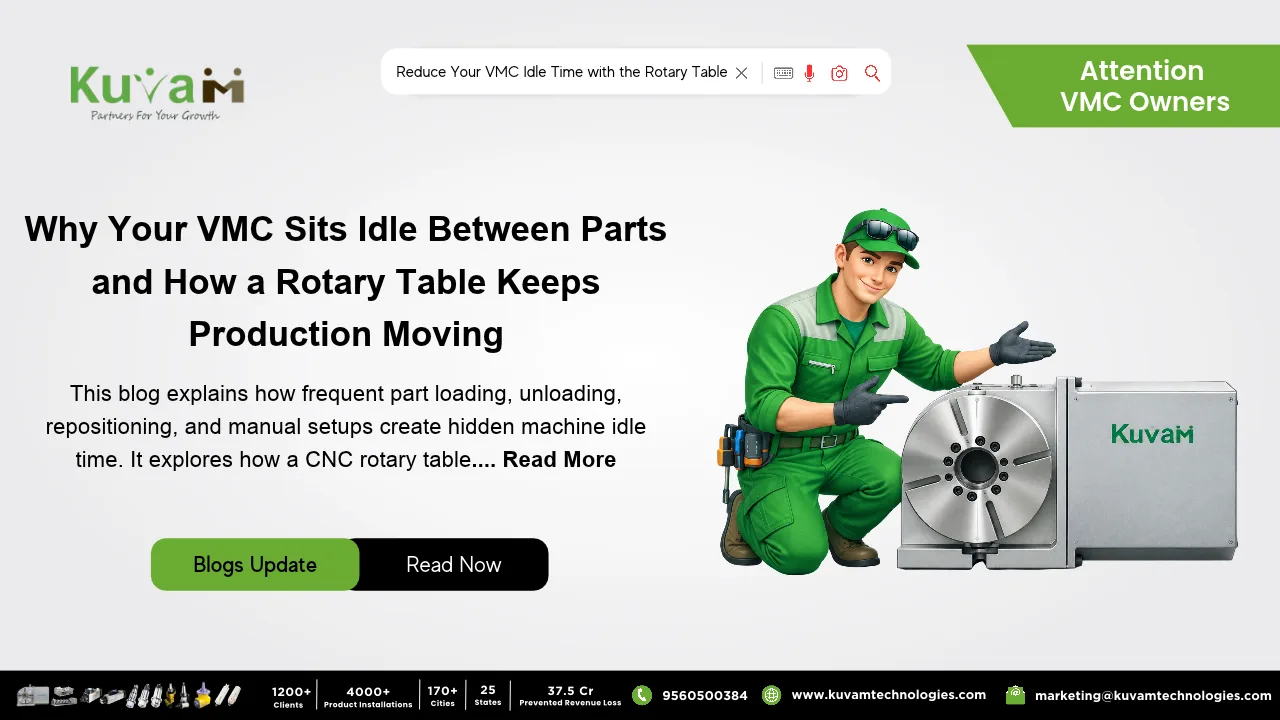
A Rotary Table is a precision workholding device that bolts onto the bed of a milling machine or machining centre and introduces a controlled, accurate rotational axis for the workpiece. The part is clamped to the table’s circular surface, centred on the rotational axis, and advanced to each required angular position by turning a handwheel connected to an internal worm and worm gear drive typically operating at a 40:1 or 90:1 gear ratio. This mechanism converts each handwheel increment into a precise, repeatable angular movement, readable to arc-minute accuracy from a graduated dial and vernier scale on the table body.
At each position, a clamping system locks the table completely rigid before the cut begins. The result is a positioning process that is mechanical, absolute, and consistent not dependent on calculation, not sensitive to operator fatigue, and not variable from part to part or shift to shift.
| CONFIGURATIONS AVAILABLE Manual Rotary Tables are the most versatile starting point, handling varied angular work across different component types without requiring integration into the machine control system. Motorized variants add servo-driven speed for production environments where the same angular sequence repeats across large batches. CNC-integrated models function as a programmable fourth axis, enabling helical interpolation, continuous arc profiling, and cam surface generation. Tilting models extend the range further with a compound angular axis for work requiring positioning in more than one rotational plane. |
| 90:1 Maximum worm gear ratio — delivering the finest arc-minute angular resolution | 4× Faster angular feature positioning versus manual coordinate calculation methods | ±0.5′ Arc-minute positional accuracy on precision manual Rotary Table models |
What Changes When the Hidden Cost Disappears
The most immediate effect when a Rotary Table enters the workflow for angular components is the disappearance of the verification loop. When angular position is read from a mechanical dial rather than calculated and estimated, the operator does not need to verify before cutting the dial is the verification. Setup sequences that previously involved calculation, physical repositioning, re-check, and occasional re-do collapse into a simple rotation to the required reading. The time saving per feature is modest. The time saving across a production week is not.
The second effect is on rework. Mechanical positioning delivers the same angular reference to every part in the batch, regardless of where that part falls in the sequence. The drift that previously appeared midway through a long run as manual repositioning accumulated small errors disappears because there is no longer any manual repositioning to accumulate them. First-pass inspection rates rise. Rework scheduling simplifies. The jobs that used to quietly absorb extra hours start finishing on time.
The third effect is perhaps the most human one: the reduction in cognitive load on the machinist. An operator who no longer has to carry the mental overhead of angular coordinate calculation across a full shift is an operator whose attention is fully available for the aspects of machining that genuinely require skill reading the cut, interpreting tool wear, catching the small signals that no instrument measures. That is not a soft benefit. It is a direct contribution to the quality of every part that leaves the machine.
The hidden cost of poor angular precision is real, it is ongoing, and it is recoverable. The Rotary Table is how production floors stop paying it and start keeping what the work was always worth.
The most valuable improvements on a production floor are not always the loudest ones. Sometimes the biggest gain comes from finally giving a quiet, chronic problem the precise mechanical answer it has always needed.