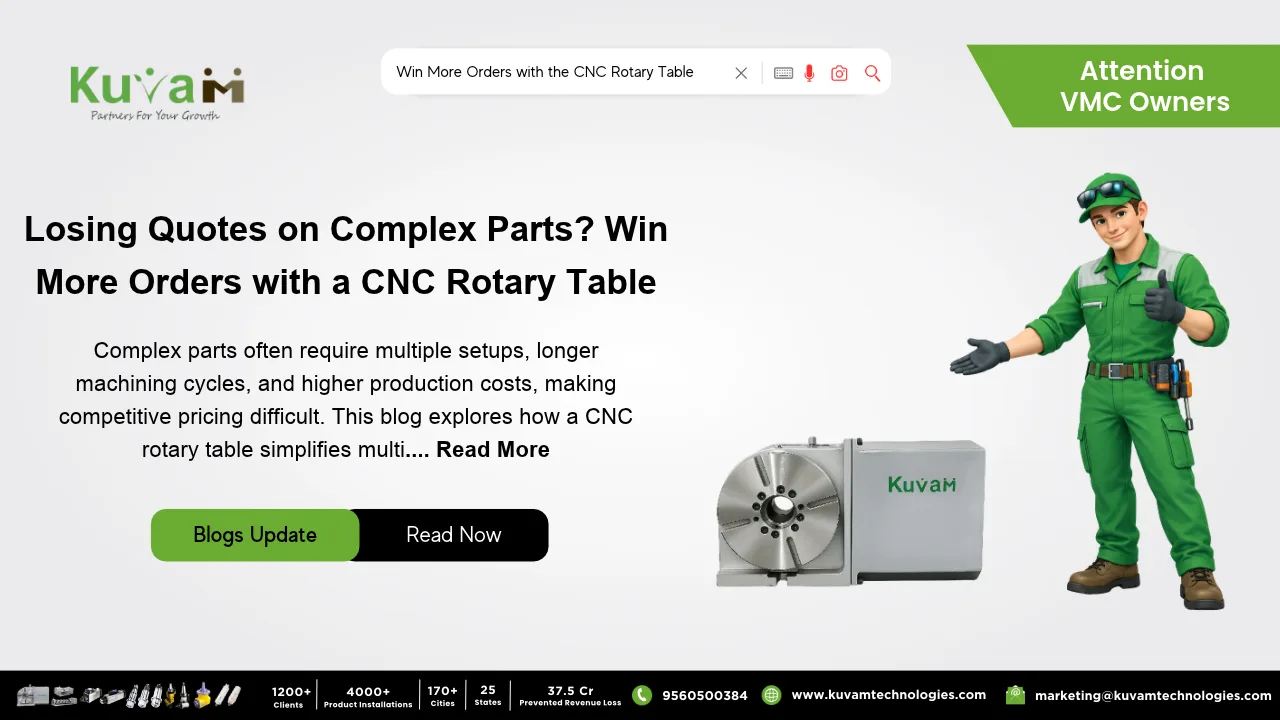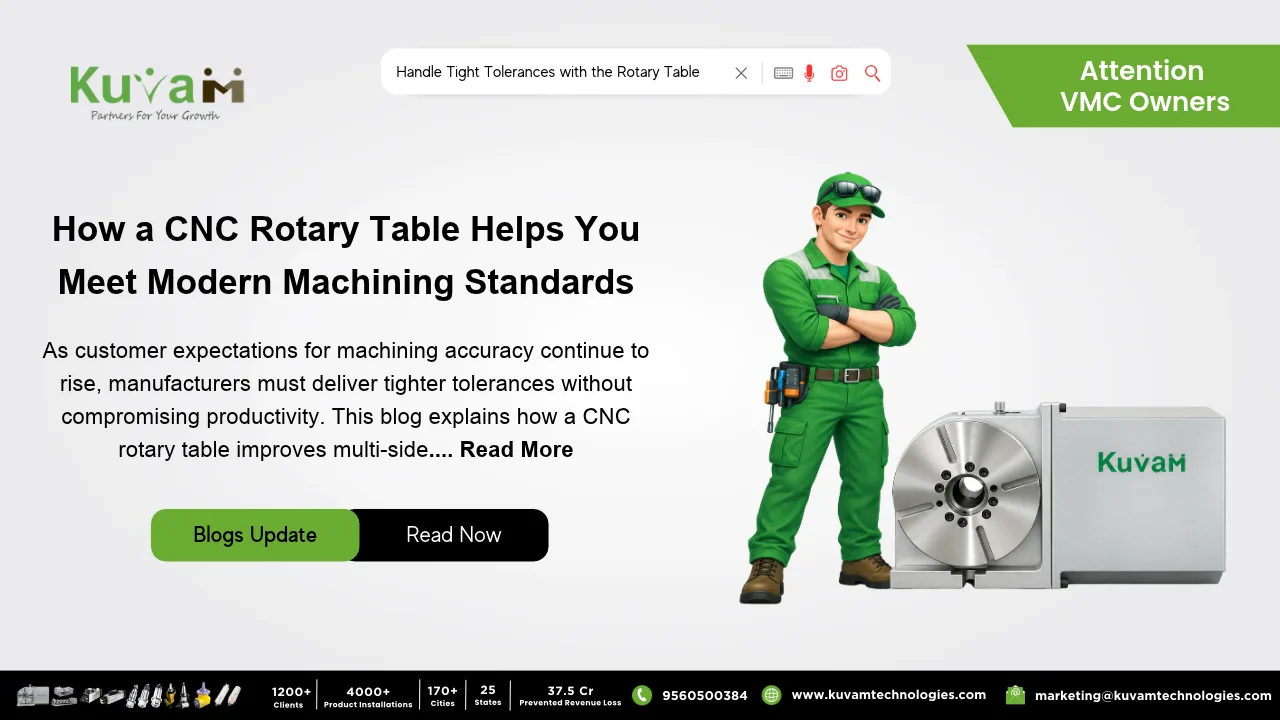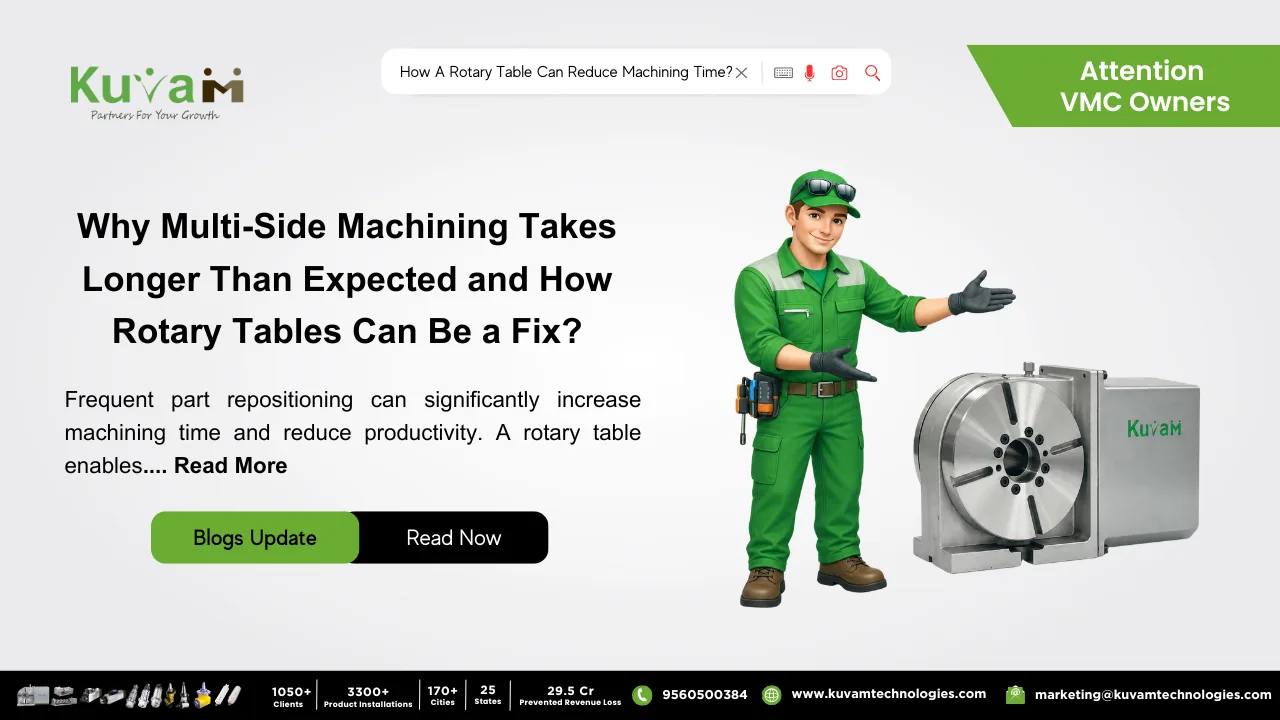

Every time a component leaves the machine table between operations, time disappears and accuracy suffers. A Rotary Table for multi-side machining is how the best shops are ending that cycle permanently.
There is a number that most production managers never consciously track but feel every single week: the total time their team spends not machining. Moving parts. Unclamping them. Re-orienting them. Clamping them again. Re-indicating to a new datum. Running a check cut. Deciding the position is good enough. Starting the operation. And then doing it all again for the next face of the same component.
For multi-side machining components that need features on more than one face, at more than one angle, from more than one approach direction this non-machining overhead is enormous. Industry data from 2026 consistently shows that part handling accounts for 40–70% of total production time on multi-face components in conventional machining cells. That is not time lost to poor skills or bad equipment. It is time built into the way the setup works and the only way to recover it is to change the setup.
That is precisely what a Rotary Table for multi-side machining does. It does not make the cuts faster. It eliminates the moves between them.
| FEATURED ANSWER: WHAT IS A ROTARY TABLE FOR MULTI-SIDE MACHINING? A Rotary Table for multi-side machining is a precision workholding device that mounts on a milling machine and rotates the workpiece to any angular position without unclamping it. It allows multiple faces and angular features to be machined in a single setup eliminating manual part transfers, reducing handling time by up to 70%, and improving dimensional consistency across all features machined in the same clamping. |
Why Multi-Side Machining Is Where Production Time Goes to Disappear?
A component that needs drilling on one face, milling on a second, and tapping on a third is not three jobs it is one job with three setups. In a conventional machining environment, each transition between setups carries a fixed overhead that cannot be compressed: unclamp, reposition, re-clamp, re-indicate, verify, cut. For a component with four faces, that overhead happens four times. For a batch of fifty components, it happens two hundred times.
⚠️ THE REAL COST OF MULTI-SETUP PRODUCTION: In a 2026 survey of machine shop production data, facilities running multi-face components without rotary workholding reported average non-cutting time per part of 18–35 minutes. At 200 parts per week, that represents 60–120 hours of pure overhead time that does not appear in the cutting cycle report but absolutely appears in the cost-per-part number and the delivery schedule.
The operational consequence is twofold. First, the schedule stretches. Jobs that should take two hours take five. Delivery promises that were achievable become difficult, then routine excuses. Second, quality suffers at every transition. Each re-clamping introduces a positional uncertainty a small shift in the datum that may be within tolerance in isolation but compounds across three or four setups into a feature-to-feature relationship error that the customer’s CMM will find every time.
The machine is not the bottleneck in multi-side production. The setup is. And a Rotary Table removes the setup from between the cuts, so the machine can do what it was built to do: run.
What a Rotary Table Is and How It Solves Multi-Side Production
A Rotary Table is a precision circular worktable that mounts on the bed of a milling machine via standard T-slots. The workpiece is clamped once on the table’s top face. To machine a second feature at a different angular orientation, the operator turns a handwheel that drives the table through a worm and worm gear mechanism, precisely advancing the workpiece to the required angle. The graduated dial and vernier scale on the table body show the exact position in degrees and arc minutes. A locking system clamps the table completely rigid for cutting.
The result is a workpiece that can be rotated to any angular position between operations without being unclamped, moved, or re-indicated. Multiple faces. Multiple angular positions. Multiple operations. One clamping. The part does not move from the setup until every feature is complete. The datum never shifts. And the time that previously lived in the transitions simply disappears.
The Measurable Gains Manufacturers Report After Switching
| 70% Reduction in part handling time on multi-face components | 1 Clamping for all operations — no re-indication between faces | 40% Typical improvement in first-pass inspection rates | ±30″ Arc-second angular accuracy on precision Rotary Tables |
Key Benefits of Using a Rotary Table for Multi-Side Machining
| ✓ Single-setup completion — Features on multiple faces machined without unclamping, eliminating the primary source of inter-feature positional error |
| ✓ Zero re-indication overhead — The part never leaves the datum established at load, removing the most time-consuming step in multi-face production |
| ✓ Consistent inter-feature geometry — All features share a single reference point, so positional relationships between faces are governed by the table’s mechanical accuracy, not by the consistency of re-clamping |
| ✓ Machine compatibility — Mounts on any milling machine via standard T-slots; CNC-integrated models add a programmable 4th axis with no machine modification required |
| ✓ Scalable across volumes — Manual models for job shops; motorised for medium-volume runs; CNC-integrated for full production automation |
Which Applications and Industries Benefit Most?
| Pump & valve bodies Port faces, mounting flanges, and angular drillings machined from a single clamping eliminating 3–4 separate setups per component. | Gearbox housings Bearing bores, cover faces, and oil port drillings at multiple angular orientations completed without machine transfer. |
| Aerospace structural parts Oblique fastener holes and multi-face features on brackets and housings reached from one setup meeting tight positional tolerances reliably. | Medical implants Multi-face features on bone-interface implants and instrument bodies machined to medical-grade dimensional consistency in a single clamping. |
Manual vs CNC Rotary Table: Matching the Tool to Your Volume
Manual Rotary Tables are the most widely used starting point. The operator sets each angular position by handwheel, reads the position from a graduated dial, and locks the table for cutting. Affordable, versatile, and compatible with any milling machine ideal for job shops where component types vary and setup flexibility is the priority.
CNC-integrated Rotary Tables connect to the machine’s control system as a programmable fourth axis. Angular positions are defined in G-code and driven automatically by the servo system, with encoder feedback confirming each position before the cut is made. Leading manufacturers including SilverCNC and Haas have released new CNC Rotary Table models in 2026 specifically designed to expand multi-axis machining capabilities without the cost of a full five-axis machine making the 4th axis upgrade more accessible than ever for mid-size facilities.
| The time your multi-face jobs are losing is not hiding in the cuts. It is hiding in the moves between them. A Rotary Table is how manufacturers make those moves disappear and start delivering multi-side components at the cost and schedule that the work was always capable of. |