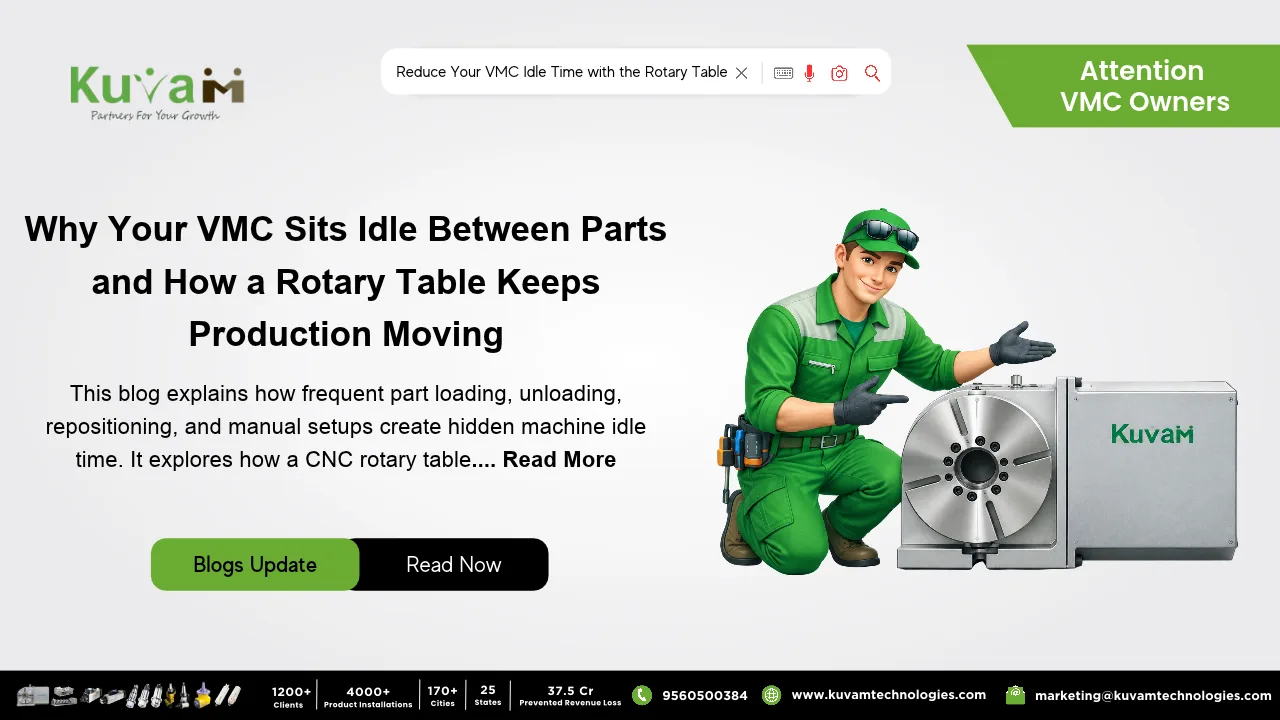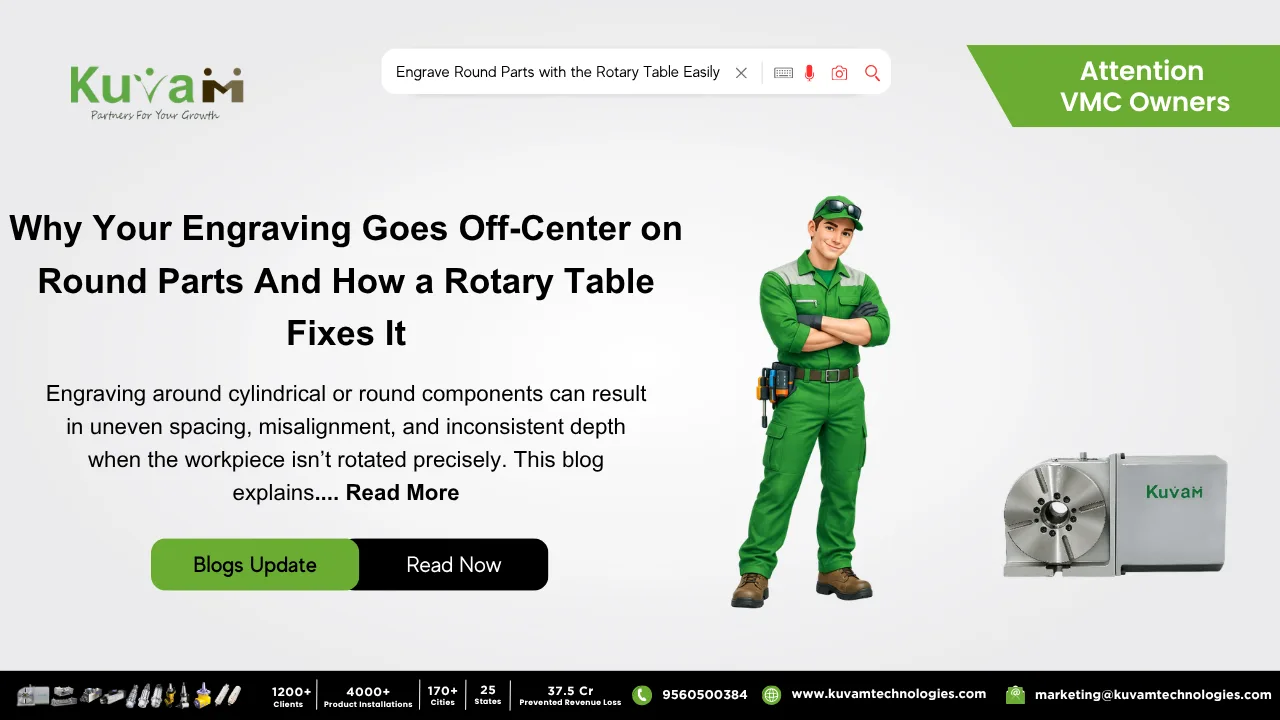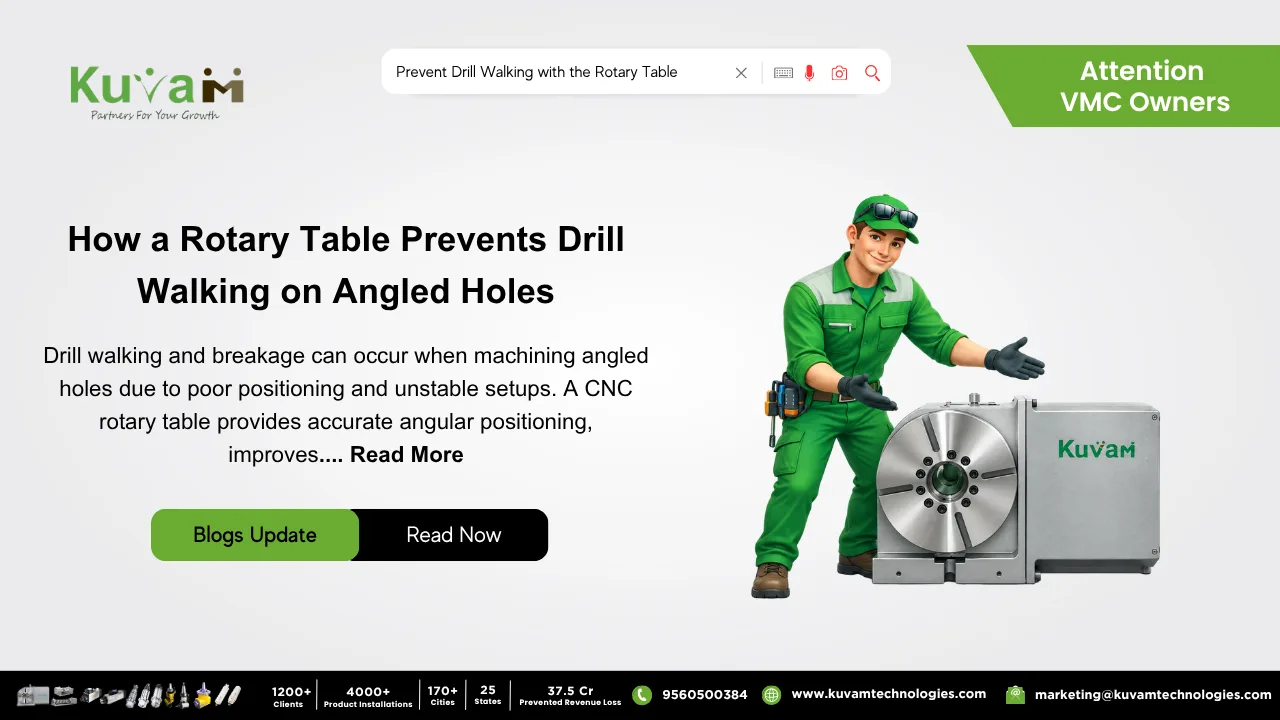

The Rotary Table easily reduces setup time. Most manufacturers focus on cutting speed to reduce costs. But the real savings — the ones that show up on the bottom line are hiding in setup time. And a Rotary Table is where that time goes.
Here is a scenario that most production managers will recognise instantly. A machinist arrives at the job. The part drawing shows a set of holes drilled evenly around a circular flange, or a housing with features milled at equal angular intervals. Simple work for an experienced operator. And yet the setup stretches to forty minutes. An hour. Sometimes longer.
Why? Because every angular position has to be calculated, marked, set by hand, checked, and adjusted. The machine is sitting idle through all of it. The operator’s skill is being used on administration, not machining. And somewhere in the background, the cost-per-part number is quietly climbing past where the quote assumed it would land.
This is one of the most widespread and underreported cost problems in precision manufacturing. It does not come from poor workmanship or worn tooling or an underperforming machine. It comes from the absence of one specific tool a Rotary Table and the manual workaround that fills its place.
⭐ Featured Answer – What is a Rotary Table?
A Rotary Table is a precision workholding device mounted on a milling machine or machining centre that rotates a workpiece to exact angular positions between cuts. It uses a worm and gear mechanism to deliver repeatable angular positioning to arc-minute accuracy, eliminating manual calculation and repositioning. The result is faster setups, more accurate parts, and lower cost per component on any job involving circular or angular features.
Why Setup Time Is Costing You More Than You Think?
In a conventional machining cell, setup time for a component with circular or angular features is largely non-productive. The machinist works through a process of calculating coordinates, positioning the workpiece by hand, checking with instruments, making adjustments, and re-checking. For a part with six equally spaced holes, this might happen six times. For a component with twelve angular faces, twelve times.
Each iteration takes time. But more importantly, each iteration involves human estimation and human estimation in angular positioning is never perfectly consistent. The first hole might land within 0.05mm of its target. By hole six, drift has accumulated. The part either scrapes on inspection or gets sent to rework. Either way, the cost of that setup has now doubled.
Setup time on angular work is not just a scheduling problem. It is a quality problem and a cost problem all three at once. A Rotary Table solves all three with the same mechanism, at the same moment, on every single part.
How a Rotary Table Reduces Setup Time Without Sacrificing Accuracy?
A Rotary Table replaces the manual angular positioning sequence with a single, mechanically controlled action. The workpiece is clamped once on the table’s circular face. The operator rotates the table’s handwheel to advance the part to the first required angular position reading the exact angle from a precision graduated dial and vernier scale on the table body. The table locks rigid. The cut is made. The operator unlocks, rotates to the next position, locks, and cuts again.
No coordinate calculation. No protractor. No repeated checking and adjusting. The angular position is defined by the table’s worm gear mechanism and the same gear ratio on part one as on part one hundred. The setup for a six-hole bolt circle that previously took forty minutes typically takes under ten minutes with a Rotary Table properly integrated into the workflow.
What a Rotary Table Can Machine – A Practical Checklist?
✓Bolt hole circles— Equally spaced holes drilled around flanges, covers, and pipe fittings at precise angular intervals
✓Equispaced milled faces— Flat faces machined at set angles on hexagonal features, couplings, and shaft ends
✓Circular arc slots— Curved slots and grooves milled along a circular path — cam grooves, curved keyways, and radial relief features
✓Radially arranged drillings— Holes drilled radially into pump housings, valve bodies, and bearing housings from a single clamping
✓Gear tooth indexing— Tooth spacing on gears, sprockets, and ratchet wheels machined with repeatable angular accuracy
✓Continuous arc profiling— Curved profiles and contoured surfaces milled along a radius when paired with CNC control
Which Industries Benefit Most from Rotary Table Machining?
Automotive Manufacturing
Engine housings, brake components, gearbox covers, all need precise bolt patterns and angular features machined consistently at volume.
Hydraulic & Pneumatic
Valve bodies and manifold blocks with radially arranged ports and equispaced face features are ideal Rotary Table applications at any batch size.
Aerospace & Defence
Precision brackets, housings, and structural components where angular tolerance is tight and first-pass inspection rates are business-critical.
General Job Shops
The broadest application — any shop regularly quoting flanges, couplings, and multi-face components gains immediate setup time advantage.
Manual, Motorised, or CNC Rotary Table — Which One Is Right for You?
Choosing the right Rotary Table configuration depends on your production volume and workflow. Manual Rotary Tables are the most widely used — affordable, versatile, and suited to varied job shop work where the operator sets each position by handwheel. Motorised Rotary Tables add servo-driven positioning for faster, more repeatable setup on longer production runs. CNC-integrated Rotary Tables interface directly with the machine control, functioning as a programmable fourth axis enabling continuous arc milling, helical interpolation, and compound angular cycles without any manual positioning step at all.
In each configuration, the core benefit is the same: angular position is mechanically defined, not manually estimated. The time saved, the quality gained, and the cost reduced all follow directly from that single difference.
Setup time is the cost your cost report never quite captures. A Rotary Table is how manufacturers stop paying it and start putting that time back where it belongs: in productive cuts, consistent quality, and parts that ship on time.