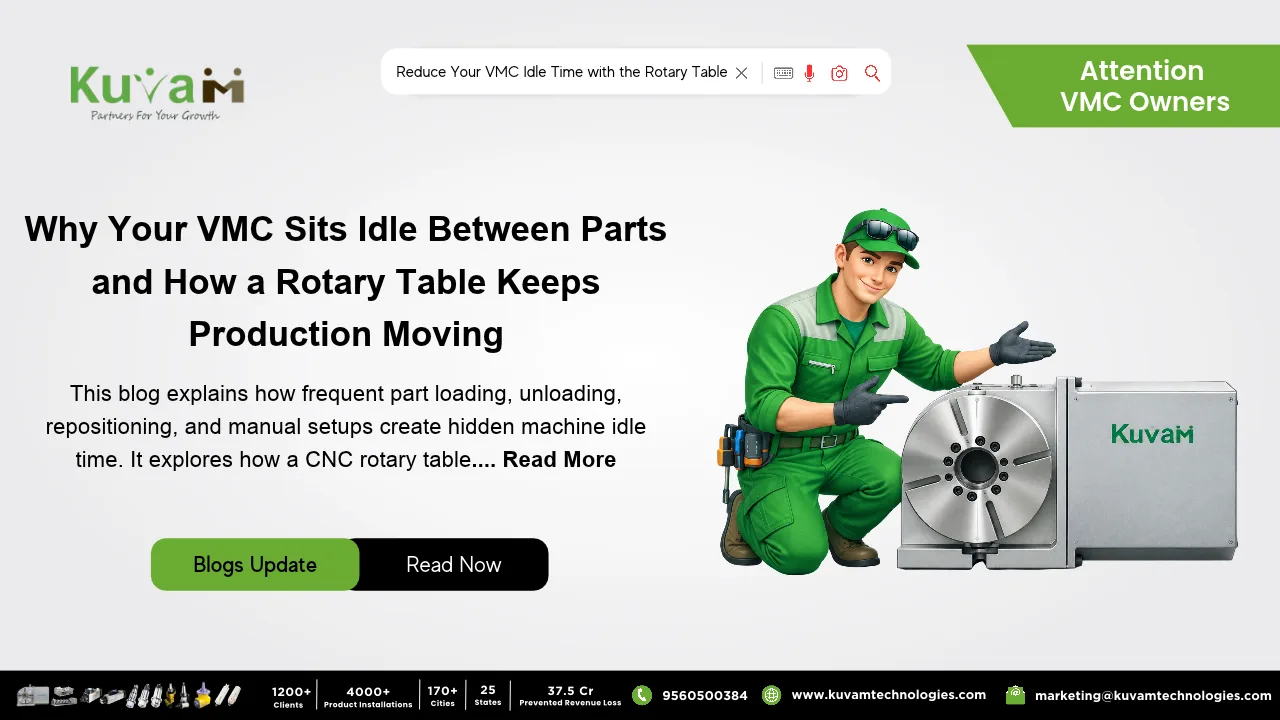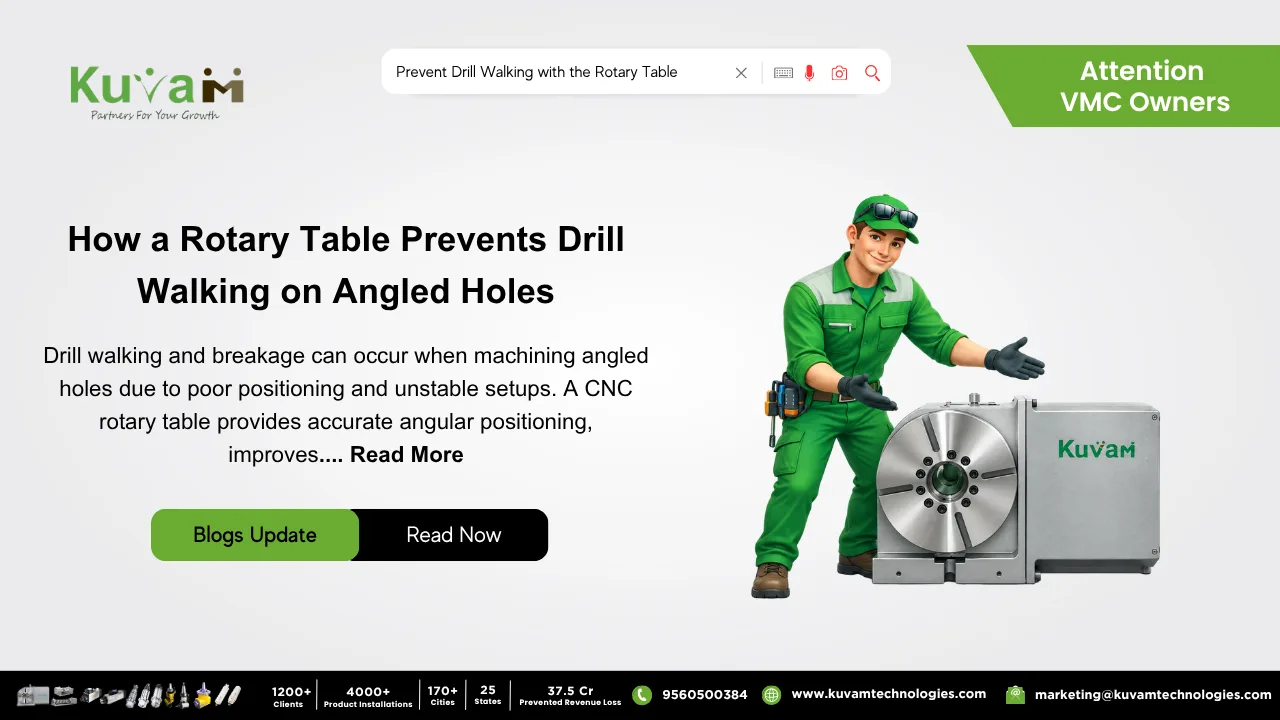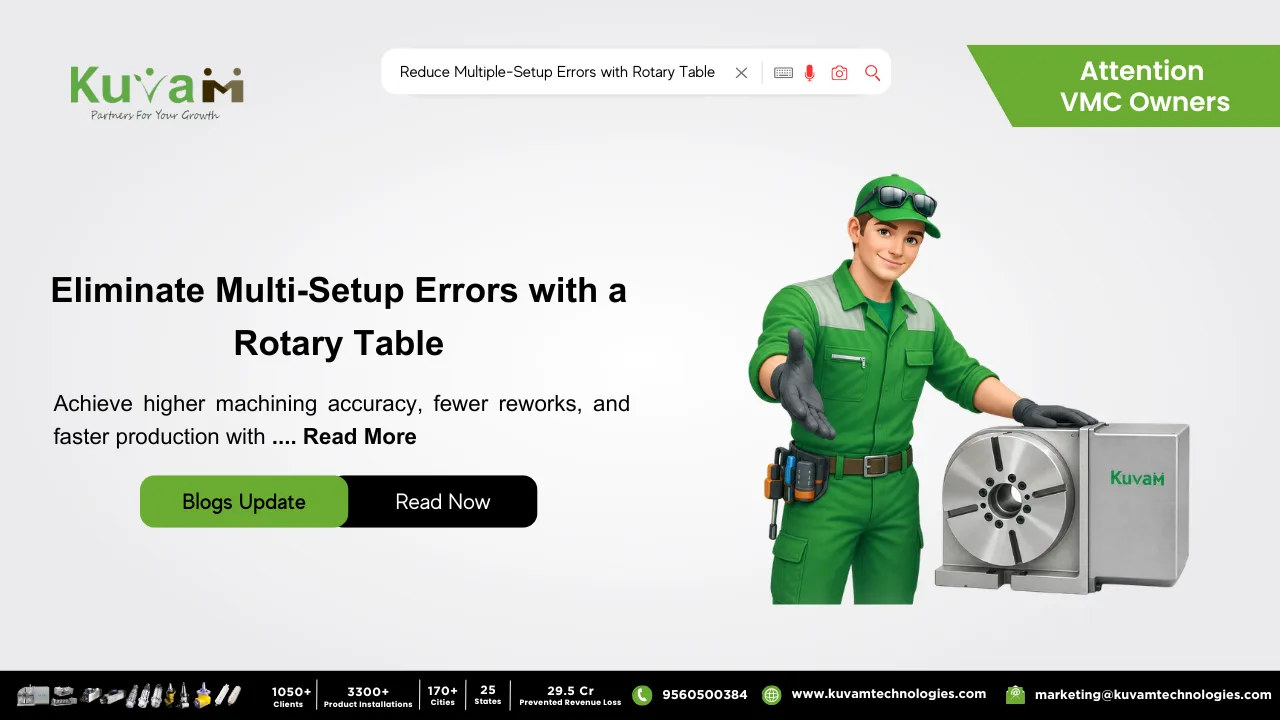

The rotary table is known for eliminating multiple-setup errors. Manufacturing technology has evolved significantly over the last decade. CNC machines have become faster, smarter, and more accurate than ever before. Yet many manufacturers continue to face a surprisingly common challenge: multi-setup machining errors.
If your operators regularly remove, reposition, and re-clamp components during production, you may already be experiencing the hidden costs associated with multiple setups.
These costs often appear in the form of:
• Increased machining time
• Alignment errors
• Higher rejection rates
• Inconsistent quality
• Delayed deliveries
• Reduced machine utilization
The frustrating part is that these issues often occur even when the machine itself is performing perfectly.
The real problem lies in the process.
This is where a Rotary Table can make a significant difference.
What is a Rotary Table?
A Rotary Table is a precision positioning device used with CNC machines such as Vertical Machining Centers (VMCs) and Horizontal Machining Centers (HMCs).
It allows the workpiece to rotate accurately around an axis, enabling machining on multiple faces without manually repositioning the component.
Instead of removing the part after every operation, the it automatically indexes the workpiece to the required angle.
This transforms a standard machining center into a more versatile and productive system capable of handling complex components efficiently.
Why Multi-Setup Machining Creates Production Challenges?
Imagine machining a component that requires operations on four different sides.
Without a Rotary Table, the process typically looks like this:
1. Machine one face
2. Stop the machine
3. Unclamp the part
4. Reposition the component
5. Align and re-clamp
6. Repeat the process
While this may seem manageable, each setup introduces the possibility of:
• Human error
• Misalignment
• Inconsistent positioning
• Additional inspection requirements
Even a slight variation can impact dimensional accuracy and final product quality.
Over hundreds or thousands of components, these small deviations become expensive.
7 Powerful Ways a Rotary Table Improves Production
1. Eliminates Repeated Setups
One of the biggest advantages of a Rotary Table is reducing the number of setups required.
Instead of repositioning the component multiple times, it rotates it automatically.
Benefits:
• Reduced setup time
• Faster production cycles
• Improved operator efficiency
2. Improves Machining Accuracy
Accuracy is critical in industries such as automotive, aerospace, and precision engineering.
A Rotary Table maintains a consistent reference point throughout the machining process.
Benefits:
• Better dimensional accuracy
• Reduced tolerance variation
• Improved repeatability
When the workpiece remains fixed, positioning errors are significantly reduced.
3. Reduces Part Rejection
Every rejected component represents lost time, material, and labor.
It helps maintain alignment throughout production, reducing the risk of machining errors.
Benefits:
• Fewer rejected parts
• Reduced rework costs
• Better customer satisfaction
4. Increases Machine Productivity
A machine that spends less time on setup spends more time cutting.
By reducing manual intervention, a Rotary Table helps maximize spindle utilization.
Benefits:
• Higher output
• Better machine efficiency
• Improved return on investment
5. Simplifies Complex Machining Operations
Many modern components require machining from multiple angles.
A Rotary Table allows manufacturers to machine holes, slots, pockets, and contours on multiple faces without moving the component manually.
Benefits:
• Easier production planning
• Reduced process complexity
• Greater flexibility
6. Enhances Consistency Across Production Batches
Consistency is one of the most important factors in high-volume manufacturing.
A Rotary Table ensures each component is positioned identically during every cycle.
Benefits:
• Uniform product quality
• Reliable production performance
• Reduced inspection effort
7. Supports Automation and Industry 4.0 Initiatives
Manufacturers are increasingly investing in automation to remain competitive.
A Rotary Table integrates seamlessly with modern CNC systems and automated workflows.
Benefits:
• Reduced labor dependency
• Improved production scalability
• Better process control
This makes the Rotary Table an excellent solution for manufacturers preparing for future growth.
Industries That Benefit from a Rotary Table
Automotive Industry
• Gear housings
• Transmission components
• Engine parts
Aerospace Industry
• Structural components
• Precision-machined parts
General Engineering
• Multi-face components
• Complex machined assemblies
Tool and Die Industry
• Molds
• Dies
• Fixtures
Wherever precision and productivity are critical, a Rotary Table delivers measurable value.
How to Choose the Right Rotary Table?
Not all Rotary Tables are the same.
Before investing, manufacturers should consider:
• Component Size
• Accuracy Requirements
• Production Volume
• Machine Compatibility
• Future Expansion
Conclusion
Modern manufacturing demands more than just fast machines. It requires processes that minimize errors, maximize efficiency, and deliver consistent quality.
It helps manufacturers achieve exactly that.
By eliminating repeated setups, improving accuracy, reducing rejection rates, and increasing machine productivity, it becomes a powerful asset for any CNC machining operation.
If your production team is spending too much time repositioning parts, correcting alignment issues, or managing inconsistent quality, it may be time to rethink your process.
The question is no longer whether your machine is capable enough.
The real question is: Are you giving your machine the Rotary Table it needs to perform at its full potential?