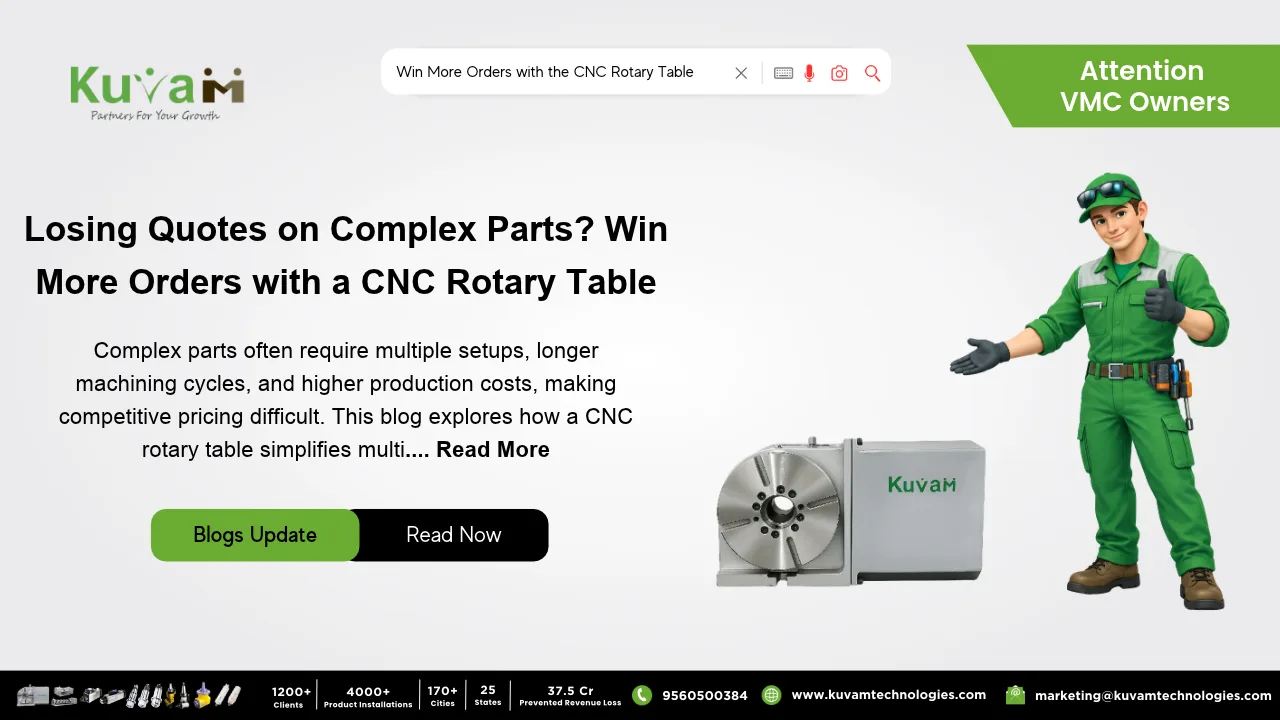

The Rotary Table is a master at handling complex parts. Every shop knows the feeling. You send a quote on a part with features on three different faces, and a week later the customer says they went with someone else. Not because your quality is worse, and not because your lead time is longer. Your price was simply higher than the next shops, and on a competitive job, that’s often all it takes.
It’s tempting to blame the market, or assume the other shop is cutting corners. Sometimes they are. But more often, a competitor is quoting lower because the part simply costs them less to make, and a big piece of that difference hides in a place most quotes barely look at: the time spent handling the part between operations.
Where the Cost of a Complex Part Really Comes From
When a shop quotes a part, the machining time is easy to estimate. The program is known, the cut times are predictable, and the number comes out clean. What’s harder to pin down is everything else: loading the part, unclamping it, flipping it, re-checking its position, clamping it again, and doing all of that for every extra face.
On a simple one-sided part, that handling is a small slice of the total. On a part with three faces, it can be as large as the cutting itself, sometimes larger. And since machine time and labour are both billed by the hour, every minute spent repositioning is a minute added to the price the customer sees.
Two shops can run identical programs on identical machines and still end up with noticeably different quotes, simply because one of them spends less time moving the part around.
What a Rotary Table Does to That Number
A Rotary Table is a work holding device that mounts on a mill or machining centre and rotates the part around a fixed point. Instead of unclamping a part to reach a new face, the part stays clamped while the table turns it to the next position. A manual version uses a handwheel and a marked dial, and a CNC version rotates automatically as part of the program.
The effect on the quote is direct. Where a three-faced part used to need three separate setups, a rotary table can often handle all three in one. That removes most of the unclamping, flipping, and re-indicating from the job, which means less labour and less machine time per part, and a lower number at the bottom of the quote.
A Simple Example with Real Numbers
Take a bracket that takes six minutes to machine and needs work on three faces. Done with manual flips, suppose each repositioning costs about three minutes, so two flips add six minutes of handling. That’s a twelve-minute job, and half of it is the part being moved around rather than cut.
Now put the same bracket on a rotary table. The part is clamped once, and the table turns it to each face. Handling drops to roughly one load and one unload, perhaps two minutes in total. The same bracket now takes about eight minutes instead of twelve.
Those figures are only an illustration, and the real numbers will depend on the part and the shop. But the pattern holds: cutting a third of the time per part, across a run of a few hundred pieces, adds up to hours of saved machine time and labour. That’s room to lower the price, protect the margin, or both.
Why This Matters Beyond a Single Quote
A shop with a Rotary Table can quote a little lower on complex parts and win a little more of them. Over a year, that can change the mix of work on the floor, with more of the profitable multi-face jobs and fewer left to competitors.
It also changes how confident a shop can be when quoting. Handling time that used to be a rough guess becomes more predictable when the part is clamped once, and a predictable cost is easier to price sharply without worrying about losing money on the job.
Quality Helps the Price Too
There’s another quiet saving that doesn’t show up in the quote but shows up in the profit. Every extra reclamping is a chance for a part to settle slightly differently and end up scrapped or reworked. A rotary table keeps the part in one fixture, so fewer parts fail inspection, and fewer parts failing means less material and machine time thrown away on the way to a good order.
Things Worth Checking Before You Buy
Match the table’s size and load rating to the parts you actually run, and choose between manual and CNC based on volume. A manual rotary table is a sensible, low-cost start for smaller runs, while a CNC version pays back faster when the same job repeats often. Confirm your machine’s control can drive an extra axis before you commit.
Worth a Look Before the Next Quote Goes Out
If you’ve been losing quotes on multi-face parts, it’s worth sitting down with one of those jobs and tracking how much time actually goes into handling rather than cutting. For many shops, the answer is a surprise, and a rotary table is one of the more affordable ways to bring that number down and put a sharper price on the next quote.