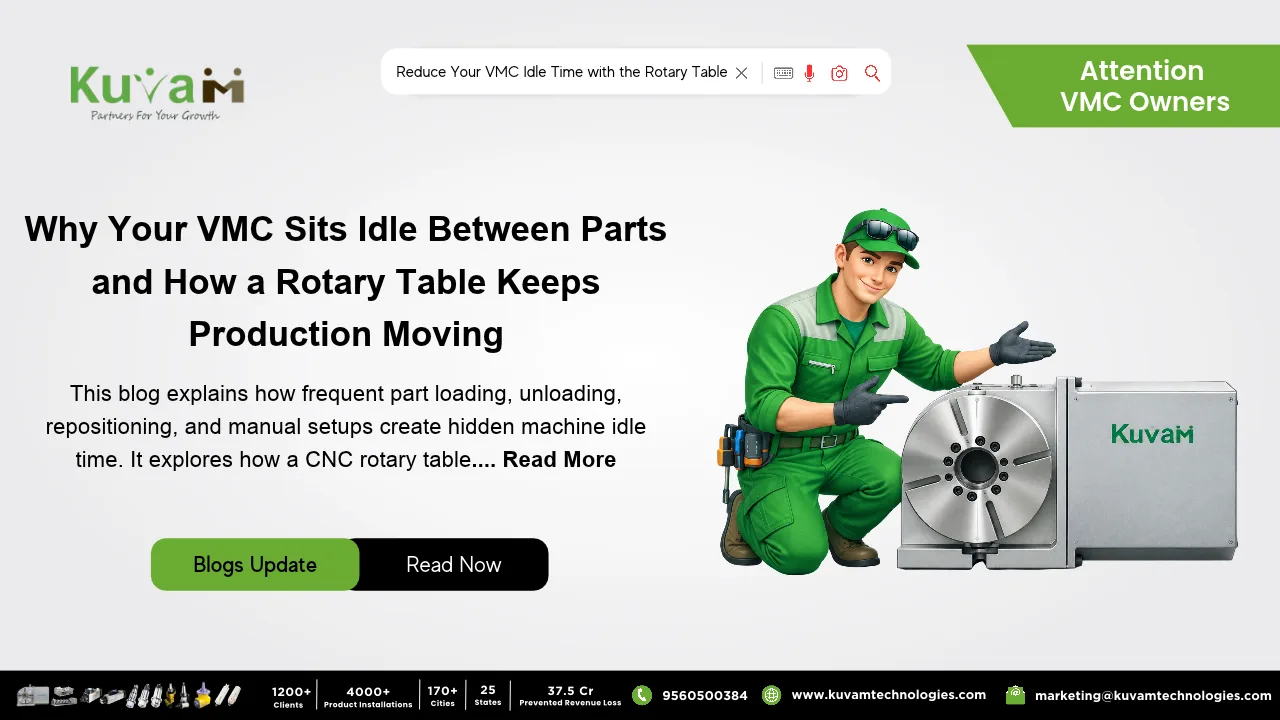

The Rotary Table is the best option for handling tight tolerances. Somewhere in the last few years, the drawings started changing. A tolerance that used to read plus or minus five thousandths now reads plus or minus two. A hole position that nobody questioned a decade ago now has a note beside it asking for tighter control. Customers aren’t being difficult. Their own products are getting more precise, and the parts that go into them have to keep up.
For a machine shop, that creates a quiet kind of pressure. The same machines, the same operators, and the same processes that handled the old tolerances comfortably are now being asked to do something a little harder. And the first place that pressure shows up usually isn’t the cutting. It’s everything that happens between cuts.
Where Tight Tolerances Actually Get Lost
Most shops assume tolerance problems come from the machine itself, so the first instinct is to check the spindle, the tooling, or the program. Sometimes that’s the cause. But on parts with features on more than one face, a big share of lost accuracy happens somewhere much less glamorous: the moment the part comes out of the vise and goes back in. But, this can be easily stopped with a Rotary Table.
Every time a part is unclamped, turned, and clamped again, it never lands in exactly the same spot. The difference might be tiny, a thousandth here, a couple of thousandths there. With a loose tolerance, nobody notices. With a tight one, that small shift can be the entire margin, and a part that looked perfect on the machine fails at inspection because its second face is slightly off from its first.
Why Better Machines Don’t Always Fix It
It’s tempting to think the answer is more expensive equipment. A more accurate machine does help, but it can’t fix an error that happens outside the machine’s control. If a part shifts by two thousandths when it’s re-clamped, the most precise spindle in the world will faithfully cut the next feature in the wrong place, perfectly.
That’s why some shops spend a lot of money upgrading machines and still see the same multi-face tolerance problems. The weak link was never the cutting. It was the handoff between one setup and the next, which is exactly where a rotary table earns its place.
What a Rotary Table Actually Does
A Rotary Table is a work holding device that mounts on a mill or machining centre and rotates the part around a fixed point. Instead of unclamping a part to reach a new face, the part stays clamped in place while the table turns it to the next position. A manual version turns with a handwheel and a marked dial. A CNC version is controlled directly by the machine’s program and indexes automatically.
The important part for tolerances is what doesn’t happen. The part never leaves its fixture, so there’s no reclamping, no re-indicating, and no chance for it to settle slightly differently the second time. Every feature gets cut from the same reference point, which means the relationship between them depends on the table’s accuracy, not on how carefully someone repositioned the part.
Why This Changes What a Shop Can Promise
Holding a tight tolerance on a single face is one thing. Holding it between features on different faces is where most shops start to hedge. A Rotary Table makes that second kind of promise much easier to keep, because the biggest source of face-to-face variation has been removed from the process.
That has a real business effect. Shops that can reliably hold tighter multi-face tolerances can quote work that competitors quietly decline, and they tend to waste less time on parts that fail inspection and need to be rerun. Over a year, that adds up to more accepted jobs and less scrap, without any change to the machine itself.
What This Looks Like on a Real Part
Imagine a bracket with two mounting holes on the front face and two on the side, and the print calls for the hole patterns to relate to each other within two thousandths. Machined with a flip in the vise, that relationship depends on how precisely the part was reseated, and some parts will pass while others sit right at the edge of the limit. Machined on a rotary table, the part stays clamped while the table turns it ninety degrees, and the relationship between the two patterns comes from the table’s index instead of a second setup. Part after part, the result stays consistent.
A Quick Word on Choosing the Right Table
Not every rotary table delivers the same accuracy, so for tight-tolerance work it’s worth checking the indexing accuracy and repeatability in the specifications. A well-made table with low backlash holds its position reliably, while a worn one can quietly bring back the variation you were trying to remove. Keep it clean and checked, since a precision tool only stays precise if it’s looked after.
Worth Asking Before the Next Tight Drawing Arrives
If your shop has started seeing tolerances shrink on multi-face parts, it’s worth looking closely at where the accuracy is actually being lost before spending on new equipment. For many shops, it turns out to be the repositioning step, and a rotary table is one of the most direct, affordable ways to take that variable out of the process and keep up with what customers are asking for.