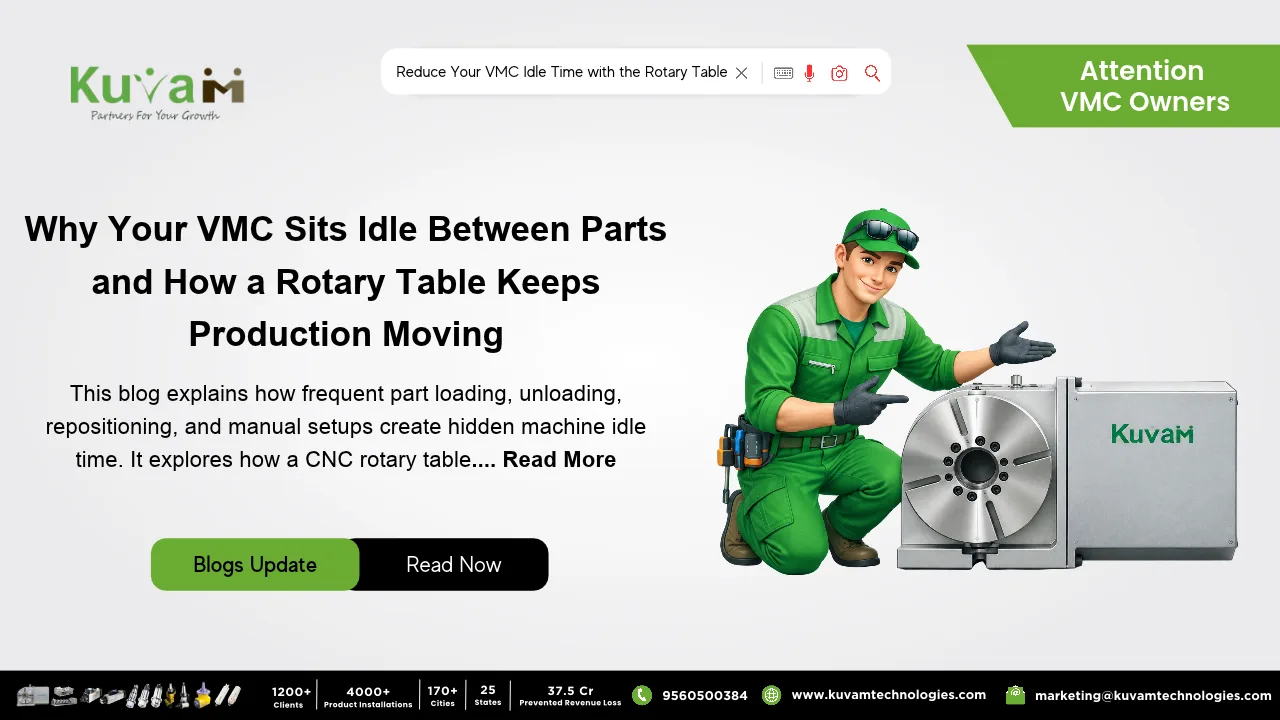

The Rotary Table is known for reducing machine idle time. Watch a machine running small parts for an hour, and you’ll notice something odd. The cutting itself is quick. A few seconds, maybe a minute. Then the door opens, the operator pulls out the finished part, wipes down the vise, loads the next blank, tightens it, closes the door, and hits start. The spindle spent a fraction of that time actually cutting. The rest was waiting for a person to swap parts.
This is one of the most common and least-discussed time drains on a shop floor. Nobody thinks of it as a problem because it feels like part of the job. But when the cutting takes forty seconds and the loading takes sixty, the machine is sitting idle more than it’s working, and that’s a costly way to run expensive equipment. A rotary table is one of the simplest ways to fix it.
Why Small Parts Make This Worse
With a large, complex part, the loading time is a small slice of a long cycle. With a small, simple part, it flips around. The faster the machining, the bigger the share of the day that goes to loading, unloading, and clamping. A shop running hundreds of small brackets, pins, or fittings can end up with a machine that spends most of its shift waiting, even though the program itself is quick and efficient.
Shops usually respond by hurrying the operator, which helps a little and burns people out a lot. Or they try to shave seconds off the program, which barely matters when the real delay is the swap between parts, not the cutting itself.
What a Rotary Table Does About It
A Rotary Table gives the shop another way to solve this. Instead of clamping one part at a time, the table can hold several parts at once, mounted around its surface or on a small fixture. The machine cuts the first part, the table rotates to bring the next one into position, and the machine keeps going. Nobody has to open the door between parts.
Think of it like a lazy Susan at a dinner table. Everything is already sitting there, and a quick turn brings the next dish within reach. The operator loads a whole set of parts in one go, starts the cycle, and the machine works through all of them before anyone needs to touch it again.
A manual rotary table gets turned by hand between parts. A CNC rotary table does it automatically as part of the program, so the machine runs through the whole set on its own.
Why This Matters for a Busy Shop
The obvious win is more parts per hour. If a machine used to cut for forty seconds and sit idle for sixty, loading eight parts at once turns eight idle gaps into one. The spindle spends far more of the day actually cutting, and the same machine produces noticeably more without anyone working faster.
There’s a quieter benefit too. The operator gets a stretch of time to do something else while the machine works through the batch. That might mean inspecting finished parts, prepping the next set of blanks, or running a second machine. Instead of standing at the door waiting for the next part to finish, they’re using that time to move the whole floor forward.
What This Looks Like in Practice
Picture a small steel bracket that takes about forty seconds to machine. Loaded one at a time, the operator spends most of every minute swapping parts, and the machine cuts for less than half the cycle. Now imagine six brackets clamped around a Rotary Table, with the machine indexing from one to the next automatically. The operator loads all six, starts the program, and the spindle stays busy through the whole set. Six loading trips become one, and the machine spends its time doing what it was bought to do.
A Few Things Worth Knowing Before Trying It
This approach works best for small parts that fit comfortably around the table without crowding each other or blocking the tool’s path. It’s a natural fit for brackets, pins, small housings, and any part where the machining is quick and the loading is the slow part.
It also helps to plan the fixture so every part sits at the same height and position relative to the table’s center. That way, the machine treats each one identically, and every part in the batch comes out the same as the first.
Worth a Look If Your Machine Spends More Time Waiting Than Cutting
If your shop runs a lot of small parts and you’ve ever watched a machine sit idle while someone loaded the next one, it’s worth asking how much of the day that waiting adds up to. A rotary table won’t make the cutting itself any faster, but it can dramatically cut down the time the machine spends doing nothing between parts, which for many shops is where most of the lost hours have been hiding all along. For a shop running plenty of small parts, that’s often the simplest upgrade with the fastest payback on the whole floor.