
If you’ve ever stood beside a CNC machine without an Angle Head watching a job pause not because the machine can’t cut, but because the tool can’t reach, you already understand this problem.
It’s not always about power. It’s not about speed either. Sometimes, the biggest limitation in machining is simply direction.
A hole needs to be drilled from the side. A feature sits deep inside a cavity. An edge requires finishing at an awkward angle. And what happens next?
You stop the machine. You re-clamp the part. You adjust alignment. You try again.
And slowly, what should have been a smooth process turns into a series of interruptions.
So here’s a better question:
What if your tool could just reach where it needs to—without changing the setup at all?
That’s where an Angle Head quietly changes everything.
The Real Problem: Your Machine is Capable But Restricted
Modern CNC machines are incredibly powerful.
They can:
- Run at high speeds.
- Maintain tight tolerances.
- Deliver excellent surface finish.
But they all share one limitation:
They cut in the direction the spindle is fixed.
This creates real-world challenges:
- Side drilling becomes complicated.
- Deep or confined areas are difficult to access.
- Angular features require repositioning.
- Multi-face machining increases setup time.
And every time you adjust the part, you introduce:
- Time loss.
- Alignment risks.
- Operator dependency.
The machine isn’t the problem.
The access is.
What is an Angle Head (Without the Technical Overload)?
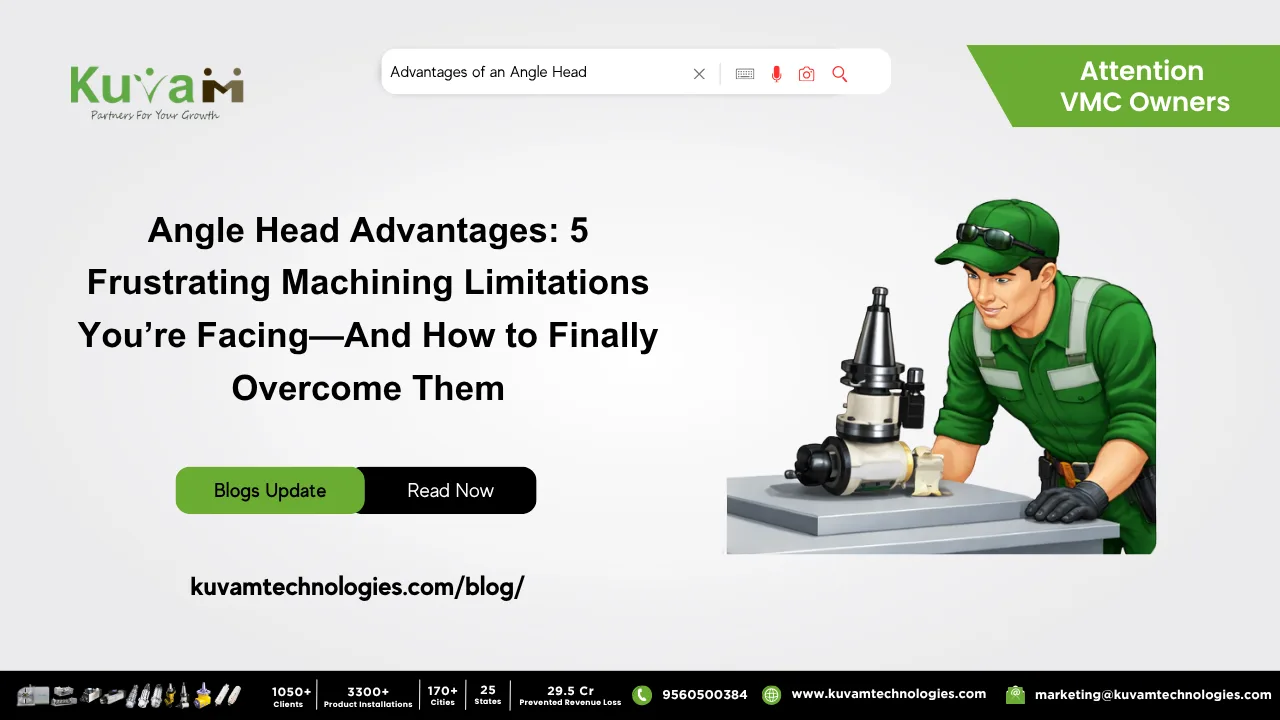
An Angle Head is a simple but powerful attachment that changes the direction of your cutting tool.
It connects to your CNC spindle and allows machining at different angles most commonly 90 degrees.
So instead of moving the workpiece again and again, the tool approaches the part from a new direction.
In simple terms:
- The spindle continues to provide power.
- The angle head redirects that power.
- The tool reaches where it couldn’t before.
No re-clamping.
No repositioning.
No unnecessary interruptions.
The 5 Most Frustrating Machining Limitations (And How Angle Heads Solve Them)
Let’s talk about what actually happens on the shop floor.
- “We’ll Have to Set This Up Again” Problem
You finish machining one side of the part, and then realise:
The next feature requires a completely different orientation.
What happens:
- The job stops.
- The part is removed.
- It’s re-aligned manually.
With an Angle Head:
- You continue machining in the same setup
- The tool adapts not the part
Result: Setup time drops dramatically.
- The “Tool Can’t Reach There” Moment
Some features are simply hard to access:
- Side holes in housings.
- Internal grooves.
- Deep cavities.
Without an Angle Head: You either struggle or redesign the process.
With an Angle Head: The tool reaches those areas effortlessly.
Result: You machine what you need without compromise.
- The Accuracy Drop After Re-Clamping
Every time you reposition a part, accuracy takes a hit.
Even a slight misalignment can lead to:
- Offset holes.
- Poor fitment.
- Rejection of parts.
With an Angle Head:
- The part stays fixed.
- The reference stays consistent.
Result: Accuracy becomes reliable not dependent on repeated setups.
- The Hidden Cycle Time Killer
Most delays don’t come from machining they come from everything around it.
- Setting up.
- Aligning.
- Checking.
With an Angle Head:
- These steps are reduced or eliminated.
- Machining becomes more continuous.
Result: Cycle time improves without increasing machine speed.
- The “We Need a Bigger Machine” Assumption
When jobs get complex, many manufacturers think:
“We need a 5-axis machine.”
But that’s a significant investment.
With an Angle Head:
- You expand the capability of your existing machine.
- You handle complex geometries without upgrading.
Result: More output without major capital expense.
What Makes an Angle Head Reliable?
It may look simple, but a good angle head is built for precision.
Key features include:
- High rigidity for stable machining.
- Precision gears for smooth power transfer.
- Compact design for tight access areas.
- High torque capability.
- Accurate alignment and concentricity.
- Compatibility with CNC machines and ATC systems.
These ensure that performance remains consistent even in demanding operations.
Where You’ll Feel the Biggest Impact?
Angle heads are especially useful in:
- Automotive components (side drilling, housings).
- Mould & die machining (deep cavities).
- Aerospace parts (complex geometries).
- General engineering (multi-face components).
If your parts involve multiple angles or difficult access points, this tool becomes essential.
A Shift in How You Think About Machining
Here’s the interesting part.
Most manufacturers think in terms of:
- “How do we position the part?”
But with an angle head, the question changes to:
- “How do we approach the part?”
That shift changes everything.
You stop designing processes around limitations and start designing them around possibilities.
Final Thought: Maybe the Problem Was Never Complexity
We often label certain jobs as “complex.”
But are they really complex?
Or are they just difficult because of how we approach them?
An Angle Head doesn’t simplify the part.
It simplifies the process.
It removes unnecessary movement, reduces interruptions, and allows your machine to do what it was always capable of doing.
So the next time your machine stops not because it can’t cut, but because it can’t reach ask yourself:
Do you really need a new machine… or just a better angle?