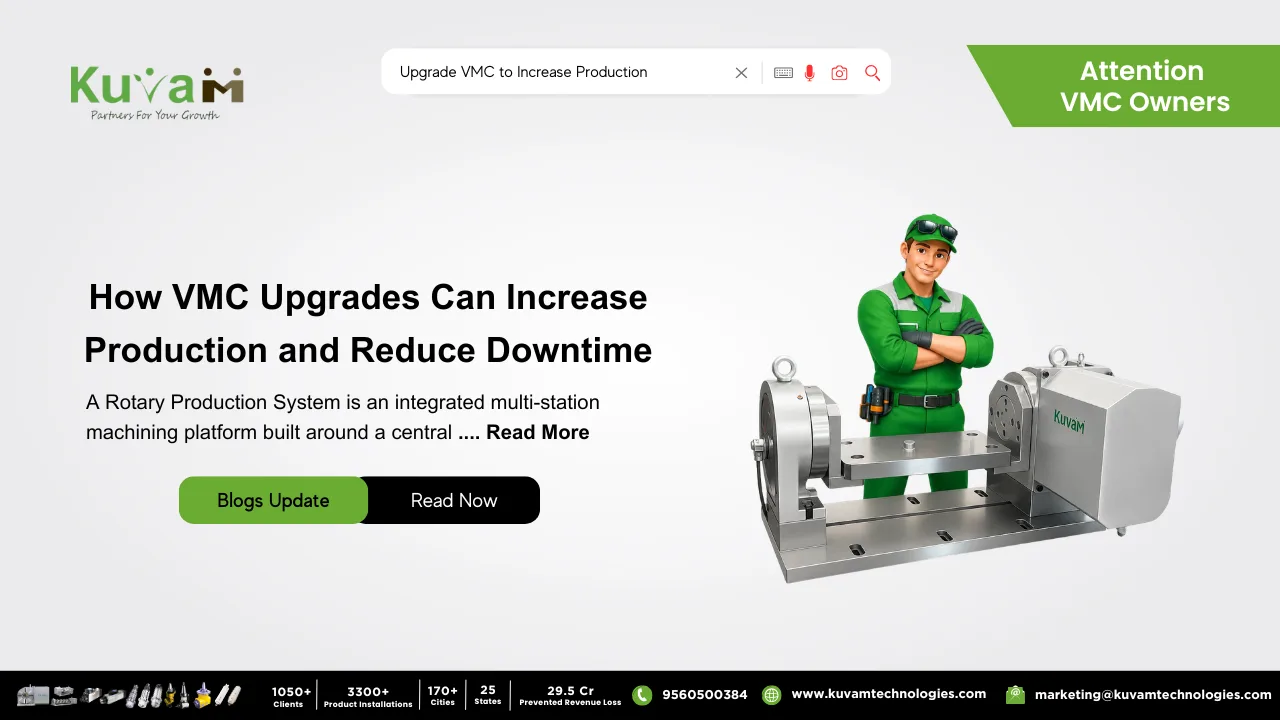

Rotary Production System is known for elevating the production output. Machines running. Operators working. And still — the parts per hour target slipping. The answer is rarely more effort. It’s almost always a smarter system
There is a particular kind of frustration that comes with a production floor that looks like it’s working perfectly with machines humming, operators active, queues moving but simply isn’t hitting the numbers. The throughput target was set based on what the equipment should be capable of. The team is doing everything right. And yet, somewhere between raw material and finished component, time is disappearing into a series of gaps that nobody has ever formally named.
Loading gaps. Transfer gaps. The seconds between one operation completing and the next beginning. The idle time while a machined part waits to be moved. The micro-delays that nobody logs because they happen in the transitions between recorded events rather than inside them. Individually, none of them seem significant. Cumulatively, across a shift, they add up to a production rate that is noticeably below what the machines alone could theoretically deliver.
This is the hidden throughput problem and it is remarkably common in facilities that rely on sequential, manually-transferred machining operations. Parts flow from station to station one at a time, under human control, with every handoff carrying its own time cost. The equipment is rarely the bottleneck. The transitions between equipment are. And the Rotary Production System is, in its most fundamental sense, a system that eliminates those transitions entirely.
Why Sequential Production Loses Time at Every Handoff?
In a conventional machining cell, a component completes one operation and then waits to be inspected, moved, loaded onto the next machine, indicated, and clamped again. Each of these steps takes time. None of them add any value to the part. They are all overhead cost, paid in seconds and minutes, on every single component that passes through the cell.
The problem compounds when production volumes are high. A ten-second transfer delay per part sounds trivial. At 200 parts per shift, it represents over thirty minutes of pure non-cutting time during which machines are idle, operators are occupied with handling rather than production, and the cost-per-part climbs quietly above where the quote assumed it would land.
| “The machine is not losing the time. The system around the machine is. And a system problem does not respond to machine upgrades, operator pressure, or faster cutting speeds. It responds only to a system-level solution.” |
What a Rotary Production System is and Why it Changes the Throughput Equation?
A Rotary Production System is an integrated multi-station machining platform built around a central precision rotary indexing mechanism. Multiple workstations during each set up for a specific operation are arranged around the periphery of the system. Workpieces are loaded onto the rotary platform, which carries them automatically from station to station in a controlled, repeatable sequence. While one part is being machined at one station, the next part is being loaded, the previous part is being unloaded, and every other station in the system is simultaneously active.
The central insight is simultaneity. In a conventional sequential cell, operations happen one at a time. In a Rotary Production System, every station works in parallel position and every index cycle advances all parts simultaneously, and every station completes its operation during the same dwell period. The total cycle time for a finished part is not the sum of all operation times. It is the duration of the longest single operation, plus the index time. That distinction is where the throughput gain lives.
| INSIDE THE SYSTEM ARCHITECTURE The rotary platform is driven by a precision cam-driven or servo-controlled indexing mechanism providing rigid, repeatable station positioning with dwell accuracy measured in arc seconds. Each workstation is independently tooled and can be configured for drilling, milling, tapping, reaming, pressing, inspection, or assembly operations. The system is modular: station count, table diameter, workpiece fixturing, and automation level are all specified to the application. Fully automated versions integrate part loading, unloading, and in-process gauging into the cycle. |
How the System Transforms a Typical Multi-Operation Workflow
| 1 | Load Station — Part enters the system once The workpiece is fixtured at the load station. From this point forward, it never leaves the rotary platform until all operations are complete. No manual transfers. No re-clamping between operations. |
| 2 | Machining Stations — All running simultaneously Each index brings the part to the next dedicated station. While this part is being drilled, the next part is being milled, and the part before is being tapped. Every station works during every dwell period. |
| 3 | Inspection station — quality built into the cycle In-process gauging or vision inspection can be integrated as a dedicated station — checking critical dimensions automatically within the production cycle rather than as a separate downstream activity. |
| 4 | Unload station — finished part exits, cycle continues The completed part is unloaded at the designated station while the next part simultaneously completes its final machining operation. Output is continuous. The system never waits for a transfer. |
The Three Dimensions of Improvement Manufacturers Actually Measure
| Cycle time compression Total part cycle time collapses from the sum of all operations to the duration of the longest single station, often a 60–70% reduction in elapsed time per part. | Positional consistency Features machined in a single fixturing share one datum reference. Inter-feature positional accuracy is limited only by the indexing mechanism and not by manual re-clamping error. | Floor space efficiency A rotary system replaces a linear sequence of standalone machines with a single compact platform and often recovering 40–50% of the floor space previously occupied by the same operation. |
| 6–12 Typical station count on production systems | 70% Typical reduction in non-cutting idle time | 1 Fixturing per part — for all operations | ±2″ Arc-second index repeatability |
Is a Rotary Production System the Answer Your Throughput Numbers Have Been Pointing Toward?
If the machines in your production cell are capable of higher output than the cell consistently delivers and the shortfall lies in handling, transfer, re-clamping, and the accumulated dead time of sequential operation and then the Rotary Production System is the architecture that closes that gap. Not by making individual operations faster. By making the system around those operations so efficient that the dead time between them effectively disappears.
For manufacturers running high volumes of multi-operation components are automotive, medical, hydraulic, pneumatic, electronic, the Rotary Production System frequently represents the single largest available improvement in output per square metre, cost per part, and quality consistency. It is not a machine upgrade. It is a system redesign. And for the class of production problem it addresses, that distinction makes all the difference.
| A production floor that looks busy is not the same as one that is efficient. The Rotary Production System is how the gap between those two descriptions closes — and stays closed, at every output target the business sets after it. |