
A Rotary Production System can help put the skills of machinists to better use. Skilled machinists are one of manufacturing’s most valuable and scarce resources. The question worth asking is whether the system they work inside is letting them use those skills — or quietly burying them in repetition.
There is a particular irony that plays out in workshops and production facilities every day. A highly experienced machinist who took years to develop, who can read a part drawing in seconds, diagnose a subtle vibration in a cut, and hold tolerances that most people couldn’t achieve and spends the majority of their shift doing things that require almost none of that capability. Loading parts. Unloading parts. Carrying components from one machine to the next. Re-clamping. Re-checking. Repeating.
Nobody planned for it to be this way. It’s simply what sequential, multi-machine production cells demand. Every transfer between machines requires a human action. Every re-clamping requires a human decision. The machinist is there, technically operating the equipment, but the actual work being done is logistical and not skilled. The skill is available. The system just isn’t asking for it.
This is one of the quieter costs of conventional production layouts. It doesn’t show up as waste on a report. It shows up as a ceiling on what an experienced team can actually produce — and as the slow, grinding frustration that comes with doing the same manual handling task for the two hundredth time in a week.
| A FAMILIAR SCENE ON THE PRODUCTION FLOOR |
| “He’s been here twelve years. He can set up a five-axis job in his sleep. And right now he’s walking parts between machines for the third hour straight because that’s what the cell needs him to do. We’re paying for expertise and using it as a conveyor belt.” |
What the System is Really Asking Your Team to Do?
In a standard sequential production cell, the machinist’s role is heavily shaped by the layout. Parts come in. They get loaded onto machine one, machined, unloaded, carried to machine two, loaded again, machined, unloaded again and so on for however many operations the component requires. For a part that needs five operations, this means four manual transfers, four additional loading sequences, and four additional unloading sequences. Per part. Every part. All day.
The machinist isn’t idle during this work but they’re constantly active. But the activity is handling activity, not machining activity. The skill that took years to build and the ability to optimise a cut, troubleshoot a process, improve a setup rarely gets used. Not because the person isn’t capable, but because the production system doesn’t give them the space to apply it.
The most expensive thing in a skilled machinist is the knowledge in their head. A rotary production system that keeps them occupied with manual transfers is not just inefficient and it’s wasteful of the thing that’s hardest to replace.
What a Rotary Production System is and Why it Changes this Dynamic?
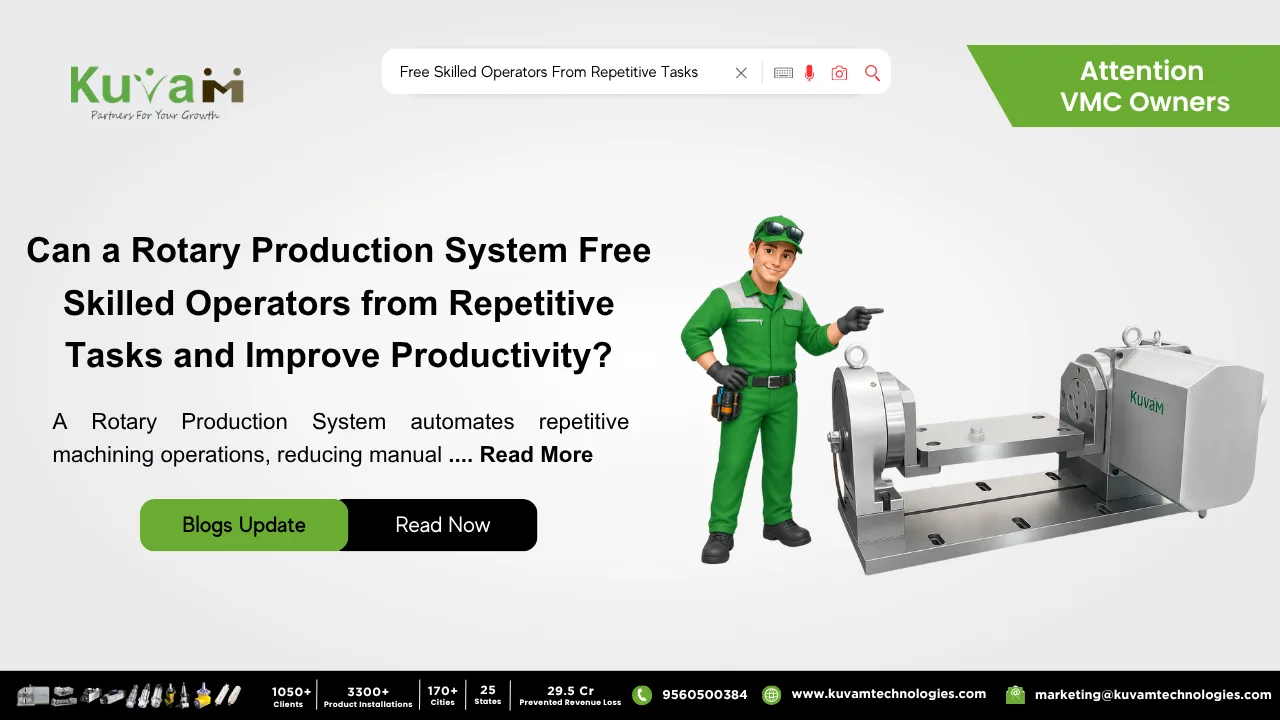
A Rotary Production System is a multi-station production platform built around a rotating central table. All the operations a part needs are performed at dedicated stations arranged around the platform. The part is loaded once, and the platform carries it automatically through every operation in sequence and no manual transfers, no re-clamping between stations, no operator carrying components across the floor.
Each station is set up for one specific task. When the platform rotates, every part moves to the next station simultaneously, and every station begins its operation at the same time. The system handles the repetitive, logistical part of the work — moving, indexing, positioning — so the people running it no longer have to.
| WHAT THE OPERATOR ACTUALLY DOES IN A ROTARY PRODUCTION SYSTEM Rather than shuttling parts between machines, the operator monitors the system, manages tool changes, responds to any process variation, and focuses on quality control. They are doing what experienced machinists are actually trained to do — overseeing a process and applying judgement — rather than performing the same physical handling task in an endless loop. One skilled operator can often oversee a Rotary Production System that previously required two or three people in a sequential cell. |
What This Means for Your Team in Practice?
| Skills Get Used, Not Wasted Experienced machinists spend their time on process monitoring, quality decisions, and setup optimisation is the work their expertise is actually built for. | Frustration Reduces Significantly The repetitive physical handling that gradually wears down even the most dedicated operators disappears from the shift. People feel like they’re doing real work because they are. |
| One Operator Covers More A single skilled person overseeing a Rotary Production System can manage what previously took two or three people. That doesn’t mean cutting headcount and it means redeploying capability where it matters more. | Training Investment Pays Back Better When the system handles the repetitive elements, the skilled judgement your team has developed is actually applied to production. The return on every hour of training increases because the skill gets exercised, not buried. |
| 1 Loading per part — for every operation in the sequence | Zero Manual transfers between operations once the system is running | 3× Typical operator coverage ratio versus sequential cell |
Is a Rotary Production System Right for Every Facility?
It delivers the most value in facilities running medium to high volumes of multi-operation components that where the same sequence of operations repeats across hundreds or thousands of parts. Automotive components, hydraulic fittings, medical parts, pneumatic housings and any product that requires several machining steps before it’s complete is a strong candidate.
It’s also worth considering for any facility where skilled operator retention is a challenge. When experienced machinists spend their days on meaningful, skilled work rather than repetitive handling, they tend to stay. The system isn’t just a production efficiency tool but it’s a working environment improvement that shows up in how people feel about coming to work.
So, Are You Getting the Best from Your Best People?
The answer, for most facilities running sequential multi-machine cells, is probably no. Not because of anything the people are doing wrong. Because of the system they’re operating inside and one that was designed around equipment capability rather than human capability, and that uses skilled people to solve a logistics problem that a machine could handle far more efficiently.
A Rotary Production System doesn’t replace your experienced team. It restores them to the role they were trained for. And in a manufacturing environment where skilled machinists are increasingly hard to find and harder to keep, that restoration is worth more than any individual gain in throughput or output rate.
| The best thing a rotary production system can do for a skilled workforce is get out of their way and stop asking them to be a conveyor belt and start letting them be the engineers they actually are. That is exactly what the Rotary Production System does. |