
A Rotary Tilting Table is very effective in reducing machining time. Most machining challenges aren’t about the skill of the operator or the quality of the machine. They’re about what the setup can and cannot reach. Add the ability to tilt and rotate together, and a whole new world of geometry becomes straightforward.
Here’s a scenario most machinists will recognise immediately. A job arrives on the floor. The part is not especially exotic — maybe it’s a housing, a valve body, or a bracket — but it has features that are awkward to reach. One face needs a hole drilled at an angle. Another face has a slot that runs diagonally. Getting to each of these features means stopping the machine, unclamping the part, physically tilting or rotating it by hand, re-clamping, re-checking the position, and starting again.
By the time you’ve done this two or three times on a single component, what should have been a three-hour job has stretched into a full day. The machine sat idle while you repositioned. The part was handled more than it was cut. And at the end of it, you’re left hoping that the slight shift during that second re-clamping didn’t push a feature just far enough out of position to fail inspection.
This is not an unusual situation. It plays out in job shops and production facilities every day. And the root cause is almost always the same: the setup can do one thing at a time — either rotate or tilt — but not both. The moment a part needs to be positioned at an angle in two directions simultaneously, the standard workholding reaches its limit. That’s exactly the problem the Rotary Tilting Table was built to solve.
Let’s Start With a Simple Picture
| THINK OF IT THIS WAY Imagine holding a football. You can spin it on its end — that’s rotation. You can tilt it to the side — that’s inclination. Now imagine you need to hold it at a specific angle while also rotating it to a specific position, and you need to hold it perfectly still at that exact combination of the two while someone drills a precise hole through it. That’s what a Rotary Tilting Table does — except with metal parts, at micron-level precision, hundreds of times a day. |
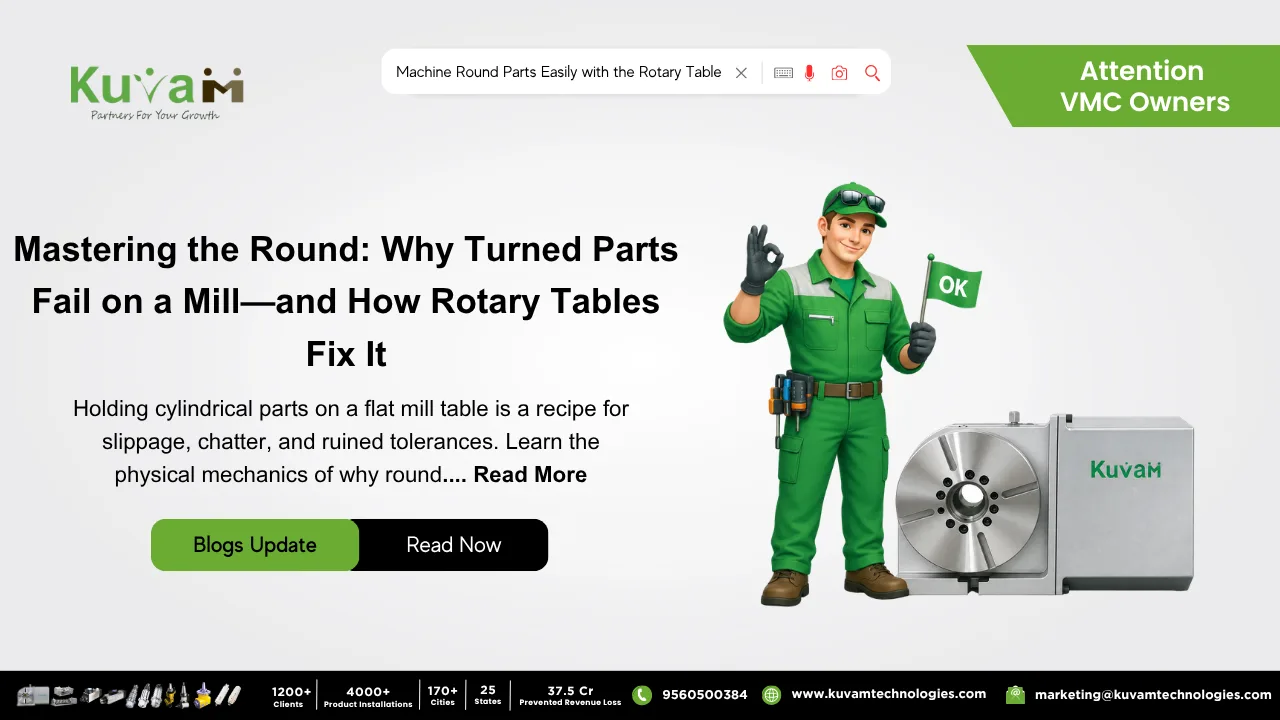
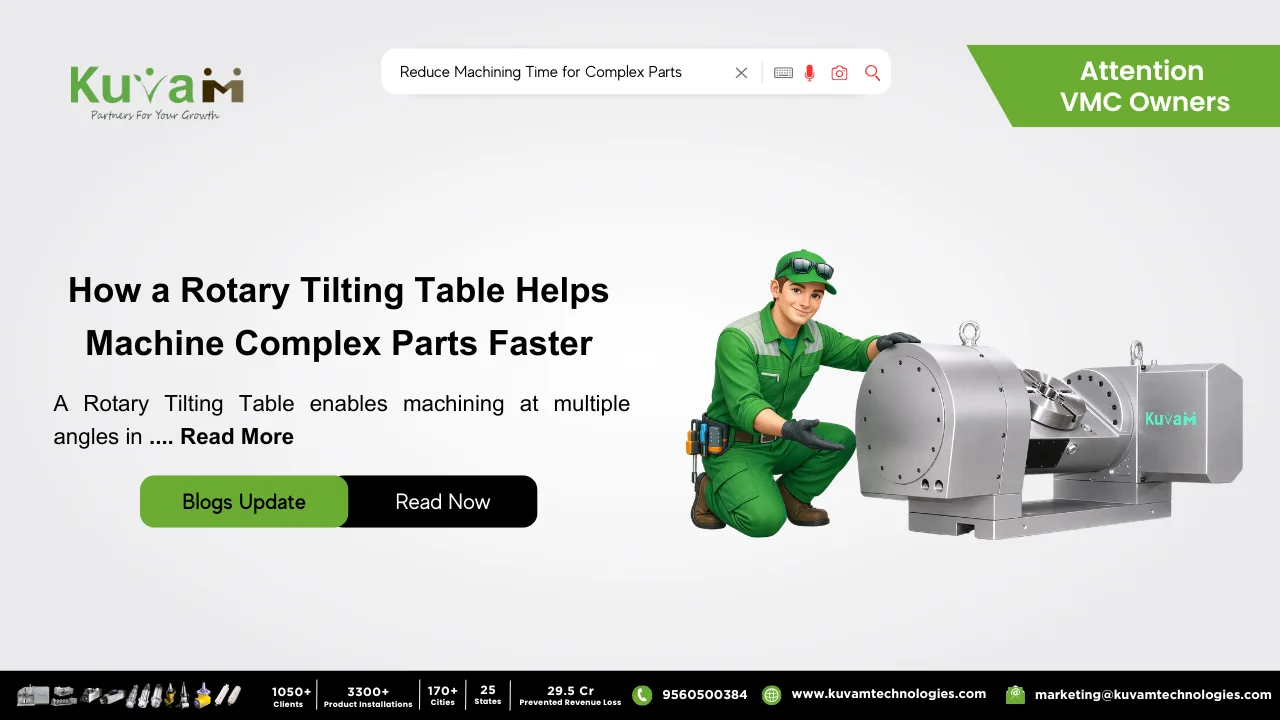
A Rotary Tilting Table is a workholding device that gives you two movements in one compact unit. The first movement is rotation — spinning the part around a central vertical axis, just like a standard rotary table. The second is tilt — leaning the whole unit to any angle you need, typically anywhere from flat to fully upright. You control both independently, you can combine them freely, and once you’ve set your position, the table locks completely solid while the machine cuts.
The result? A part that used to need three or four separate setups to reach all its features can often be completed in one. The machine runs longer. The part moves less. And the quality is better because there’s less opportunity for positioning errors to creep in between operations.
What Changes on the Shop Floor?
| WITHOUT ROTARY TILTING TABLE | WITH ROTARY TILTING TABLE |
| ✗ Multiple setups for a single part ✗ Manual repositioning between each operation ✗ Positional errors build up with every move ✗ More time, more handling, more risk ✗ Complex jobs feel harder than they should | ✓ Tilt and rotate to any angle in one setup ✓ All features accessible from a single clamping ✓ Position set once, held precisely throughout ✓ Faster jobs, less handling, better results ✓ Complex geometry becomes manageable |
The Rotary Tilting Table doesn’t make you a better machinist. It removes the obstacle that was slowing a good machinist down — the constant need to stop, unclamp, reposition, and re-check every time the part needs to face a new direction.
What Does it Actually Look Like in Practice?
Say you’re machining a valve body. It needs ports drilled on the front face, slots on the side face, and a set of angled holes that come in at 30 degrees to the body’s main axis. In a conventional setup, that’s at least three completely different clampings on potentially two or three different machines.
With a Rotary Tilting Table, you clamp the part once. You tilt the table to reach the angled holes, drill them. You bring the table back to flat, rotate to the side face, machine the slots. Rotate again to the front face, drill the ports. The part hasn’t moved. Every feature was machined from the same reference point. The job is done in a fraction of the time — and the dimensions between features are better because there was no opportunity for positioning drift.
WHO MAKES THE MOST OF A ROTARY TILTING TABLE?It’s most valuable for job shops and production facilities that regularly machine parts with features on multiple faces or at compound angles — things like valve bodies, pump housings, aerospace brackets, mould inserts, and medical components. If your team regularly has conversations that start with “how are we going to hold this to get to that feature?” — a Rotary Tilting Table is almost certainly the answer to that question. |
The Real Value: Time You Stop Losing
It’s easy to look at a Rotary Tilting Table and see it as a solution to a technical problem. And it is that. But the deeper value is in everything you stop losing once you have it. The half-shifts spent repositioning and re-checking. The parts that came back from inspection with features slightly out of position because of a second re-clamping. The jobs you declined to quote because the setup complexity made the price uncompetitive. The good machinists who spent their afternoon doing manual handling instead of actual machining.
All of that time, margin, and capability is recoverable. It doesn’t require a new machine or a bigger team. It requires a setup that can tilt and rotate at the same time — and hold that position with complete confidence while the spindle does what it was built to do.
| Valve & pump bodies Multiple port faces and angled drillings accessible from one clamping instead of three or four separate setups. | Aerospace brackets Oblique mounting faces and compound-angle fastener holes machined in a single operation without custom fixturing. |
| Mould & die inserts Angled cavity walls and compound-angle features reached cleanly in one setup — no machine transfers, no tolerance risk. | Medical components Precision features on complex implant geometries machined with the consistent positional reference that patient safety demands. |
| 2-in-1 Tilt and rotate — two axes of control in one compact device | 1 Setup to complete jobs that previously needed three or four | Hours Saved per complex part by eliminating manual repositioning |
So — Is Your Setup Holding Your Machining Back?
If complex parts are consistently taking longer than they should, if your team spends a significant part of their day repositioning and re-clamping rather than actually cutting, and if certain jobs feel harder to price competitively than your skill level should make them — the answer is very likely yes. And the fix isn’t a new machine or a more experienced operator.
It’s a Rotary Tilting Table. A tool that costs a fraction of a new machining centre, mounts on the equipment you already own, and immediately expands what that equipment can reach. Starting with the very next complex job your floor encounters.
| The part doesn’t get easier. The setup does. And when the setup can tilt and rotate at the same time, the jobs that used to take all day start finishing before lunch. |