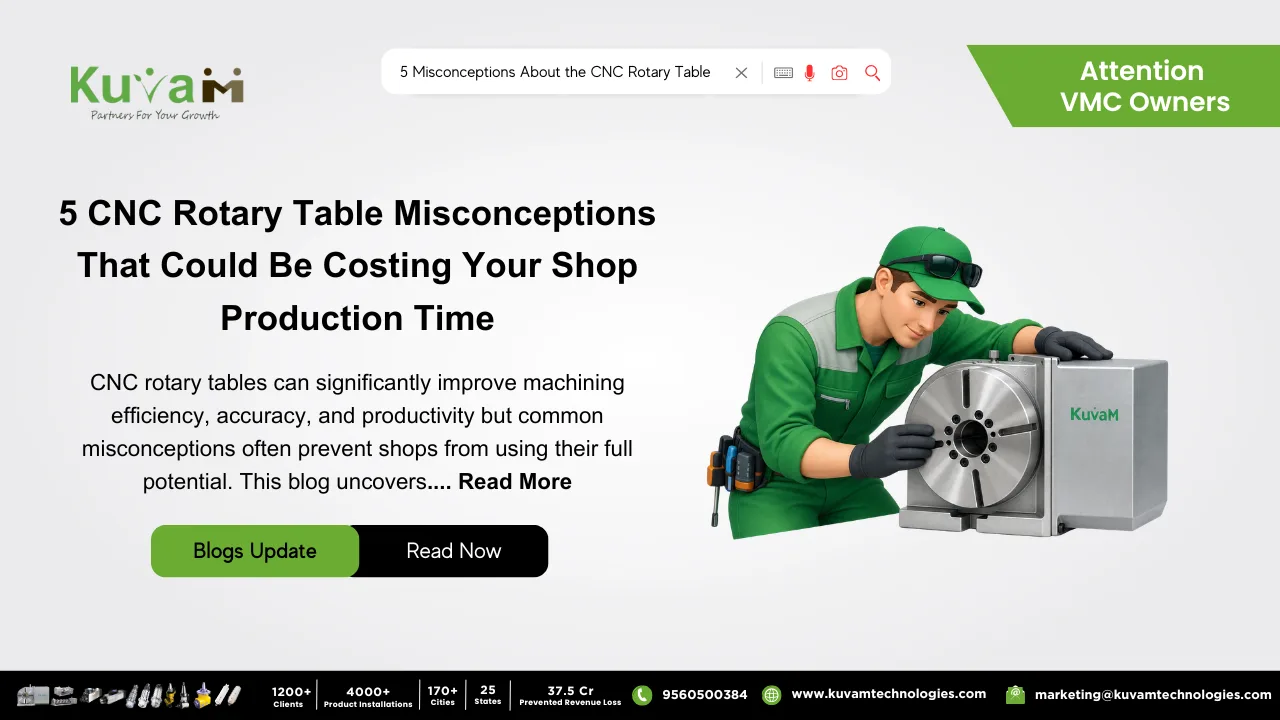

Ask ten machinists what a CNC rotary table is for, and you’ll likely get ten slightly different and sometimes outdated answers. Some picture it strictly as a tool for round parts. Others assume it’s only worth the investment on high-volume runs, or that it’s so complicated to program it’s not worth the learning curve. These aren’t just harmless misunderstandings. They’re the reason a lot of shops keep manually repositioning parts, absorbing longer cycle times and inconsistent tolerances, when a rotary table sitting one aisle over in the tooling catalog could have solved the problem months ago.
Before writing off a CNC rotary table based on something you heard second hand or assumed from the name, it’s worth separating the myths from what this tool actually does on a modern production floor.
What a CNC Rotary Table Actually Is, in Plain Terms
A CNC Rotary Table is a precision work holding accessory that mounts to a mill or machining center and rotates the workpiece around a fixed axis, controlled directly by the machine’s program rather than a manual handwheel. It effectively adds a new axis of motion, letting a part be indexed to different angles automatically while staying clamped in a single fixture. A tilting version adds a second rotational axis, bringing a standard 3-axis mill much closer to true 5-axis capability.
With that baseline understanding, here are the five misconceptions that quietly keep shops from using this tool where it would help most.
Misconception 1: “It’s Only Useful for Round or Circular Parts”
This is probably the most common misunderstanding, and it comes from the table’s obvious use case circular bolt patterns and radial features. But that’s only a fraction of what it actually does. A CNC rotary table is just as valuable for machining flat-sided brackets with features on multiple faces, angled bores on rectangular blocks, or contoured surfaces that have nothing to do with circular symmetry.
The real function isn’t “making round things.” It’s holding a part in a fixed position while rotating it to present a new face or angle to the spindle a need that shows up constantly on parts that have no circular geometry at all.
Misconception 2: “It’s Only Worth It for High-Volume Production”
There’s a common assumption that a rotary table only pays for itself when you’re running thousands of identical parts. In reality, some of the strongest use cases are the opposite: low-volume, high-complexity jobs and prototypes where a shop simply can’t justify buying a dedicated 5-axis machine for a handful of parts.
A manual or entry-level CNC Rotary Table lets a shop take on complex, one-off geometry using equipment it already owns, without needing production-scale volume to make the investment worthwhile.
Misconception 3: “It’s Too Complicated to Program and Not Worth the Learning Curve”
This misconception keeps more shops on the sidelines than almost any other. Modern CNC controls handle rotary axes with the same G-code logic used for standard linear moves, and most CAM software generates the toolpaths automatically once the rotary axis is defined in the setup. It’s a learning curve measured in a few practice jobs, not months of retraining.
Compare that to the actual cost of the alternative and manually re-fixturing a part for every face and the “complexity” of programming a rotary axis is almost always smaller than the complexity it eliminates.
Misconception 4: “A Rotary Table Is Basically the Same as a Manual 4th-Axis Indexer”
It’s easy to lump these together since both add rotational capability, but they solve different problems. A manual indexer typically locks into fixed, pre-set positions and requires an operator to physically engage each index point. A CNC rotary table, by contrast, is driven directly by the program and can index to any angle called for in the code, including continuous rotation for contour milling, not just fixed stops.
Treating them as interchangeable undersells what a true CNC rotary table can do, particularly on parts that need irregular or non-standard angles rather than simple, repeated indexing.
Misconception 5: “It’s Just a Cheaper Way to Fake 5-Axis Work, So It Won’t Hold Real Tolerance”
Some shops assume that because a rotary table is more affordable than a 5-axis machining center, it must be a compromise on accuracy. In practice, a quality CNC rotary table is a precision-engineered device in its own right, often holding indexing accuracy well within a few arc-seconds more than sufficient for the vast majority of angled and multi-face work that comes through a typical shop.
It’s true that a rotary table won’t replace simultaneous 5-axis contouring on the most complex aerospace geometries. But for the much larger share of jobs that simply need accurate, repeatable indexing across multiple faces, it holds tolerance just as reliably as far more expensive equipment.
The Bottom Line
Misconceptions like these don’t just create confusion they actively keep shops repeating manual setups, absorbing longer cycle times, and declining jobs that a rotary table could have handled all along. The tool itself hasn’t changed much in principle, but the assumptions floating around it clearly have room to catch up. Before ruling out a CNC rotary table based on something that sounded true a decade ago, it’s worth taking a fresh look at what it can actually do for the specific bottleneck slowing down your floor today.