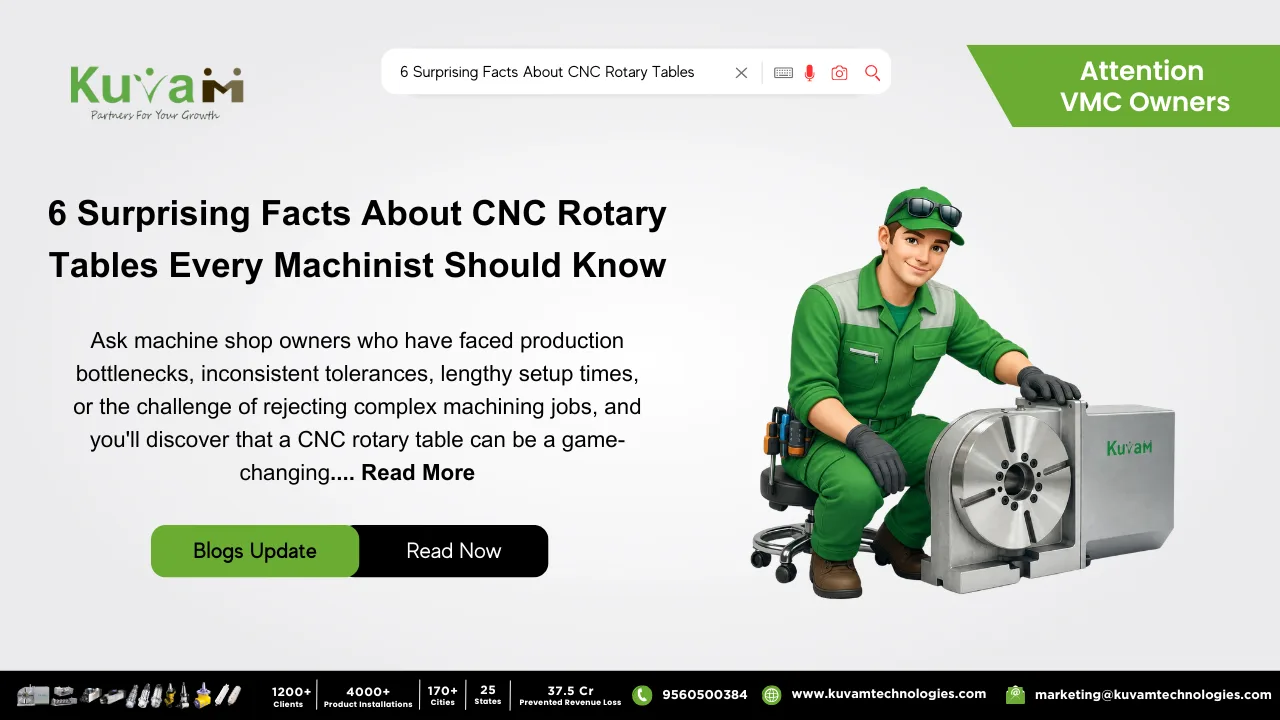

Most machine shops know the basics of a CNC rotary table: it rotates a part, it adds an axis, it helps with angled features. But talk to shop owners who’ve actually run into production bottlenecks and missed deadlines, inconsistent tolerances, or jobs turned away because the geometry was “too complex” and you’ll find the real value of a rotary table runs a lot deeper than most people realize.
If your shop is still treating the CNC rotary table as a niche accessory instead of a core problem-solver, these six facts might change how you look at your own production floor.
1. It Solves a Problem You Might Not Even Be Naming Correctly
Ask most manufacturers what their biggest production headache is, and you’ll hear things like “long changeover times” or “too much scrap.” Rarely does anyone say “inconsistent workholding”, yet that’s often the actual root cause hiding underneath both complaints.
Every time a part is manually unclamped, flipped, and reclamped to machine a new face or angle, you introduce a small chance of misalignment. That misalignment shows up later as scrap, rework, or a changeover that takes twice as long as it should because the operator is re-indicating the part from scratch. A CNC Rotary Table removes this hidden variable entirely by keeping the part fixed in place while the table itself handles the rotation precisely, and identically, every single time.
2. It Can Replace Several Manual Setups With One Continuous Cycle
Here’s something a lot of shops don’t fully appreciate until they see it in action: a single CNC rotary table can often eliminate three, four, or even six separate machine setups on one part. A flange with evenly spaced mounting holes, a gear blank needing angular indexing, or a bracket with features on multiple faces would traditionally require repeated unclamping and repositioning.
With a rotary table, the part is loaded once. The CNC program then indexes the table to each required angle automatically, and the spindle keeps working without ever pausing for a manual reset. What used to be a multi-setup job with multiple chances for human error becomes one uninterrupted, repeatable cycle.
3. It’s Often Cheaper Than the Alternative Everyone Assumes They Need
When a job calls for multi-angle or multi-face machining, the instinctive assumption is that the shop needs a 5-axis machining center. That’s a six or seven-figure investment, and for many shops, it’s simply not justified by the volume or complexity of the work coming through the door.
A CNC Rotary Table especially a tilting rotary table, which adds a second axis of rotation can bring a standard 3-axis mill remarkably close to 5-axis capability for a fraction of the cost. It won’t replace true simultaneous 5-axis contouring on the most complex geometries, but for a large share of “5-axis-sounding” jobs, it’s a far more practical and affordable fix.
4. It Protects Quality Late in a Production Run, Not Just Early
Most people assume machining quality problems show up early, when a setup hasn’t been dialled in yet. In reality, a lot of quality drift happens later in a run after 50, 100, or 500 parts as manual repositioning quietly accumulates small errors and operator fatigue creeps in.
A CNC rotary table doesn’t get tired and doesn’t lose focus. It indexes to the exact same angle on part 1 and part 1,000, because the positioning is governed by the program rather than a person’s hands. For manufacturers running long batches or lights-out shifts, that consistency is often the difference between a clean run and a slow, invisible slide into scrap.
5. Manual, CNC, and Tilting Versions Solve Very Different Problems
Not every rotary table is built for the same job, and shops sometimes buy the wrong type for their needs. A manual rotary table, adjusted by hand with a graduated dial, is a smart, low-cost option for prototyping or low-volume work where an operator can afford to dial in each position. A CNC rotary table integrates directly into the machine’s program, indexing automatically ideal for repetitive, higher-volume production. A tilting rotary table goes a step further, adding a second rotational axis so the part can both spin and tilt, which is essential for compound-angle parts that would otherwise need repeated repositioning across multiple planes.
Matching the right type to the actual production need avoids both overspending and under-delivering on capability.
6. It Shows Up in Far More Industries Than People Expect
Rotary tables are often associated with aerospace brackets or gear manufacturing, but their reach extends well beyond that. They’re used in mold and die work for contour milling around curved surfaces, in medical device manufacturing for tight-tolerance indexed features, in automotive production for circular bolt patterns and manifold ports, and even in job shops handling one-off prototype parts where flexibility matters as much as raw speed.
Wherever a part needs to be rotated accurately and repeatedly without being physically removed from its fixture, there’s a good chance a rotary table is quietly doing the work behind the scenes.
The Bottom Line
A CNC rotary table rarely gets the spotlight the way a new machining center does, but as these six points show, it solves problems that go far beyond simply “turning a part.” It cuts hidden variability out of manual workholding, collapses multiple setups into one, offers a genuine cost-effective alternative to full 5-axis capability, protects quality across long runs, and adapts to an unusually wide range of industries. For manufacturers still treating it as an afterthought, it might be worth a second look the next production bottleneck it solves could be one you didn’t even know you had.