
A Rotary Table is capable of machining complex parts. Manufacturers lose hours every week trying to machine circular features without the right tool. A Rotary Table changes that — and this blog explains exactly how.
If you work in manufacturing, you have almost certainly experienced this. A job comes in with holes that need to be drilled in a perfect circle around a part. Or a component needs flat faces milled at equal intervals. On paper, it looks simple. In practice, your machinist spends the next few hours measuring, marking, repositioning by hand, and checking each time — only to find the spacing still isn’t quite right.
This is one of the most common production bottlenecks in machine shops today. It’s not dramatic. It doesn’t trigger alarms. But it steals hours from your schedule every single week, pushes up your cost per part, and quietly frustrates your most experienced operators. And the root cause is almost always the same: there is no dedicated tool controlling the angular position of the workpiece between cuts.
That tool exists. It’s called a Rotary Table. And for manufacturers who don’t have one, it’s often the single most cost-effective addition they can make to their production floor.
Quick Answer — What is a Rotary Table?
A Rotary Table is a precision workholding device that mounts on a milling machine and allows a workpiece to be rotated to exact angular positions between machining operations. It eliminates manual repositioning, improves accuracy, and significantly reduces the time required to machine circular, radial, and angular features on metal components.
What is a Rotary Table and How Does It Work?
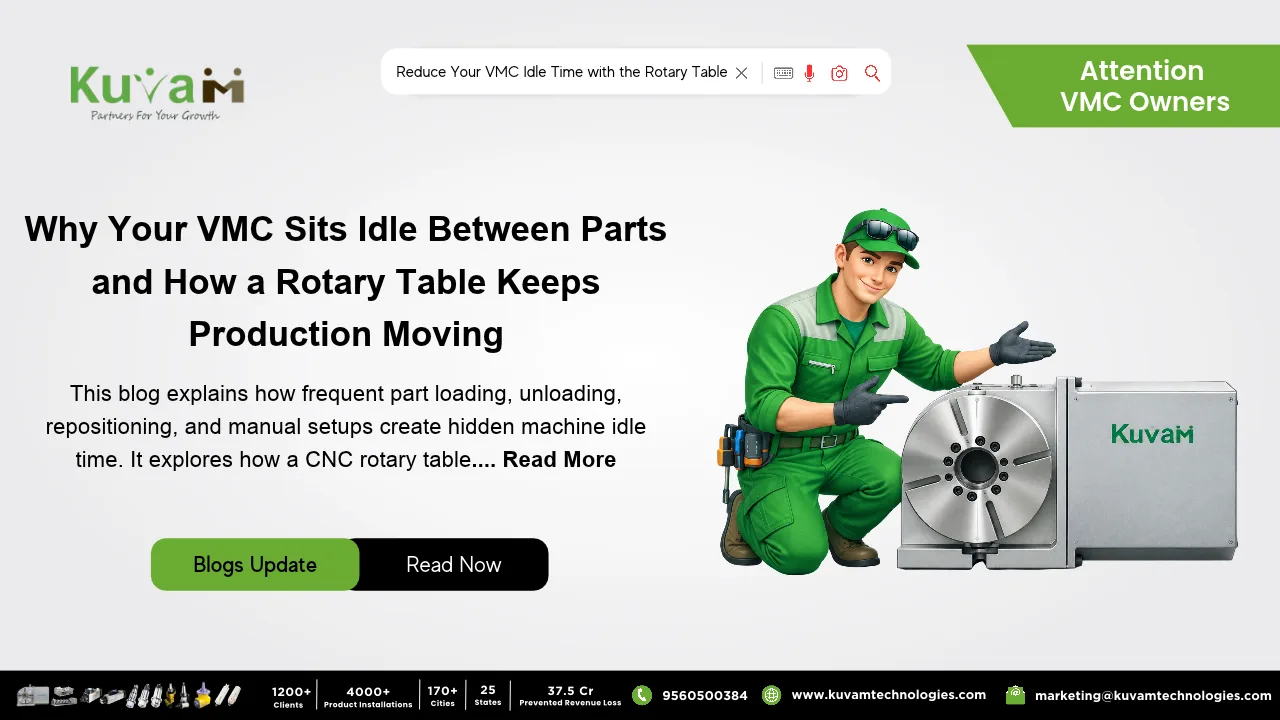
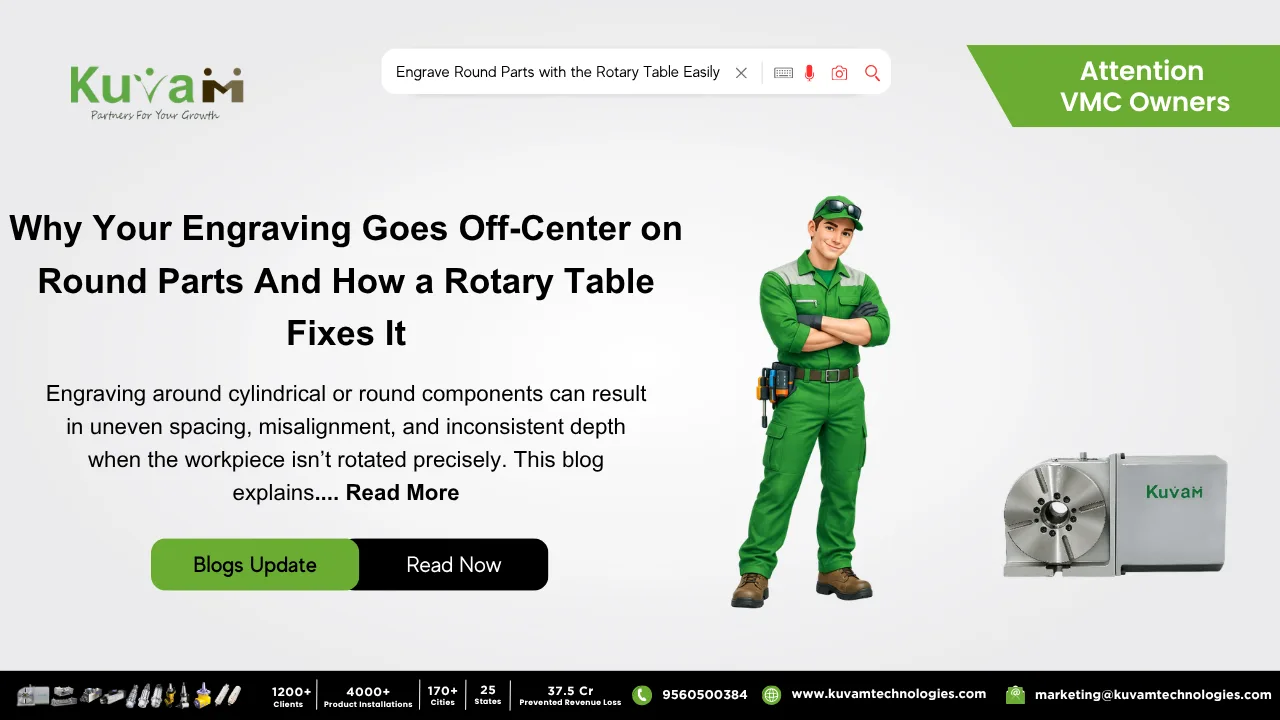
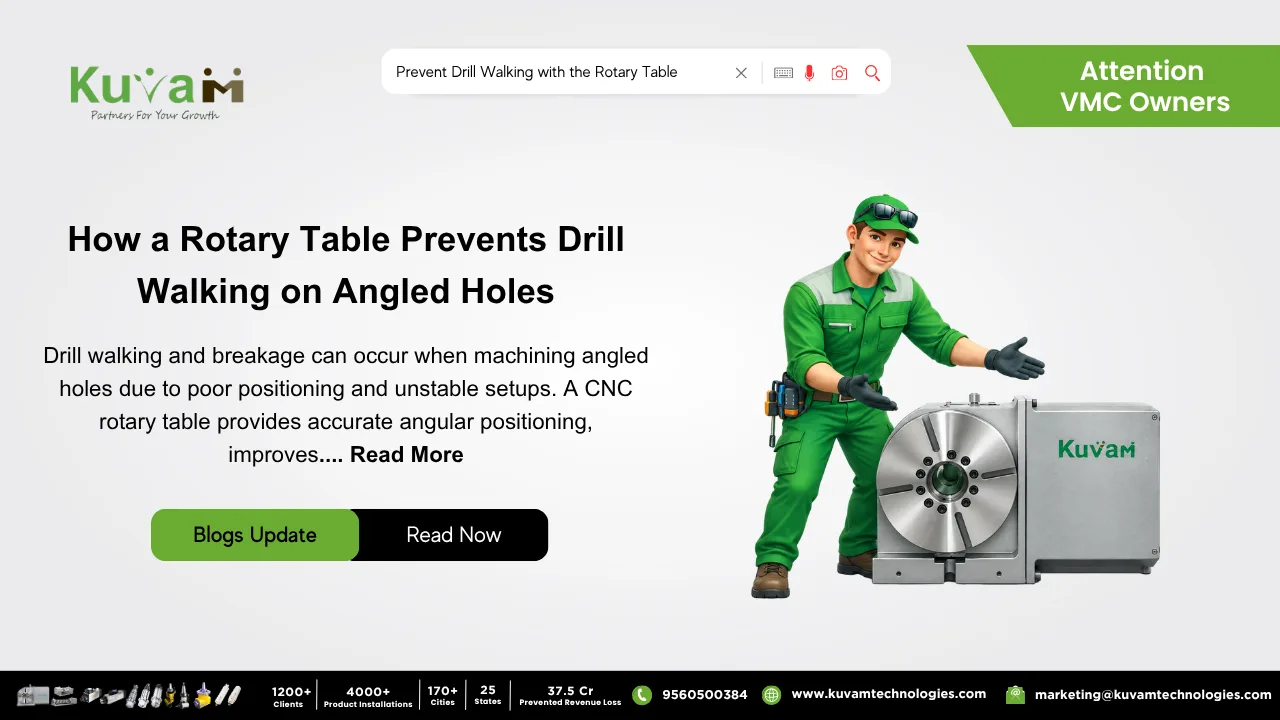
A Rotary Table is a flat, circular platform that sits on the bed of a milling machine or machining centre. The workpiece — the metal part you’re machining — is clamped firmly on top of it. Then, using a handwheel or motor connected to a precision worm gear system inside the table, you rotate the part to any angular position you need.
A graduated scale on the side of the table shows you exactly where the part is positioned — in degrees, minutes, and even fractions of a degree. Once you’ve reached the right angle, a locking mechanism clamps the table completely still. You make the cut. Then you unlock, rotate to the next position, lock again, and cut again.
There are no calculations to do on the floor. There’s no marking out by hand. The table handles the positioning — precisely and repeatably — every single time.
A Rotary Table doesn’t just improve accuracy. It removes an entire category of manual work from your production process — the kind that slows your best machinists down and quietly inflates your cost per part.
Why Does Circular Machining Slow Production Down?
The problem begins the moment a component requires features arranged in a circle or at precise angular intervals. Standard machine tools move in straight lines — X, Y, and Z. They’re brilliant at linear features. But the moment you need to drill eight holes equally spaced around a 100mm circle, or mill six flat faces at 60-degree intervals around a housing, those three linear axes are not enough.
Without a Rotary Table, machinists typically either calculate X-Y coordinates for each feature and move the machine table by hand, or they mark out the part with a protractor and hope for the best. Both methods are slow. Both introduce human error. And both produce results that are acceptable some of the time but inconsistent enough to cause regular re-runs and rework.
The cost adds up fast. A single re-run on a batch of 50 parts can cost an hour of machine time and operator attention. Multiply that across a week and the number becomes significant — even before you factor in the cost of material that couldn’t be salvaged.
What Can a Rotary Table Be Used For?
- Bolt hole circles: Drill evenly spaced holes around flanges, pipe fittings, and cover plates with perfect angular spacing — every hole, every time.
- Equi-spaced milled faces: Machine flat faces at precise angular intervals on shafts, hexagonal features, and coupling components.
- Circular slots and grooves: Mill arc-shaped slots that follow a circular path — cam grooves, curved keyways, and radial clearance slots.
- Gear and sprocket work: Index through tooth positions on gears, sprockets, and ratchets with the consistent angular accuracy that gear geometry demands.
- Radial drilling on housings: Position and drill radially arranged holes on pump housings, valve bodies, and bearing housings without multiple machine setups.
Which Industries Use Rotary Tables Most?
Rotary Tables are used wherever precision circular or angular machining is a regular part of production. Automotive manufacturers use them for engine components, brake parts, and gearbox housings. Aerospace and defence suppliers rely on them for brackets and precision housings where angular tolerances are tight. Hydraulic and pneumatic manufacturers use Rotary Tables when machining valve bodies and port manifolds. General engineering job shops depend on them for the wide variety of flanges, couplings, and housings that flow through their doors every week.
In each of these environments, a Rotary Table pays back its investment quickly. The time saved on angular positioning alone — just by removing manual marking and coordinate calculation from the process — typically reduces setup time for circular-feature components by 40 to 60 percent. That time becomes available for more parts, more jobs, and better margins.
Manual, Motorised, or CNC — Which Rotary Table Do You Need?
The right Rotary Table depends on your production environment. Manual Rotary Tables are the most affordable and flexible — suited to job shops running varied work where the operator sets each position by handwheel. Motorised Rotary Tables add servo-driven positioning for faster, more consistent setup on higher-volume runs. CNC-integrated Rotary Tables connect directly to your machining centre’s control system, effectively adding a fourth axis to your machine and enabling continuous arc milling and helical interpolation without any manual input at all.
Whichever configuration suits your work, the underlying benefit is the same: your workpiece goes to the right angular position, every time, without your machinist having to figure out how to get it there manually.
Can a Rotary Table be used on any milling machine?
Manual Rotary Tables can be mounted on virtually any milling machine using standard T-slots on the machine’s worktable. CNC-integrated models require compatibility with the machine’s control system. Most modern machining centres can accommodate a Rotary Table as a fourth axis with the appropriate interface.
The slowdowns, the re-runs, and the hours lost to manual angular positioning are not inevitable costs of manufacturing. They’re the cost of not having the right tool. A Rotary Table is how you stop paying them — and start machining circular features the way they should have been machined all along.